 Jenny Gathright
Police in Montgomery County say they will step up enforcement of disorderly conduct and protest-related laws as part of an effort to respond to protests outside the homes of Supreme Court justices.
“MCPD supports the first amendment right to protest, however anyone violating the disorderly conduct statute, may be subject to arrest,” the department tweeted Wednesday evening. Montgomery County police also updated its website and placed the county’s protest laws and disorderly conduct laws prominently on its homepage.
https://twitter.com/mcpnews/status/1547344509675208705
Earl Stoddard, the county’s assistant chief administrative officer, wrote on Twitter that a “point of emphasis” for county law enforcement would be the portion of state law prohibiting people from “making an unreasonably loud noise” or “willfully disturb[ing] the peace” at someone’s home. Police have said they will allow quiet or silent protests, but will crack down on louder forms of protest like the use of bullhorns or drums.
Montgomery County Police did not immediately respond to questions about what kind of punishment could result from violating these laws.
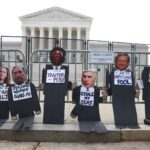
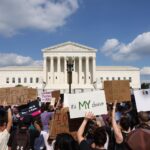
The messaging from the county comes after weeks of protests outside the Chevy Chase homes of Justice Brett Kavanaugh and Chief Justice John Roberts, who live less than a mile apart. Since May, when a draft of the court decision ending the constitutional right to an abortion in the United States was leaked and published, protesters have repeatedly gathered outside their homes and the homes of other conservative justices in northern Virginia. Protests – both outside the Supreme Court and outside the homes of conservatives justices – accelerated after the Supreme Court officially overturned the landmark Roe v. Wade ruling in June, a move that will drastically curtail access to abortion across vast swaths of the country.
On Wednesday night, protesters proceeded with a demonstration outside Kavanaugh’s home, abiding with new rules they called “constitutionally questionable.” They refrained from using bullhorns or any kind of amplification tools, and instead sang quietly while marching along the sidewalk.
“We felt like they were putting us in a corner,” Sadie Kuhns, an organizer with the group Our Rights DC, tells DCist/WAMU. “There wasn’t much we could do besides just continuing to use our voices, as is our First Amendment right.”
Kuhns told DCist/WAMU that prior to last week, Montgomery County police had been “hands off” with protesters, quietly watching the protests and protecting Kavanaugh’s home. Last week, they said, police started telling the activists that they needed to turn down their bullhorns and stop using speakers and other tools that amplify sound. Then, last night, police went even further, telling protesters they couldn’t speak over “talking voice” level and using decibel meters to monitor their volume. Police blocked off the street outside Kavanaugh’s home, Kuhns says. And, Kuhns adds, “they also brought an arrest van, which they don’t usually have.”
https://twitter.com/LiteraryMouse/status/1547395426130825226
Kuhns said police significantly outnumbered the protesters; they told DCist/WAMU that there were about 50 police officers and about 20 protesters in Chevy Chase Wednesday night. And Kuhns said that police told protesters that if their volume got too loud, they would be issuing warnings and eventually arresting people. Kuhns said police issued three warnings on Wednesday night but there were no arrests.
“We find it to be unconstitutional,” said Kuhns. “It infringes on our First Amendment freedoms. It was one thing when they told us that we can’t use amplification such as bullhorns and sound systems, but actually policing the volume of our voices is going too far.”
Residents of the affluent neighborhood of Chevy Chase have been divided over the protests outside their neighbor Kavanaugh’s home. Some Chevy Chase residents have organized protests themselves or quietly expressed their support for the gatherings. But others have said that while they may share the protesters’ disappointment with the decision in Dobbs v. Jackson Women’s Health Organization, they disagree with organizing protests outside the homes of the justices.
Kuhns said “most of the neighbors have been extremely supportive” of their protests, but one or two Chevy Chase residents have consistently registered complaints about them. A few Chevy Chase residents reached out to the police department to express concern about the protests in their neighborhood, according to Bethesda Beat.
The protests outside justice’s homes have also led to tension between local and federal authorities.
Earlier this month, the Supreme Court Marshal sent letters to several Maryland and Virginia officials – including Maryland Gov. Larry Hogan and Montgomery County Executive Marc Elrich – asking them to enforce state laws that prohibit picketing outside people’s homes. In her letters, Marshal Gail Curley – the top security officer for the Supreme Court – cited the fact that a man had been indicted for attempted murder after allegedly traveling to Maryland from California with the intention to kill Kavanaugh.
In response to that letter from Curley, activists held another small protest earlier this month outside Kavanaugh’s home where they read the First Amendment out loud.
A spokesperson for Hogan responded by noting that the constitutionality of the statute Curley cited in her letter “has been questioned by the Maryland Attorney General’s Office.” The spokesperson, Michael Ricci, argued that it was actually federal law enforcement’s responsibility to enforce laws prohibiting protests outside justice’s homes. Ricci said that both Hogan and Virginia Gov. Glenn Youngkin had jointly asked Attorney General Merrick Garland to use federal laws to prevent picketing at justices’ homes in Maryland and Virginia, and Garland had declined.
Supreme Court justices have been provided with around-the-clock security at their homes since the leak of the Dobbs opinion, and last month, Congress passed a bill granting additional security protections for families of the justices.
Kuhns says organizers are still talking through how they will approach their protests given the escalation of police enforcement. However, they add: “We’re not going to stop.”
Kuhns also says they will start advertising the protests differently.
“When it comes to the plans for the future of the protests at Kavanaugh’s specifically, we are just going to make sure people know there’s an increased risk there where there wasn’t before,” says Kuhns. “We used to advertise it as a place where you could come and voice your opinion and use your First Amendment freedom, but we’re going to let people know it’s a much different environment now.”