 Jordan Pascale
The Federal Highway Administration has given its final stamp of approval to Maryland’s plan to add high occupancy toll lanes on parts of I-270 and I-495. The agency released its Record of Decision Thursday, the last step in the environmental review process.
But the future of the public-private partnership project is still unclear. The state’s Board of Public Works would need to approve the final contract later this fall.
It’s been a pet project for Gov. Larry Hogan (R) who is term-limited and will leave office in five months. Getting a signature project like this completed could prove to be a valuable feather in his cap if he runs for president. But Democrat Wes Moore and Republican Dan Cox have not expressed support for the current iteration.
Earlier this month on WAMU’s The Politics Hour, Moore said he’d like to see a project that focused more on reversible lanes and more transit. He also would like to see more cooperation with local governments, which have gone back and forth on the project. Cox has previously spoken out against tolls in 2016 and more recently said officials could re-purpose existing lanes as reversible lanes to meet the needs.
The $5 billion project would replace and expand the American Legion Bridge, as well as 15 miles of two lanes of high occupancy tolls from the Maryland state line up to near Gaithersburg. Pedestrian and bike access is planned for the new American Legion Bridge.
High occupancy toll (HOT) lanes would be free for buses and vehicles with more than three passengers. Others would pay a variable toll depending on congestion in the regular lanes. If people choose to use the high occupancy toll lanes, costs could range from 17 cents a mile up to $3.76 a mile, according to the FHWA document.
The project would also bring $300 million for transit investment in Montgomery County during the project’s 50-year agreement. Maryland also says the HOT lanes would provide more reliable bus trips, and more connections to park and ride lots, Metrorail, and other transit facilities.
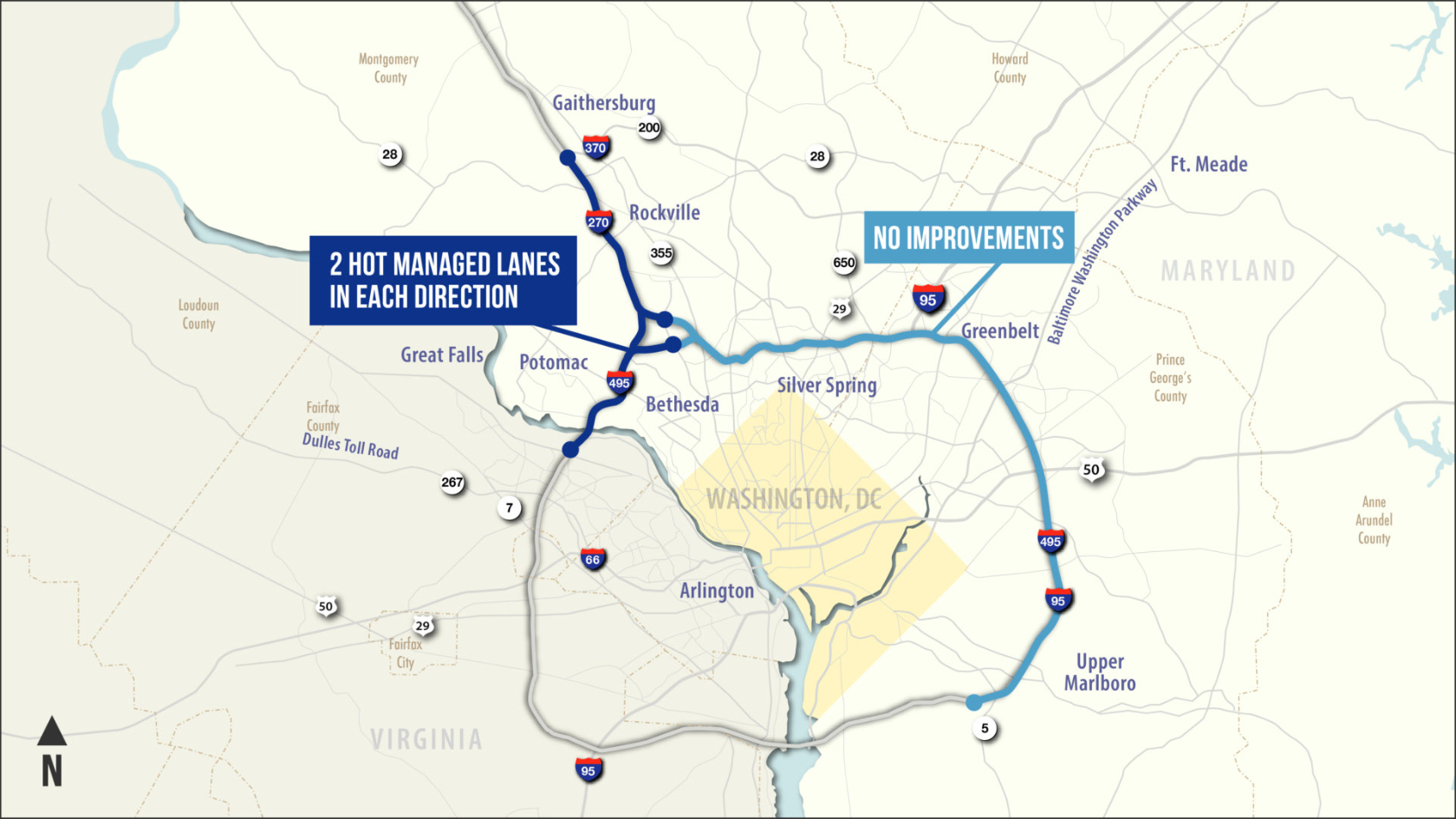
An earlier version of the project envisioned high occupancy toll lanes around most of the Maryland portion of the Beltway. Hogan had previously said no taxpayer funds would be used to build the project, instead, a consortium of private companies would finance, build, and maintain the infrastructure for 50 years. Recently, he said delays would now require help from the federal tax dollars.
“As I emphasized in my discussions with Secretary Buttigieg, years of federal bureaucratic delays — along with political stall tactics by Montgomery County politicians ignoring the will of their constituents — have significantly increased the costs and hurdles for the project,” he said in a statement. “As a result, we have applied for a federal grant to help in mitigating the costs of these needless delays.”
Hogan said the approval is a major milestone for the “most important transportation project for the National Capital Region in the last 50 years,” and will address one of the country’s worst bottlenecks, create jobs, and expand bike, transit, and pedestrian infrastructure.
Opponents say building more lanes will only lead to induced demand — the idea that traffic will ultimately fill up the space that it is provided, regardless of how many more lanes there are. Opponents also say the project would simply move the backups further east on I-495
The project has been locked in a bitter fight for years among rival groups.
“The decision is disappointing, especially given the failure of MDOT to meet key federal requirements related to transparency, environmental justice, and greenhouse gas emissions,” Barbara Coufal of Citizens Against Beltway Expansion said. “But this is not the end of the fight. There are other challenges ahead for (the state).”
Opponents can bring legal challenges over the next five months, according to the federal process.
Meanwhile, Jason Sanford, president of the Northern Virginia Transportation Alliance says the decision is a “major victory for the hundreds of thousands of people who rely on the American Legion Bridge and I-270 every day.”
“This project will reduce travel times across the American Legion Bridge and on I-270 for people using the free travel lanes, incentivize more carpooling, invest in more transit options, and make a new bike and pedestrian connection between Virginia and Maryland. This important, multimodal project will benefit our entire region.”