Colleen Grablick
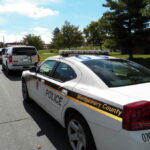
The U.S. Interior Department announced a new policy this week that will require all law enforcement agencies within the department — including the U.S. Park Police — to wear body cameras.
The requirement comes alongside several changes to the department’s policing protocols, guided by a task force formed by Secretary Deb Haaland last year to build trust between the public and the department’s law enforcement officers. It also comes just days after a D.C. man filed a lawsuit (seeking $1 million) against Park Police officers using excessive force while arresting him for unknown and “bizarre” reasons.
A spokesperson for the Interior Department told DCist/WAMU in an email that the changes are effective immediately, and each bureau will be working with “established budget formations” to implement the policies and procure equipment.
In addition to the body camera requirement, the new practices update the no-knock entry protocol and use-of-force policies. Going forward, no-knock entries (those which allow officers to enter a home without announcing themselves) will be restricted to instances where the agent’s announced presence would “create an imminent threat of physical violence to the agent and/or another person,” according to the Interior Department. Agents seeking judicial authorization for a no-knock warrant will also need to first obtain approval from their first and second line supervisors and an assistant U.S. Attorney.
The new policing regulations apply to the U.S. Park Police and thousands of other law enforcement officers within the department’s purview, including the Bureau of Indian Affairs, Bureau of Land Management, and the U.S. Fish and Wildlife Service.
The Park Police–which oversees the District’s federal parks, monuments, memorials, and roadways–and the Interior Department have been scrutinized in recent years for a lack of accountability and transparency, particularly after the killing of Fairfax resident Bijan Ghaisar. In 2017, Ghaisar, 25, was rear-ended on the George Washington Parkway, and after leaving the scene was pursued by two U.S. Park Police officers. The brief chase ended when the officers, Lucas Vinyard and Alejandro Amaya, fired at Ghaisar’s car multiple times. Ghaisar died in the hospital ten days later.
The only video evidence from the killing came from a dashboard camera mounted on a Fairfax County Police vehicle, and the ensuing FBI investigation failed to provide clarity on what happened. The Justice Department has twice declined to charge the officers, and an indictment by the former Virginia Attorney General Mark Herring was dismissed after the case moved to a federal court in 2021. (current Virginia Attorney General Jason Miyares later dismissed appeals to the ruling after taking office in 2022.)
Ghaisar’s killing prompted D.C. Del. Eleanor Holmes Norton and Rep. Don Beyer (D-Virginia) to introduce a House bill that would require uniformed police officers, including Park Police, to wear body-worn cameras. The legislation passed the House last Congress and was passed again this Congress as a part of the George Floyd Justice in Policing Act, which now needs a Senate vote.
Federal agencies generally lag behind local departments in outfitting officers with body cameras; D.C. Police have worn body cameras since 2015. The Justice Department only began equipping its first agents with cameras in 2021, after rejecting the concept for years, citing the need to protect sensitive investigations.
The body camera requirement follows up on a goal of U.S. Park Police Chief Pamela A. Smith, who said the addition of body worn cameras would be one of her first priorities when she assumed the role in 2021. The first cameras were implemented in May 2021, with officers in the San Francisco field office.
According to the Interior Department’s policy, each bureau must establish a framework for storing, downloading, and documenting video footage. Generally, the footage is required to be uploaded in its entirety at the earliest possible time, and officers must turn on the camera at the “earliest possible opportunity” in an interaction.
The policy also states that the Department will “strive to expedite the public release of [footage] following incidents involving serious bodily injury or death in order to promote transparency and accountability.”
This post has been corrected to reflect the Del. Eleanor Holmes Norton’s legislation passed the House.