Jacob Fenston
The D.C. region met its goal to cut greenhouse gas emissions by 20% by the year 2020, according to a new report by the Metropolitan Washington Council of Governments. This means the region is on track to meet ambitious climate goals for 2030 and 2050, but the hardest part still lies ahead.
“We’re not talking about the low-hanging fruit anymore,” said Maia Davis, senior environmental planner at COG. “We need to push towards the zero’s: zero carbon or carbon-neutral grid, zero-energy buildings, zero-emission vehicles, and zero waste.”
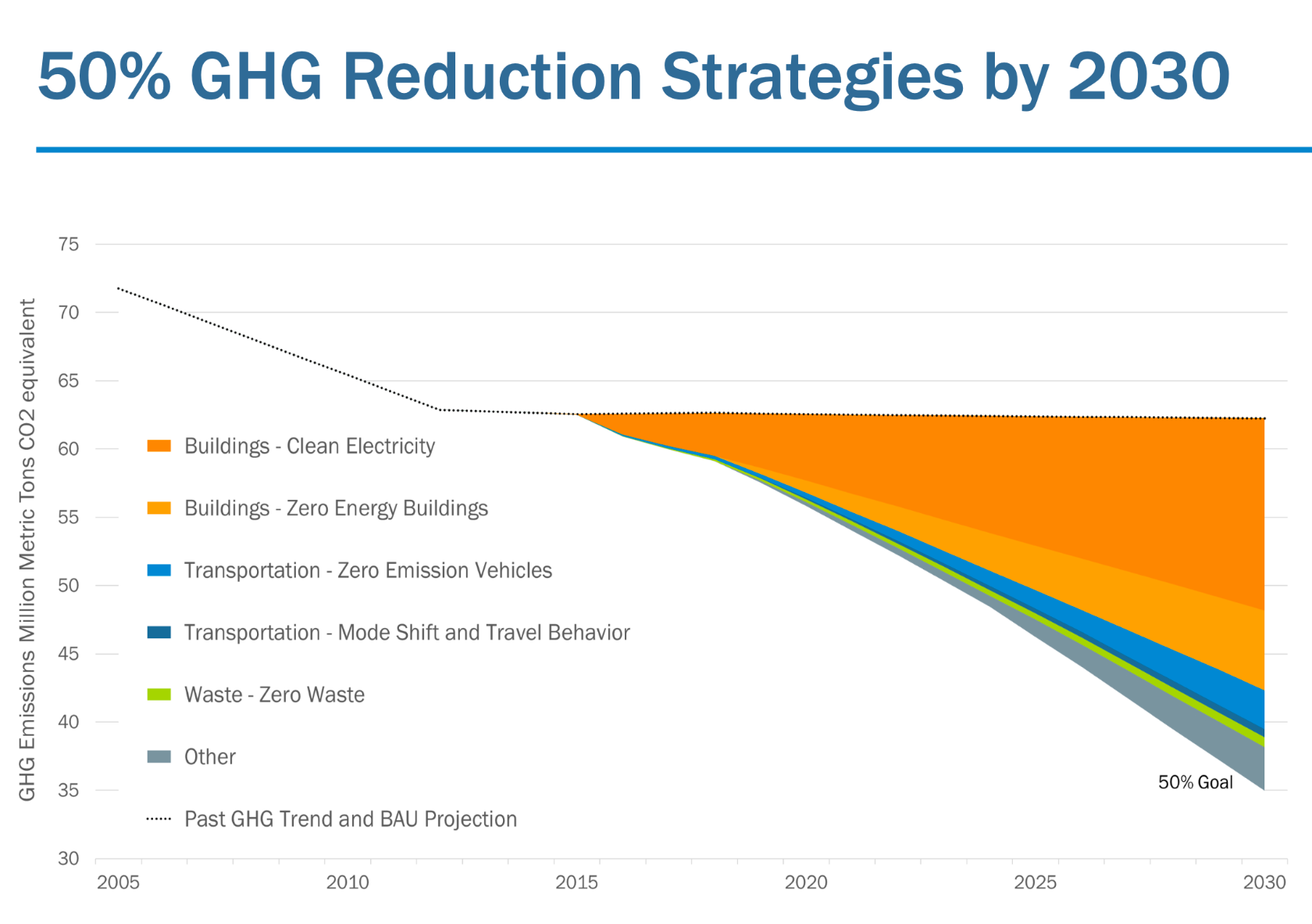
For 2030, the region’s jurisdictions have committed to cutting carbon emissions by 50%, compared to 2005 levels. The goal for 2050 is an 80% cut in emissions.
The biggest area of emissions reductions, by far, has been in the power grid: transitioning away from coal to natural gas and renewable energy. Electricity on today’s grid has roughly half the carbon emissions associated with it compared to 2005. This means that even though the region is using more electricity — about 10% more — there has been a dramatic drop in greenhouse gas emissions from generating that electricity. (Despite this progress, Gov. Glenn Youngkin intends to remove Virginia from a cap and trade initiative aimed at further reducing greenhouse gas emissions from power plants.)
In terms of renewables, the increase in solar adoption is striking: In 2009, when COG started keeping track, there were less than 500 rooftop solar power systems in the region. By 2020, there were over 51,000 — more than double the region’s goal for that year.
There was also major growth in the number of highly efficient green buildings. In 2005, there were less than 90 third-party-certified green buildings in the region. By 2020, there were more than 5,300.
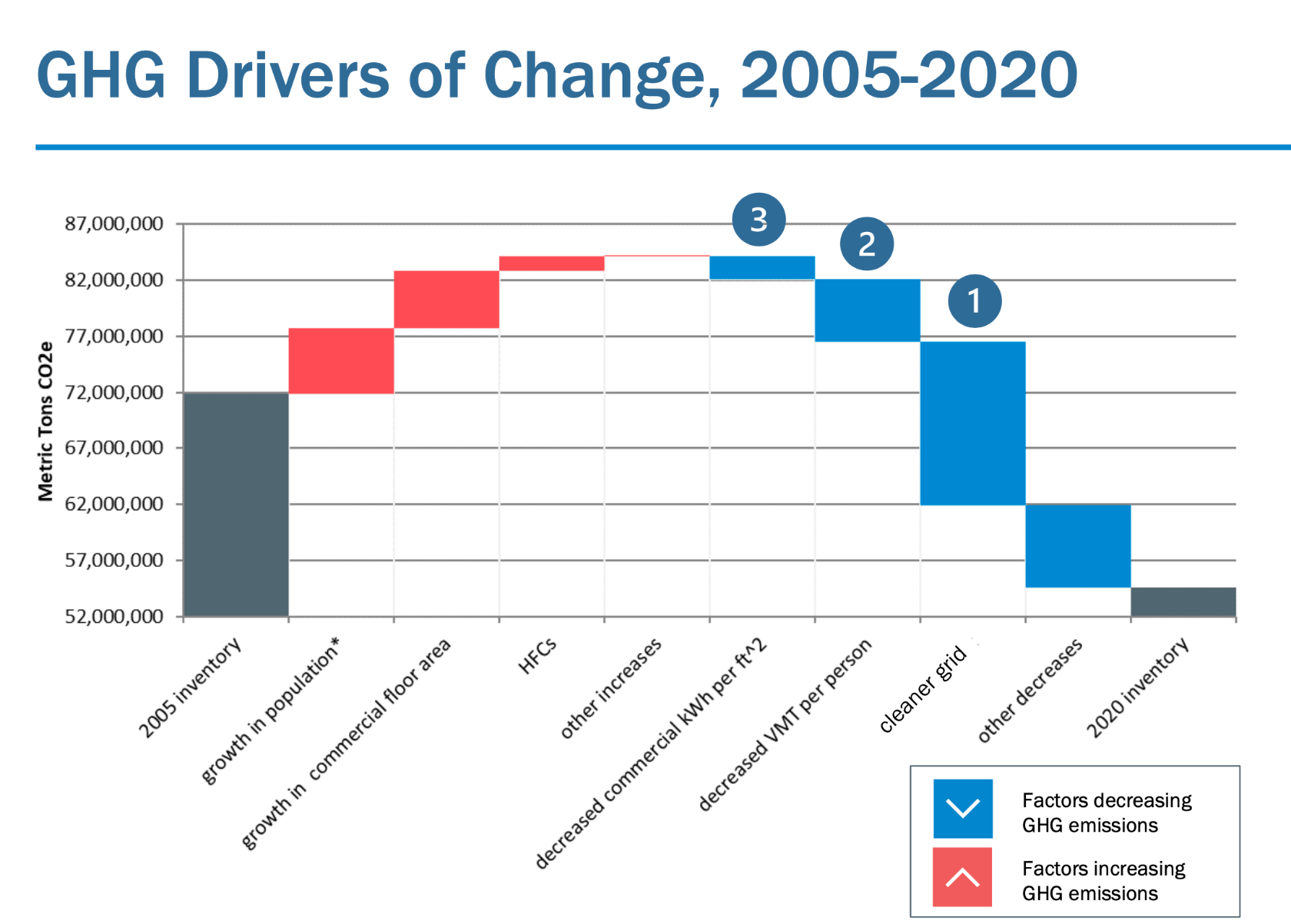
Other big areas of emissions reductions are related to cars: people in the metropolitan area are driving fewer miles and driving more efficient vehicles. From 2010 to 2020, vehicle miles traveled dropped by 15%, as did the share of commuters who drive alone. This decrease in driving occurred even as the region’s population grew by 13%.
Meanwhile, there was a boom in hybrid and electric vehicle ownership: in 2012, there were fewer than 500 EVs in the region; by 2020 there were 33,000. In 2012, there were just 124 EV charging stations; today there are 10 times that number.
Some of these reductions reflect pandemic-driven changes in behavior that may not be permanent. But Davis says the pandemic didn’t tip the scales. “The main reason that greenhouse gas emissions have reduced in the region is because the grid is getting cleaner, and that’s going to happen with or without the pandemic,” Davis said.
Much of the transition toward cleaner electricity has been driven by larger forces outside the region: cheap natural gas and federal emissions standards, both of which make coal less competitive. Over the past decade, more than 100 coal-fired power plants around the country have converted to natural gas or been replaced by new gas-powered plants.
But in the D.C. region, the shift has also been driven by state and local policy, in particular clean energy requirements that specify what percentage of electricity must come from renewable sources. D.C. law mandates 100% clean energy by 2032, while in Maryland the renewable portfolio standard requires 50% clean energy by 2030, and 100% by 2040. In Virginia the requirements are 30% clean energy by 2030 and 100% by 2050.
The growth of rooftop solar can also be attributed to local policy. D.C. has some of the most generous solar incentives in the nation. District residents who install solar panels can recoup their investment in just a few years by selling solar renewable energy certificates. An average-sized system can generate nearly $3,000 in these SRECs per year.
At a COG meeting on Wednesday, regional leaders celebrated the news that the area met its 2020 climate goal, which was set in 2008.
“There were a lot of skeptics and naysayers,” recalled Fairfax County Supervisor Penny Gross. “When we started, a lot of people were wringing their hands that we will never be able to do it, it’s just too hard. We’ve proved them wrong.”
Chuck Bean, executive director of COG, said working toward the climate goals is like running a marathon — and the region is only halfway to the finish line. “We just hit the 13-mile mark, and we can celebrate this achievement for a moment, have a sip of Gatorade. But then it’s off to work to hit our 2030 goal,” Bean said.
According to COG’s projections, the remaining reductions will come from cleaner electricity, more efficient buildings, transitioning to electric vehicles, and driving less.
Davis says meeting the 2030 and 2050 goals will require ramping up climate action. “We’ve had 15 years to work towards this goal — from 2005 to 2020 — to get 20% below greenhouse gas emissions. And now we have eight years to work towards a 50% reduction in greenhouse gas emissions.”
To return to the marathon metaphor: the race course is about to head up a steep, unrelenting hill.