 Jenny Gathright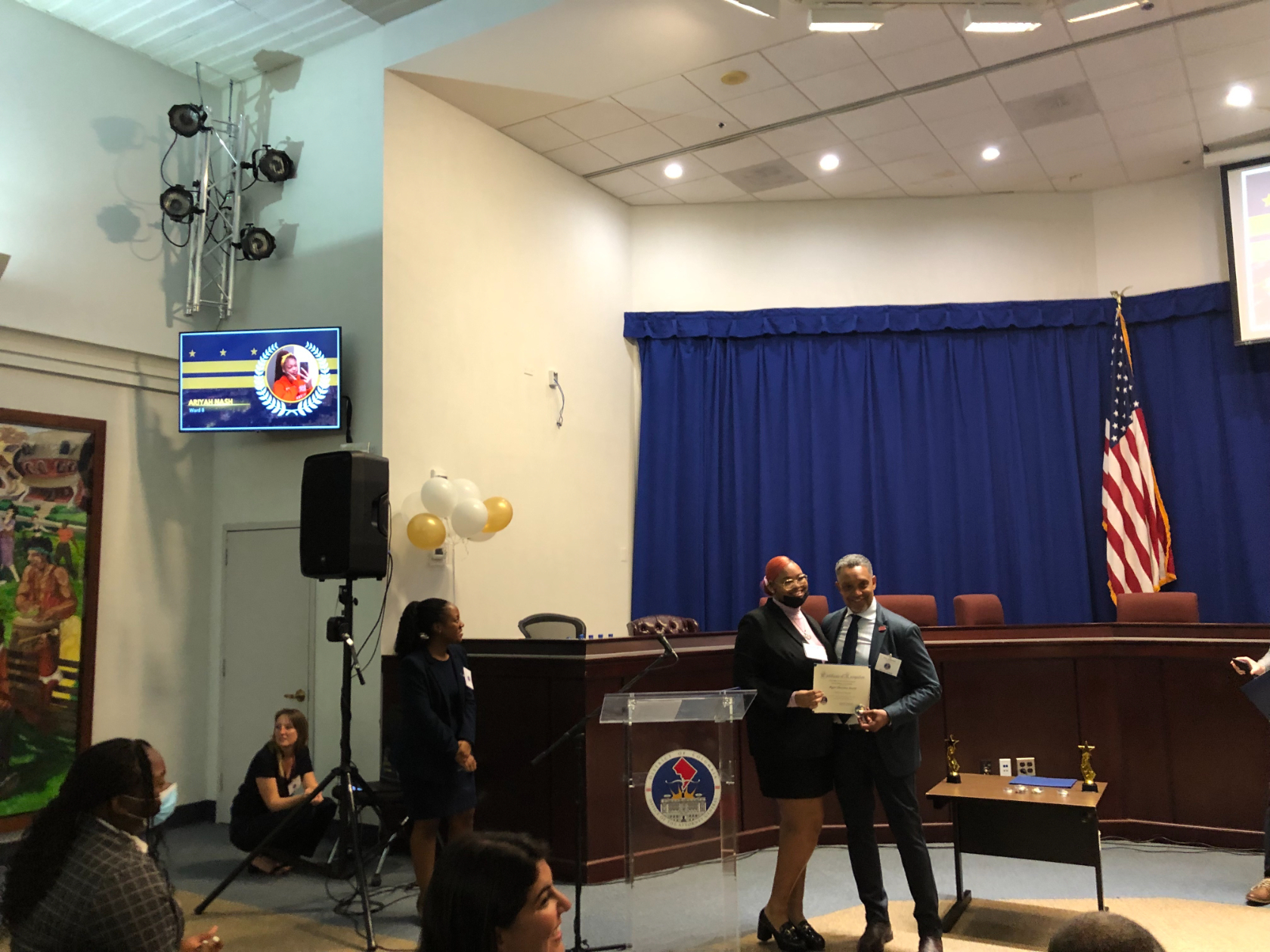
Jamarri Kane-White, 21, is a senior at Howard University studying computer science. Before that, he spent ten years in the foster care system in the District, at times navigating group homes and homelessness.
On Wednesday night at D.C.’s Right Direction Awards, a ceremony that honors D.C.’s youth who have experienced major life challenges and had a positive effect on their community, Kane-White said he felt like he was being recognized for all that he overcame. At the ceremony, he was seated next to a friend — a young man that he’d been in a group home with when they were in eighth grade.
“When I hold this [award], it’s in representation of not me – but my community. And by community, I mean foster kids,” said Kane-White. “Everyone who had to sleep with their clothes in a trash bag cause they didn’t know where they were going to be in the morning. Everyone who felt like their future wasn’t their own.”
Kane-White was one of 26 young people aged 12 to 24 who were recognized at the awards ceremony, held by D.C.’s Office of the Attorney General.
Racine’s office prosecutes youth crime in the District. But he says they started the Right Direction Awards ceremony in 2015 because it’s important to set aside time to recognize young people for doing positive things.
“Young people — often vilified — need to be celebrated,” said Racine.
The awards were paused in 2020 and 2021 because of the pandemic, but returned this year. Awardees, their loved ones and D.C. officials gathered at the Old Council Chambers for the ceremony, held on Wednesday night.
Racine noted that though youth crime has been a focus in this election cycle, as well as in recent media coverage, yet people under 18 are only responsible for about 7% to 8% of reported crime in the District.
“These kids, oftentimes, are never recognized for doing the right thing — which overwhelmingly they do every day,” said Racine.
18-year-old Ariyah Nash was nominated for the award by her mentor at the Boys and Girls Club of Greater Washington in Southeast D.C.
“I had a very, very hard senior year,” says Nash. “I was homeless for a couple of months. And during that time I managed to put all my pain into working with the Boys and Girls Club.”
In addition to her work as an ambassador with the Boys and Girls Club, Nash started a new club for survivors of sexual assault and abuse at her high school, the D.C. International School.
“I know it’s not talked about a lot in school, so I felt it was appropriate to make a safe space,” said Nash. The club is continuing, even though Nash has graduated.
Nash, who is taking a gap year this year, has big goals. She wants to attend Spelman or another university where she can study psychology. And she wants to become an advocate — and perhaps, one day, do that work in a prosecutor’s office.
Wednesday night was about optimism — but the speakers and youth at the event also acknowledged the intensity of the challenges that many young people in the District — particularly Black youth — are up against.
In his speech on Wednesday night, Racine noted that the race and class-based disparities in outcomes in the District are directly linked to the legacy of slavery. Today, many Black youth in D.C. face segregation, poor housing conditions, concentrated poverty, and generational trauma.
But Wednesday was about celebrating the success that those young people have forged despite those odds. The event started with the National Anthem, followed by the song ‘Lift Every Voice and Sing’ – also known as the Black National Anthem.
“Lift Every Voice is a powerful message for all of us to understand and live deeply. It speaks of our potential – no matter what the narrative about us was. That we were less than human, that it was OK to be in bondage,” said Racine. “I’ve been to too many celebrations where it was for the first time ever a young person was shown the kind of respect, applause, praise that they deserve. Especially if they’re coming out of slavery. Especially if they’re coming out of public housing, especially if they’re walking to school literally through gunfire. Especially if they’re going through life being told that they’re less than.”
Kane-White was frank about the challenges D.C.’s foster care system faces. He said social workers’ caseloads are too full — and he wants to see more empathy in the system, and a greater willingness to connect youth with opportunities to do the right thing.
“There are a lot of foster kids who didn’t get to do what a lot of us in the [Right Directions award ceremony] room got the chance to do,” said Kane-White.
Nash said she wants to see young people better represented in the city’s decision-making processes.
“We are going to be next in office,” she said. “You know, we are going to be running the schools, we are going to be running the police departments. So as long as we continue to be more involved, then I see D.C going higher and better.”
The awardees also described having a sense of limitless potential.
Flo White, 23, one of the award recipients, currently works at Sasha Bruce Youthworks — the same organization that helped her exit youth homelessness. She’s now studying social work at the University of the District of Columbia.
White said the fact that the District took the time to recognize young people was important.
“It makes us as young people feel recognized,” said White. “It makes us want to go harder and strive harder and definitely just be activists in our community and make a difference in somebody else’s life — to pass on the torch.”
21-year-old Dieudonne Kazzembe says his belief in himself comes from his record of overcoming challenges. Kazzembe immigrated to D.C. in eighth grade from Uganda, where his family had been living for years as refugees from his birthplace in the Democratic Republic of the Congo. He spoke very little English when he arrived and went on to graduate from Cardozo High School second in his class. Now, he’s studying at Arizona State University and wants to become a pilot — a dream he says he’s had ever since he heard the pilot speak across the intercom on his first ever plane ride to the United States.
“Every interest that comes to my mind — we’re going there,” said Kazzembe. “I don’t mind how hard it’s going to be. I welcome challenges. And I’ve been training myself to embrace them and not run away from them.”