Margaret Barthel
The Fairfax County school board adopted last-minute changes to a resolution on Thursday evening focused on a commitment to “protect and support educators” in their work delivering inclusive classroom instruction. The final version softened earlier language and deleted a reference to a fractured political climate around Northern Virginia schools.
The final resolution references the goal of an “inclusive classroom culture,” along with support for “an education that reflects all voices, and respects the need for robust instruction regarding historic and systemic injustice.” It notes the Fairfax community’s diversity, and cites existing policy guiding educators navigating “controversial issues” in class toward a “more inclusive curriculum related to racism, bias, intolerance, and injustice.”
“It is our humble goal that regardless of the vote tonight, that our board, our employees, our families and our community understand how deeply committed we are to ensuring that Fairfax County demonstrates its commitment to inclusive classrooms and instruction,” said Braddock District representative Megan McLaughlin, who introduced the amended language.
Drainesville representative Elaine Tholen seconded McLaughlin’s proposal. She argued that the revised language was more unifying for the Fairfax community.
“I understand that our teachers and staff may want a clear statement that we support the work they are doing to implement FCPS-approved curriculum and [are] happy to do that in a way that gets the message across but does not alienate any subset of our FCPS community,” said Dranesville representative Elaine Tholen.
Ultimately, the amended version passed 7-4, with Board members Ricardy Anderson, Abrar Omeish, Melanie Meren and Karen Keys-Gamarra voting against. Karl Frisch was absent.
Resolutions are normally non-controversial, mostly symbolic gestures from the school board. They don’t have policy-making power, and they don’t set the direction for future strategy.
But in this case, the split vote and heated debate revealed fault lines over how the board should respond to a barrage of conservative criticism of its equity and inclusion efforts. The final text was a last-minute rewrite of a more strongly-worded statement, which used the words “anti-racism” and “equity” and explicitly referenced teacher fears of harm in the current political climate.
“Recent events have caused many FCPS educators and school-based administrators to fear that implementing these necessary curricular improvements could lead to personal or professional harm,” the original resolution said.
Mason District representative Ricardy Anderson introduced the original resolution with its more pointed language in collaboration with a long list of progressive advocacy organizations in the county, including the NAACP, Fairfax’s teacher’s unions, several PTA organizations, and antiracist advocacy organization Free and Antiracist Minds. Anderson said she believed strong language was needed to demonstrate full-throated support for teachers and staff.
“Our teachers are facing some very difficult conversations in classrooms with their students, and they have shared with me, both teachers and administrators, that this would help them just know that they have our public backing,” she said.
She criticized the amendment as “[shying] away” from those difficult conversations by not including the words “anti-racist,” “equity,” and “truth.” In a statement to WAMU/DCist on Friday, Anderson said the Board “missed the opportunity to signal our commitment to anti-racist, justice and equity based work which is of great concern to me” and noted that the board is about to begin work on a division-wide equity policy.
At-large member Karen Keys-Gamarra, Hunter Mill District representative Melanie Meren, and at-large member Abrar Omeish offered similar criticisms of the revision. They were joined by student representative Michele Togbe, who said her own educational experience in Fairfax supported the need for clear language around equity and antiracism.
“Students are seeing this,” she said. “Amending it to the weak and hollow statements and words doesn’t make sense to me…I really am urging you guys to get this right.”
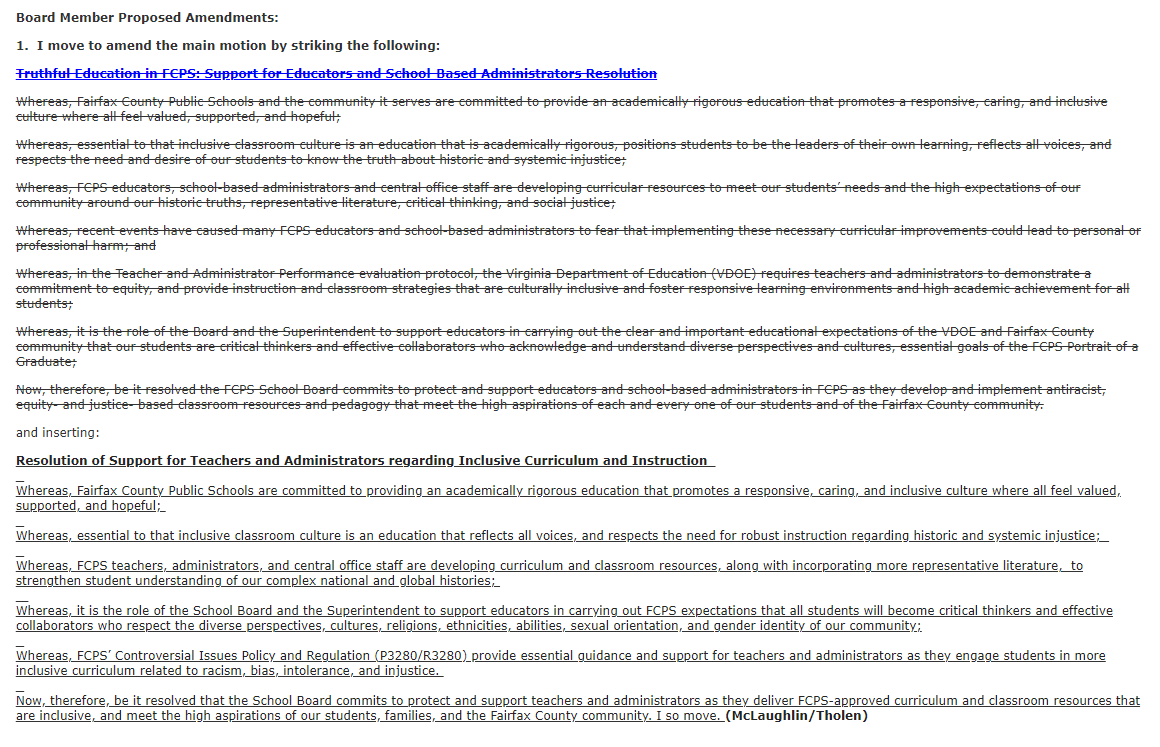
It was not immediately clear what happened behind the scenes between board members to prompt the changes. Board members offered competing timelines of what had happened and who had collaborated on the different versions. McLaughlin claimed that some board members were uncomfortable with the original language, and said she had brought the new amendment forward — with what she said was support from seven board members — to ensure that something would pass.
“There were many board members that were supportive of the original language that was brought forward by Dr. Anderson,” McLaughlin said. But, she said, there weren’t enough members on board “to have a strong vote of support.”
Others, meanwhile, said they had not been included in discussions about McLaughlin’s amendment.
“We have an amendment that appeared this morning, at least that’s when I saw it,” said Keys-Gamarra. “It’s my understanding that some people on this board had an opportunity to discuss this, but I wasn’t wasn’t included in that and perhaps some others were not.”
Some board members also pointed out confusion over whether voting on the statement of support as a resolution — or introducing an amendment to a resolution — was procedurally sound, or a good use of time.
“Let me be very clear that we have spent an inordinate amount of time on a resolution that does not and will not move the dial on what [are] the most important issues before this school system at this time,” said Karen Corbett Sanders, the Mount Vernon District representative.
The crux of the disagreement, though, was not over the function of resolutions or the process of arriving at one, but rather how the board should respond to a remarkably toxic political climate centered on the schools.
Fairfax and other Northern Virginia school divisions are a frequent political target for Republican officials, including Gov. Glenn Youngkin. Youngkin has suggested that teaching about past and present effects of systemic racism in American society is “divisive,” and upon taking office earlier this year he set up a tip line to report teachers for teaching “divisive” topics and rescinded state educational resources that focus on equity. A number of local conservative parent groups, some with well-established ties to conservative media and national Republican politics, have amplified their concerns in dramatic testimony at school board meetings, including criticism of Fairfax’s inclusive policies towards transgender students, and calls to remove certain books from schools. The online climate is particularly poisonous, with conservative groups posting video of incendiary school board testimony and publishing the content of FOIA requests, and progressives firing back with lengthy commentary of their own.
“So we find ourselves yet again in the same place of having the national debates, really, at our dais and struggling through the same challenges and experiencing the same tensions that are happening all over the country, and that ultimately will determine the future of our country,” said at-large board member Abrar Omeish, who supported the original resolution. “We’re in a place where you vote one way, you’re racist, and you vote another way and you’re an anti-Semite or anti-conservative.”
Anderson and her supporters argued that the board should not appear to back down in the face of conservative anger.
“We have sat here and we have been accused of so many horrible things. We have been told that we’ve been groomers. We have been told that we are encouraging pedophilia in our schools. We have been told that we have porn in our libraries,” she said. “Yet we stand in the face of that adversity.”
But several board members who spoke in favor of the amendment emphasized the importance of unifying the Fairfax community. Some referenced unspecified outreach from community members who disagreed with the original resolution. Tholen called the new version “less divisive for our broad community.”
It’s not clear how widespread the criticism of the original resolution was in comparison to the list of its supporters. Before Thursday’s meeting, Fairfax County Parents Association, an organization that frequently criticizes the schools’ handling of pandemic protocols and often posts anti-teachers’ union rhetoric online, suggested online that the original resolution resolved to “protect teachers seeking to teach, as truth, certain political views.”
“The amendment passes, removing much of the divisive language from the resolution & recentering the resolution on supporting FCPS’s diversity & inclusive efforts,” the group tweeted after the board vote.
But the amended version didn’t appease everyone. Several public comment speakers used their time — after the amended resolution had already passed — to continue to rail against the original version.
“After years of gaslighting, parents have been proven right. The truth of the agenda behind this school board is not academics,” one man said. “You’re using the education system to co-opt our children into your political activism.”
Meanwhile, progressive supporters of the original resolution said they had worked with Anderson over several months to draft the original language. Many expressed disappointment and frustration at the board’s ultimate decision to soften the language.
“They don’t want to make angry White people angrier. That’s the metamessage,” tweeted Sujatha Hampton, who leads the Fairfax NAACP’s education work.
A press release from Free and Antiracist Minds called the vote “craven systemic racism,” and called out the board’s decision to ignore three Black women — Anderson, Keys-Gamarra, and student representative Togbe.
“I suspect it was a great way of not having to vote no, but also completely undermining the substance of the actual message,” said Kweli Zukeri, a Free and Antiracist Minds representative, during the public comment period that followed the board’s vote.
“If you’re against anti-racism, you’re either racist, you’re misinformed about what anti-racism actually means, or you’re privileged enough not to have experienced American racism,” he said.
After the debate and the vote, the board gathered in front of the dais to take a photo, as they usually do when they vote on a resolution. Typically, they’re joined by supporters of the resolution to mark the occasion. This time, no one stepped forward to pose with them.
This story has been updated to reflect the correct wording of the final resolution.