Jacob Fenston
What’s known as “the nation’s report card” is in, and it’s not good news for students in D.C., Maryland, and Virginia, who had some of the biggest declines in scores in the nation.
Scores on the National Assessment of Educational Progress are down nationally, in the first round of testing released since before the pandemic. Regional leaders blamed a variety of factors, including pandemic interruptions and political opponents.
“You can see the national trends, which none of us are surprised by,” D.C. Mayor Muriel Bowser said during a press conference Monday morning. “We know that our school children being separated from school for more than a year [led to] some decreases in their testing [scores].”
Declines were the largest among fourth graders. These students were in second grade when COVID-19 first shut down classrooms, disrupting their education at a key time, when many are still learning basic reading and math skills.
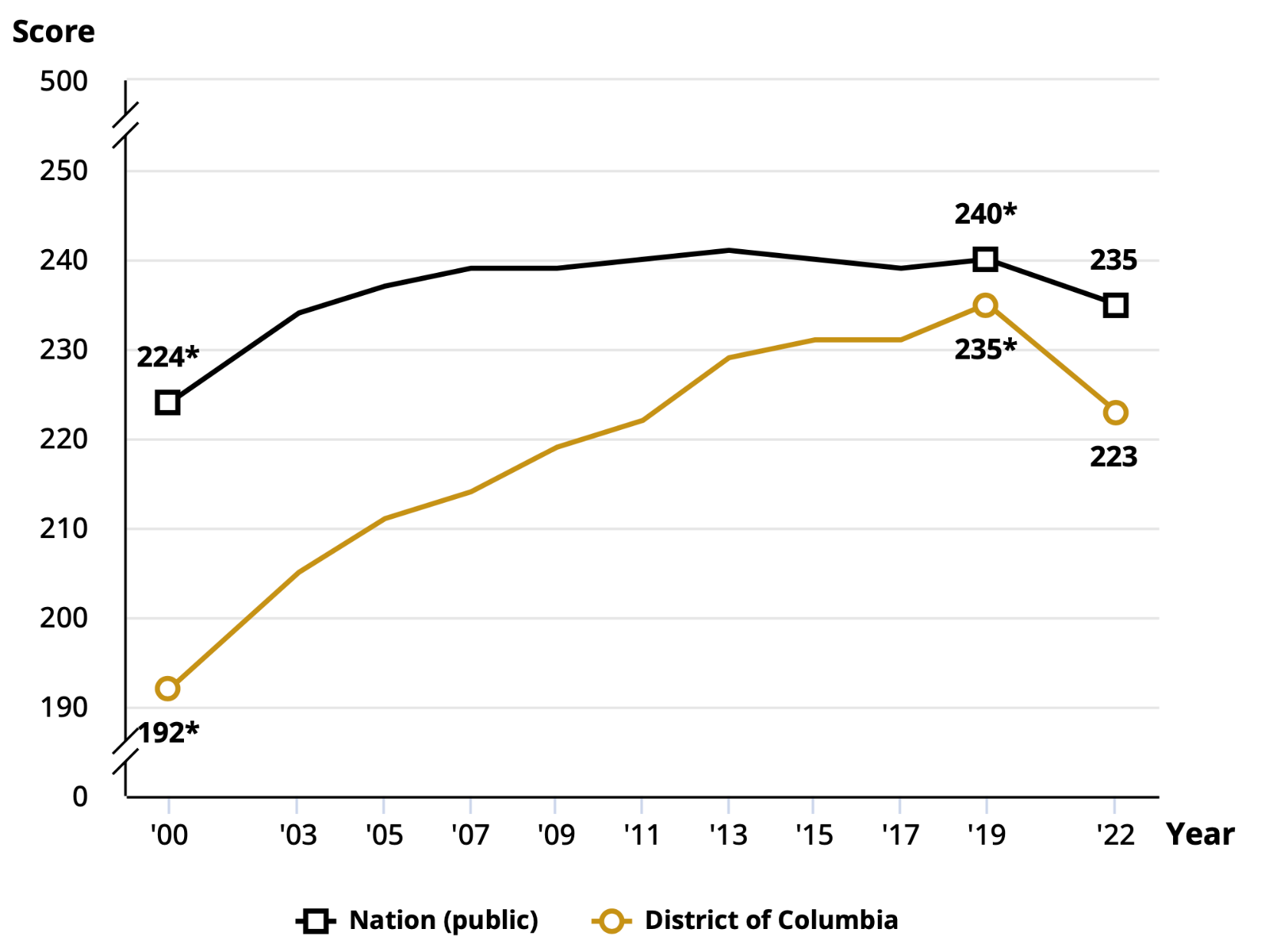
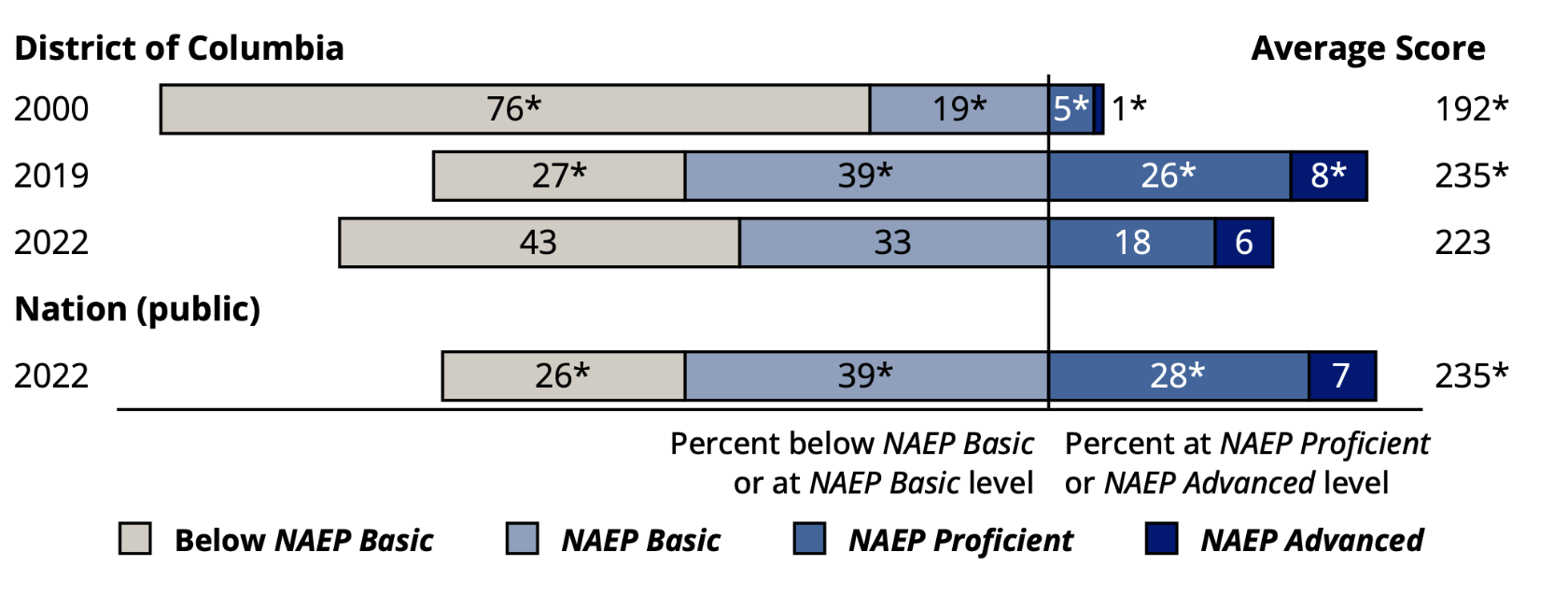
In D.C., fourth grade math scores dropped by 12 points compared to 2019, the second biggest decline in the country, after Delaware, while fourth grade reading scores fell by 8 points. In eighth grade, D.C. saw a 10 point decline in math, but held steady in reading.
D.C. education leaders touted investments since the start of the pandemic, including spending $40 million on tutoring students.
“We are investing in how to catch them up,” Bowser said. “We know even in the last year we are seeing them improve based on the interventions we are making.”
Bowser and other D.C. leaders suggested that pandemic closures and interruptions were the biggest factor in declining test scores, emphasizing the overall gains made over the past two decades.
“Students did not fare well academically during the pandemic, particularly those from historically marginalized groups,” said Michelle Walker-Davis, executive director of the DC Public Charter School Board, in a statement.
The NAEP results showed persistent learning gaps among racial and ethnic groups. For example, among eighth graders, Black students averaged 65 points lower than white students in D.C., virtually the same as in 2000. The math gap between white and Latinx eighth graders was 58 points, and also unchanged since 2000.
In Virginia, Gov. Glenn Youngkin (R) and his administration held a press conference blasting state Democrats, blaming previous administrations for a “catastrophic decline” in test scores.
“Today’s data release is a clear and heart-wrenching statement that Virginia is failing her students,” said Virginia Secretary of Education Aimee Guidera during the press conference Monday morning. The declining scores, she said, were “a predictable outcome of the decade long systemic dismantling of a foundational commitment to excellence in education.”
Among Virginia’s fourth graders, reading scores dropped by ten points, the biggest decline in the nation, while math scores fell by 11 points. Among eighth graders, math scores declined by 8 points — the same as the national average — while reading scores dropped by 2 points, less than the national average of 3.
“In the world I came from — in the business world — if this was your report card, there would be an immediate change in management,” said Youngkin, a political outsider who started his first term in January. “You would get fired. And I think that’s exactly what voters did last November.”
Youngkin placed the blame in part on pandemic school closures. “Too many leaders in Virginia supported keeping our schools shut for an unnecessary, extended period of time, forcing students to learn exclusively through a screen, telling parents and students that that’s a quality education.”
But he also said part of the problem predated the pandemic: State leaders lowered proficiency standards in math and reading in 2019 and 2020, “allowing our children’s learning to suffer,” Youngkin said.
It’s similar to a talking point Youngkin has used before: In May, the governor released a report on student learning, in which officials blamed “a rhetorical emphasis on equity” for lower standardized testing scores in the commonwealth.
Meanwhile, the state is already making changes to its reading education, with enhanced literacy instruction and resources for families and teachers starting in the 2024-2025 school year.
Maryland saw similar declines, with fourth graders’ scores falling by 10 points in math and 7 points in reading. Eighth grade math scores fell by 11 points, while reading dropped by 5 points.
“There is no sugar coating these results,” said Maryland State Superintendent of Schools Mohammed Choudhury in a statement. “Maryland has been experiencing a downward trend since 2013, and a return to normal is not good enough. The current struggles of our students cannot be solely attributed to the pandemic.”
The NAEP, mandated by Congress, is conducted every two years, though this year’s assessment was put off one year due to the pandemic. The tests were administered in winter 2022.
On a national level, U.S. Secretary of Education Miguel Cardona said the declining scores coming out of the pandemic were “appalling and unacceptable.”