 Jenny Gathright
An unprecedented trial began this week at D.C.’s federal courthouse, where two D.C. police officers face a combination of second-degree murder, obstruction, and conspiracy charges related to the death of 20-year-old Karon Hylton-Brown. Hylton-Brown died in October 2020 after his moped collided with an oncoming car as he fled from a police cruiser in pursuit.
Prosecutors allege that Terence Sutton — who faces second-degree murder, obstruction of justice, and conspiracy charges — initiated a police chase that led to Hylton-Brown’s death. And they also argue that Andrew Zabavsky – who has been charged with obstruction of justice and conspiracy — helped him cover it up and mislead Metropolitan Police Department officials about what happened.
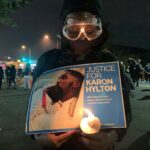
Hylton-Brown’s death sparked outrage in his neighborhood, where community members gathered for days of intense protests outside the Fourth District police station. Some smashed police cars and the windows of the station itself; Police also used flash bangs and tear gas on the protesters. Residents, including friends and family of Hylton-Brown, said the police chase and death was the violent result of a broader pattern of police harassment in the neighborhood.
The trial is historic; At the time of Sutton and Zabavsky’s indictment, prosecutors and police told the Washington Post they could not recall any other cases where a D.C. police officer had been charged with murder in a death that occurred while they were on-duty. The U.S. The Attorney’s Office has not brought charges in connection with recent deaths at the hands of D.C. police, including 18-year-old Deon Kay and 27-year-old An’Twan Gilmore.
The trial began on Tuesday with opening statements from prosecutors with the U.S. Attorney’s Office for DC and Sutton’s defense attorney. Here’s what you need to know about the trial, and what to expect as it continues.
What do we know about what happened that night in October 2020?
Hylton-Brown died in October 2020 after a police pursuit and crash in Brightwood Park. Sutton, a member of the Fourth District Crime Suppression Team, was driving an unmarked police car with three other officers in it.
Body-worn camera footage from that night shows Sutton’s police car chasing Hylton-Brown – who was riding a Revel moped – down a narrow alley at increasing speeds with flashing lights. The chase lasted approximately three minutes through Brightwood Park’s streets and alleys. Hylton-Brown exited an alley on Kennedy Street NW and collided with an oncoming vehicle. He later died from his resulting injuries. D.C. police said at the time that officers initiated the chase because they were trying to make a traffic stop after they saw Hylton-Brown riding his moped on the sidewalk without a helmet. MPD policy prevents officers from chasing vehicles for traffic violations.
Zabavsky, Sutton’s supervisor, was also part of the chase, driving at times behind Sutton and at others on parallel streets. He arrived at the scene of the crash right behind Sutton.
In the days after the crash, D.C. officials acknowledged MPD’s no-chase policy and said they were investigating why Sutton chose to pursue Hylton-Brown. Then-police chief Peter Newsham said that police did not know why Sutton and the other officers were trying to make the stop.
“It looks like our police were following the moped that Karon was riding,” Mayor Muriel Bowser told reporters at the time. “And if your question is, ‘Does that violate our policies about chasing?’ You know, we have very clear policies about no chasing.”
What have Sutton and Zabavsky been charged with?
The two officers are facing a combination of local and federal charges. Sutton is facing a D.C. charge for second-degree murder and federal charges for conspiracy and obstruction of justice. Zabavsky is facing federal charges for conspiracy and obstruction of justice.
What is the prosecution’s case against Sutton and Zabavsky?
In their opening statement on Tuesday, prosecutors laid out their case against Sutton and Zabavsky, calling what happened “a murder, and a coverup.” They argued that Sutton caused Hylton-Brown’s death by recklessly chasing him through the streets and alleys of Brightwood Park.
Assistant U.S. attorney Ahmed Muktadir Baset said that MPD’s general order, which prohibits officers from initiating vehicle chases except in extreme circumstances, “could not be more clear.” He argued that despite training that instructed him not to, Sutton chose to pursue Hylton-Brown, at times traveling up to 40 miles per hour in a 15 mile per hour zone. Other officers in the car expressed hesitation about the chase, wanting to call it off and get an arrest warrant for Hylton-Brown instead, Baset said. But Sutton chose to continue.
“Without this unauthorized and unnecessary police chase,” Baset said, “Hylton would be here today.”
Prosecutors also alleged that Sutton and Zabavsky worked together to downplay Hylton-Brown’s injuries and mislead senior MPD officials after the crash.
As Hylton-Brown lay with an expanding pool of blood beneath his head, severely injured at the scene, Sutton and Zabavsky did not notify their on-duty watch commander about what happened, Baset said. For two hours, neither officer notified MPD’s major crash unit – which investigates vehicle crashes – or MPD’s Internal Affairs Division about what happened.
Sutton and Zabavsky looked on as other police officers who had been in Sutton’s car tried to treat Hylton-Brown’s injuries, Baset claimed. The officers let the driver of the car that hit Hylton-Brown leave the scene within 20 minutes.
At one point, prosecutors said, Sutton and Zabavsky shut off their body-worn camera to have a private conversation at the scene, away from the other police officers. Prosecutors played video showing Sutton leaving the crash scene shortly after, driving over some of the debris from the crash in the process.
When they got back to the Fourth District station, Sutton and Zabavsky did not tell their commanding officer that Sutton had chased Hylton-Brown, prosecutors said. They only relayed information that Hylton-Brown had been injured after they received word from the hospital that he was braindead. In his incident report, they said, Sutton wrote that officers “were only able to observe superficial abrasions” on Hylton-Brown’s eyebrow line, though Hylton-Brown had suffered severe head trauma and was clearly profusely bleeding in images taken at the scene.
Baset said prosecutors will bring evidence and testimony to prove that the officers’ actions amounted to second-degree murder, and “a coverup that began at the scene where Hylton lay dying.”
What is Sutton and Zabavsky’s defense?
In his opening statement, Sutton’s attorney Michael Hannon portrayed Sutton as a respected, experienced officer who has received numerous commendations for his work.
He argued that police decided to pursue Hylton-Brown because they suspected he may have come to Brightwood Park that night to retaliate against someone. As members of MPD’s crime suppression team, he argued, they were doing their duty to investigate.
It was Hylton-Brown’s reckless driving on the moped and decision not to stop for police that led to his death – not Sutton’s actions, Hannon said. The attorney played video of Hylton-Brown making a risky turn into oncoming traffic, which he said was evidence the 20-year-old was driving recklessly.
“If he had stopped, he would be alive today,” Hannon told the jury. “He chose not to.”
On the obstruction and conspiracy charges, Hannon argued that Sutton acted reasonably in the aftermath of Hylton-Brown’s death. Sutton’s report describing Hylton-Brown’s injuries would never have prevented anyone from learning that he had died, Hannon said. The word “abrasion,” which Sutton used to describe Hylton-Brown’s injuries in the report, was the same word the medical examiner who performed Hylton-Brown’s autopsy used to describe the injuries on Hylton-Brown’s face, Hannon said.
In his opening statement on Wednesday, Zabavsky’s attorney Christopher Zampogna called the prosecution’s claims about his client “unbelievable,” saying there was no coverup and his client was innocent of all charges.
Zampogna said that immediately after the crash, a warning about the scene went out over the police department’s radio system — which the watch commander would have been aware of. And, he argued, Zabavsky made sure Hylton-Brown got immediate medical attention. Zampogna said that body camera footage will prove that Zabavsky, from his vantage point, could not see the extent of Hylton-Brown’s injuries at the scene as other officers were tending to him.
Zampogna also argued that his client did not impede any MPD investigations. He said that MPD’s major crash unit was able to complete their investigation of the crash properly. And he said his client couldn’t have possibly impeded investigators’ ability to look into what happened, because so many police were present with their body cameras turned on.
“He’s not a mastermind genius that somehow figured out a way to suppress” all that footage, Zampogna told the jury.
What will the jury have to decide?
In order to convict Sutton of second-degree murder, prosecutors will have to prove to the jury beyond a reasonable doubt that Sutton caused Hylton-Brown’s death, and that he acted “in conscious disregard of extreme risk of death or serious bodily injury” when doing so.
In order to convict Sutton and Zabavsky of obstruction of justice, prosecutors will have to convince jurors that the officers engaged in misleading conduct towards other MPD officials and acted knowingly in doing so. They’ll also have to show that the officers acted with the specific intent to hide information about a possible federal offense from police.
To convict the pair of conspiracy, prosecutors will have to show that Sutton and Zabavsky came to an intentional agreement to commit obstruction of justice.
What are the next steps in the trial?
Over the course of the trial, which could last several weeks, prosecutors and the defense will call witnesses and present evidence to prove the cases they laid out in opening statements. In opening statements, attorneys hinted that the witnesses will include other members of MPD, including officers ranked as high as assistant chief. It remains to be seen whether either Sutton or Zabavsky will take the stand.
This story was updated to include information from Christopher Zampogna’s opening statement in defense of his client, Andrew Zabavsky.