Margaret Barthel
The political dynamics of the contests for the Leesburg and Broad Run district seats on the Loudoun School Board may be fascinating, but we also think voters benefit from concrete information about the candidates’ positions.
It’s a crucial moment for the Loudoun County school board. Local schools are facing serious challenges. They’re working to catch students back up after the pandemic, trying to bounce back from a few years of lagging testing scores and other indicators of student achievement. They’re trying to hire and retain good teachers, who are in short supply. They’re faced with persistent gaps in learning and discipline for students in poverty, English language learners, special education — dynamics magnified for Black and Latinx students. They’re implementing a completely new, science-based way of teaching reading, at the behest of the Virginia General Assembly.
And while school board races in the county are technically non-partisan, these two have gotten political — no surprise, since Loudoun County has become a focal point in national culture-wars debates over education.
The candidates, like the community, will be tasked as board members with weighing in on contentious issues of parents’ rights, teacher retention and support, and equity and transgender policies. Here’s what we learned in interviews with each of the six people running to serve on the school board.
You’ll find candidate positions broken out by topic area, then by district.
Who they are and why they’re running
What they’d do first, if elected
On teachers and collective bargaining
On transgender students in schools
On equity policies and programs in schools
Who they are and why they’re running
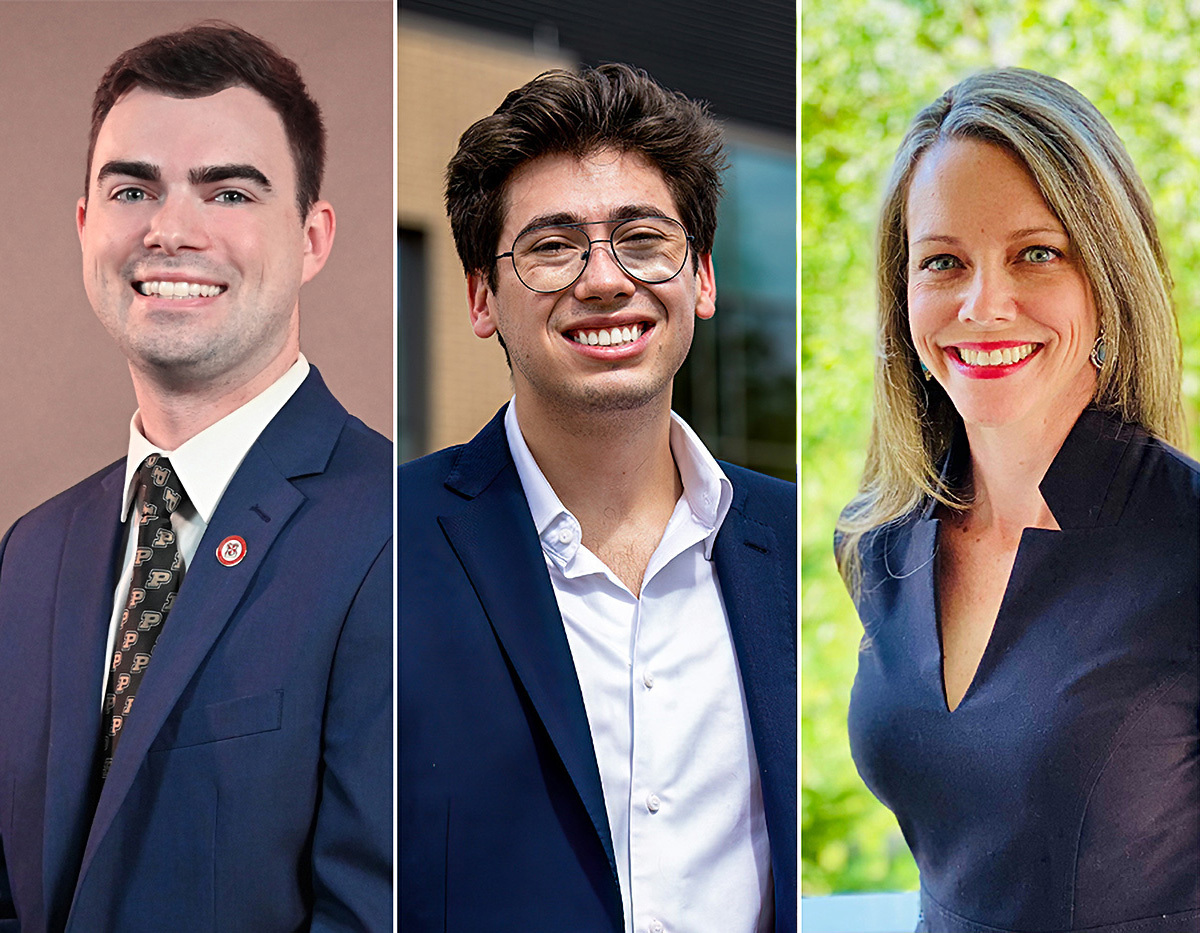
Broad Run District
The Broad Run seat on the school board has been open since last summer, when board member Leslee King died. Andrew Hoyler, a 26-year-old airline pilot and LCPS alumni who was King’s opponent in the 2019 election for the seat, was appointed by the board to fill the position until this fall’s general election. Hoyler, whose mother and brother are current LCPS teachers, has received praise from some locals for hosting town hall events for community members amid political turmoil surrounding the school board, and he’s running as a centrist without major party backing.
“Some people would say I’m pretty crazy for wanting to continue on the school board after everything that’s happened over the past 12 months,” Hoyler says. “But for me, I recognized pretty early on that any type of change at any level of government, especially at a local level, takes time.”
Running to Hoyler’s left is Nick Gothard, another young LCPS grad (he’s 22) who wants to shore up the protections he counted on as a queer LCPS student from a low-income background. Gothard has been endorsed by the Loudoun Democratic Party, where he previously served as executive director, and by the Loudoun Education Association Political Action Committee, as well as incumbent Democratic Congresswoman Jennifer Wexton. Earlier in the race, he declined to participate in a debate staged by the Loudoun chapter of Moms for Liberty, a conservative group that has referred to kids coming out as transgender or nonbinary as “a social contagion” on Twitter. Gothard said he would not attend an event sponsored by “an organization that espouses discrimination.”
On the right is Tiffany Polifko. She’s an LCPS parent with a background in special education and behavioral analysis who works with autistic children. She’s also a member of Parents Against Critical Theory, a conservative group behind frequent attacks on the school board for racial equity policies and regulations to make the schools more inclusive for transgender and nonbinary students. Polifko says she wants to remove “identity politics” from the classroom, and has decried the idea that racism is systemic in American society. Polifko has been endorsed by the Loudoun Republican Party, and has appeared numerous times on ex-Trump senior advisor Steve Bannon’s show, “War Room.”
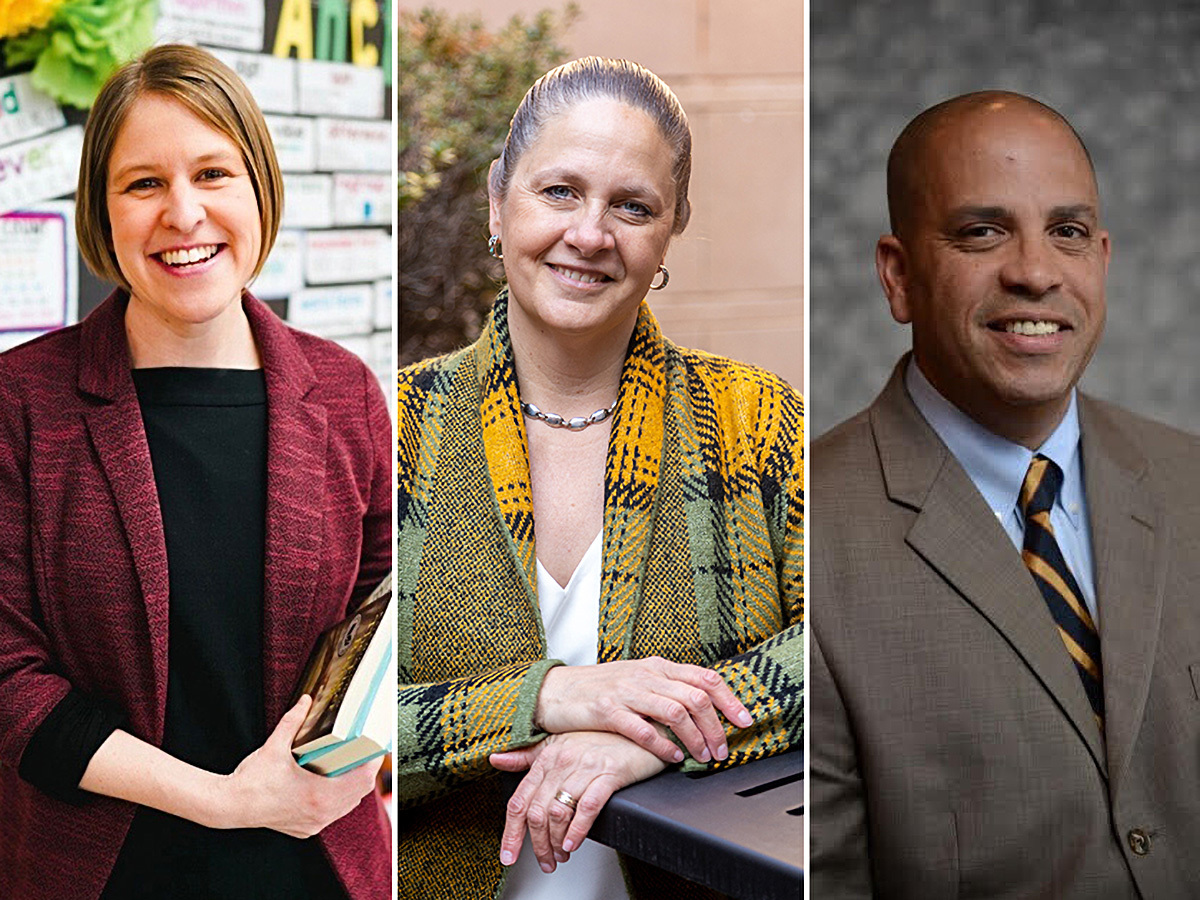
Leesburg District
The Leesburg District seat has been empty since its former occupant, Beth Barts, announced that she was stepping down last fall amid a recall attempt spearheaded by conservative parent group Fight For Schools, plus a concerted harassment campaign that made her fear for her family. The school board appointed former member Tom Marshall to fill in for Barts until the election; he dropped out of the race, leaving three candidates up for voters’ consideration this fall.
Erika Ogedegbe is an LCPS parent and a higher education administrator at American University. (Note: American University holds WAMU’s license.) She’s running on a progressive platform of investing in individualized supports for students, focusing on global citizenship, and protecting schools’ equity work. She’s received the backing of the Loudoun County Democrats, the Loudoun Education Association Political Action Committee, current Congresswoman Jennifer Wexton, and the Loudoun Board of Supervisors Chair Phyllis Randall. Like Gothard, she declined to participate in a candidate forum hosted by conservative parents group Moms for Liberty. Ogedegbe did appear in a forum hosted by a group of Leesburg-area PTAs.
Michael Rivera is an LCPS parent and a deputy with the Loudoun County Sheriff’s Office. He’s running with the backing of the local Republican Party, and he’s focused on removing what he calls “identity politics” and indoctrination from the schools. He’s also concerned about special education services in the county — one of his children has special needs — and increasing transparency and communication with LCPS parents. His campaign has an active Twitter presence, which includes campaign updates as well as retweets of popular conservative culture-wars content from Libs of TikTok and some anti-COVID-vaccine information.
Lauren Shernoff works with kids on literacy skills as an English Language Arts facilitator in LCPS, and also has young children in the schools (if elected, she’d have to step down from her current role in the school division). She’s running a non-partisan campaign — though that has not hurt her in fundraising, where she’s four or five times ahead of her two opponents — in an attempt to bring the voice of a teacher to the school board dais. She wants to return the focus of the board and the community to the classroom, evaluating teacher workloads, LCPS’ grading policy, and more. She believes the current board has gotten too embroiled in “a tug of war” between political factions. “When I started to see how all that could trickle down to day-to-day classroom life, I really started to see if I was represented on our school board. And with everything becoming so polarized, I started to notice I wasn’t,” she says.
What they’d do first, if elected
Broad Run District
Hoyler says he wants to focus on helping direct resources and county support to high-poverty schools in the Broad Run district. He also hopes to expand the free online tutoring program offered by LCPS to help kids catch up after pandemic disruptions in learning, and address parent concerns that the program doesn’t serve the needs of students with dyslexia. Other priorities for Hoyler are providing mental health services for students — next month, LCPS will begin offering free online therapy, he notes — and looking into teacher concerns about the schools’ current grading policy.
Gothard says he wants to be a champion for the implementation of LCPS’ new phonics-based literacy curriculum, particularly focused on ensuring that the new program is rolled out in a way that supports English language learners and students with disabilities. “We can’t just check a box and say, ‘Yes, we’ve adopted it. Now everyone’s going to read better,’” he says.
Polifko says she wants the school board to consider firing Superintendent Scott Ziegler over the mishandling of a pair of sexual assaults committed by the same student in different schools. The incidents are the subject of a grand jury investigation by the Virginia Attorney General, and LCPS has fought the release of an independent review of what happened. “People need to remember that it is the school board who is in charge of hiring and firing a superintendent,” Polifko says. “That needs to be a major focus. It’s got to be at the forefront of our minds.”
Leesburg District
Ogedegbe wants to focus on understanding and meeting the needs of each individual student, citing kids in special education or who are English language learners in particular. She’s also concerned about schools’ ability to recruit and retain teachers. And she wants to host town halls and informal meetings with community members to give people another forum to air frustrations or concerns besides two-minute public comment slots at school board meetings (this is a goal all the candidates for the Leesburg seat share). “When parents or community members come and they have the opportunity to say their piece for 1 to 2 minutes, there’s no exchange,” Ogedegbe notes. “I think it’s really important to provide other mechanisms for communication.”
Rivera has a handy acronym for the guiding principles of his campaign: SAVE, which stands for “safety and student security,” “advocate for parents,” “values and integrity,” and “educational excellence.” He speaks extensively about curbing progressive political ideologies in schools — including the idea of systemic racism (“critical race theory”), social-emotional learning, and “transgender ideology” — which he believes the LCPS administration is pushing on teachers and, by extension, students and families. At a candidate forum, he tacitly acknowledged that some of his ideas are controversial: asked what he plans to do to prepare himself to take office, he said he’d want to reach out to people on the other side. “If I cannot figure out how to build bridges with the people that disagree with what I campaigned on, I’m not going to be successful,” he said at the time.
Shernoff’s platform includes ideas about evaluating the heavy load on teachers’ plates, supporting the transition to a new science-based literacy curriculum, and taking a hard look at grading policies, cell phone usage, and dress codes. She also wants to reprioritize the core curriculum around “true equity,” focused on closing poverty-based learning gaps and addressing the needs of Loudoun’s diverse student population, rather than “social and political initiatives” pushed by the current board. She says she’d also host regular town halls and engagement opportunities with constituents.
On teachers and collective bargaining
In 2020, the Virginia General Assembly passed a law allowing public employees — including county and school employees — to collectively bargain over pay and benefits. One of the first steps towards that goal requires the school board to pass a resolution that sets the framework for the bargaining process. The Loudoun Education Association is currently gathering signatures of school staff to demonstrate employee support for collective bargaining, after which the school board would vote on a resolution to begin the process. Meanwhile, the Loudoun Board of Supervisors already approved collective bargaining with county public employees.
Broad Run District
Hoyler, a union member himself, says he supports unions in principle, but has some concerns about the LEA’s current collective bargaining proposal, including the idea that the union could have access to teachers during the school day at full pay, and would also have access to contact information for all school staff, non-union members included. While negotiations over the specifics of collective bargaining go forward, Hoyler wants to explore other options for ensuring teachers can share their ideas. “I’m all for, in the meantime, getting our teachers’ voices together, whether that’s monthly meetings with LEA or having a solidified teachers group where they come and give feedback on our different policies,” he says. “Everyone should want that.”
Gothard, who has the endorsement of the union, supports collective bargaining as a means of giving teachers a voice in school board and administration decisions. “We need to have teachers at the table and we need to start treating them like the professionals,” he says. “I feel very strongly that that can be achieved with collective bargaining.”
Polifko says she understands the desire for “organized support” for teachers, but accuses teachers’ unions — including the Virginia Education Association and Loudoun Education Association — of taking teachers’ dues and using the funds for political lobbying. (The Loudoun chapter of the Virginia Education Association has spent a total of $1,000 across the two school board races in Loudoun this year, according to the Virginia Public Access Project.) Polifko thinks there should be some kind of alternative teacher organization that does not participate in party politics but could perform some of the union’s support functions.
Leesburg District
Ogedegbe, who has the endorsement of the union and has served as a shop steward in the past (though she’s not in a union currently), says she’ll vote in favor of collective bargaining if the Loudoun Education Association gathers enough signatures in support. “My experience is that the union can be an important support for employees to feel like they are heard, and that managers and supervisors have a clarity around their responsibilities for supporting growth,” she says.
Like many of his fellow conservatives, Rivera thinks that unions writ large are overly political and corrupt (he does not offer specific issues with the Loudoun Education Association, beyond anecdotes from teachers feeling that the organization did not effectively help them navigate issues). But he does believe in teachers having some sort of nonprofit organization that would be able to help speak up for them about pay and working conditions. “When you have a group of similar professions together, you have to get those economies of scale — you can’t be doing one off, ‘I need a raise,’ ‘I need a raise,’ ‘I need better health care,’” he says. “I just don’t think that the union is the right vehicle to accomplish that.”
Shernoff, a teacher herself, makes strong statements in favor of teacher voice in LCPS-wide decisionmaking, but she is reserving judgment on collective bargaining until the LEA receives a majority of teacher support and until the specifics of the resolution are finalized. “For me, it’s going to come down to the rules, like what are the rules? How does it work?” she says. “Then let’s evaluate and look at how if there was a majority there, then that maybe that could be the voice.”
On transgender students in schools
Loudoun County Public Schools have been at the center of several significant inflection points in policy debates over how schools should treat transgender and nonbinary students. In 2020, the General Assembly passed bipartisan legislation directing the Virginia Department of Education to develop a model policy on how schools should acknowledge nonbinary and transgender students’ identities and protect them from harassment. The Northam policy, which came out in 2021, said school staff should use the names and pronouns that match students’ gender identities and should allow non-cisgender students to participate in school activities and use bathrooms according to their gender identity. Northern Virginia schools, including Loudoun, mostly followed suit — but in the face of significant pushback from conservative parents.
Now, Republican Gov. Glenn Youngkin is attempting to replace the Northam policy with a new model — one that does not compel school staff to use a student’s name and pronouns, and requires written parental permission for students to change their names or pronouns or participate in school activities according to their gender identity. Republicans argue the issue is about the right of parents to determine how their children are raised and educated; the Northam policy suggested that school staff might choose not to notify parents about their child’s gender identity if they thought there could be safety concerns in doing so.
Broad Run District
Gothard says he supports the Northam version, which he characterizes as “tremendous progress” in “cementing the rights of transgender students” and a big step forward in making sure schools are welcoming and accepting of all students, including LGBTQ children. He sees the back-and-forth over transgender and nonbinary students — a relatively small student population — as a political distraction.
“When I talk to families and teachers, they just want to make sure that every student feels accepted and that they can use the facility that they need to use so that they can get back to learning,” he says.
Polifko thinks Youngkin’s policy “is not denying the rights of any child to express who they are,” just requiring parental consent to do so, in line with legal language in Virginia code about parents’ rights to raise their children as they see fit. She’s concerned that not including parents in discussions about a child’s gender identity “fractures the relationship” between parents and school staff. Polifko also suggests the current policy is unconstitutional in that it “compels speech” from teachers who may not want to refer to students by certain names or pronouns — an issue that has already gone to court once in the county.
A tweet pinned to the top of her Twitter profile accuses the current school board of “[voting] for your daughters to share locker rooms with boys,” alluding to a debunked claim that nondiscrimination laws for transgender people are a cover for male aggressors to access and assault women.
Asked about LGBTQ children who may be abused or even kicked out of their homes if they are outed, Polifko says school officials should contact the authorities if they believe a student is being mistreated, but doesn’t weigh in on hypothetical situations where a school notifying a parent could be a safety risk, saying those decisions must be made at “the most individual level.”
Hoyler points out that the right for transgender and nonbinary students to use bathrooms according to their gender identity has been settled by the courts, in a case from Gloucester County, Virginia, and he said he expects further legal action over the Youngkin model policy to determine the balance between student rights under Title IX and parental rights under Virginia code. (Others have also suggested that the Youngkin policy could be in conflict with Virginia human rights law, which prevents discrimination on the basis of gender identity.)
Hoyler says he has a unique perspective on the question of outing students to parents. He was “terrified” of coming out to his parents in high school, not because he feared reprisals, but because of “the fear that I would be seen differently in their eyes.” He notes that he has friends who were not welcomed by their families after coming out in college, but believes that the vast majority of parents want to be supportive of their children.
“There are certain fears that we as closeted kids have that may not always be accurate,” Hoyler says. “A parent’s love, 99.9% of the time, will be there. It may cause some difficult conversations at times. But I think it would be difficult for us to try to find an exception that is wide enough to incorporate into policy.”
Leesburg District
Ogedegbe wants to keep LCPS’ current policy, which is in line with the Northam administration’s version, in place. She sees that stance as part of her overall philosophy that students need to feel safe to be ready to learn, and that transgender students — who face high rates of self-harm, according to experts — need to have their identities accommodated and acknowledged by schools in order for them to excel academically. Ogedegbe, unlike conservatives around the commonwealth, denies that her support for transgender students is antithetical to her desire to involve parents as much as possible in the educational process. In fact, she criticizes Republican parental-rights concerns about the policy for “setting it up as though the teachers are actively working against the parents.” “That hasn’t been my experience,” she says. “I see teachers who are energized and love the work they do and have always been receptive to any communication that I’ve sent.”
Rivera, like Polifko in Broad Run, believes the current LCPS policy on transgender students — requiring school staff to use student names and pronouns, allowing students to use facilities and participate in school activities according to their gender identity, and offering staff the option to not disclose issues to parents if they believe there is a safety concern — “[deletes] parents rights by keeping them out of their children’s mental health issues.” Like the Youngkin policy, he’d like to see schools offer gender-neutral single-stall bathrooms to transgender or nonbinary students. Also like the Youngkin policy, he says he doesn’t want any child to be bullied or harassed.
Rivera doubts some transgender students’ sincerity in stating their gender identity, tweeting about the distinction between “clinically-diagnosed gender dysphoria” not “conjecture or feelings” to question data showing an increasing number of young people identifying as trans or nonbinary. He also suggested that “they may be guided down this path” by schools intent on “furthering an ideology.”
“I don’t believe that children are coming up with these thoughts on their own. My personal opinion is that a child shows up to school. Maybe they’re chubby. Maybe they got a lot of acne. Maybe they don’t get along because they’re a little quirky. Maybe they’re nerdy,” he says. “And they’re having a hard time fitting in and they’re presented with this notion that maybe you’re not a boy, maybe you’re a girl. And it’s like, ‘Oh, I can escape all of this craziness and go down this path.’”
Shernoff thinks that feeling safe in school is a prerequisite for a good learning experience, but she is reserving judgment on the issue until the Youngkin administration finalizes its proposal. She says she’d like to hear from teachers and parents about how they feel, and believes that purposeful engagement would help get at the nuances that the debate over the issue is missing. Above all, Shernoff is critical of the discourse on the issue itself, which has become a central political campaign issue in the final weeks of the midterms in Virginia. “Creating communities means loving one another, and it means showing grace to each other,” she says. “And that is lacking right now around this issue,” noting high levels of vitriol on social media on the subject.
On equity policies and programs in schools
Another recent flashpoint in Loudoun has been the schools’ push to emphasize racial equity in policy and practice in schools, on the heels of a state investigation into discrimination against Black and Latinx students and a third-party report that found a “hostile learning environment” for students of color, frequent use of racial slurs in schools, and teachers who were mostly “unclear and fearful” about how to talk about race, poverty, and other topics in productive ways.
Backlash to that work came during the gubernatorial race in 2021, when then-Republican candidate Glenn Youngkin made attacks on “critical race theory” — an advanced academic area of study that suggests that American society is rooted in structural racism — a centerpiece of his campaign. Youngkin has long suggested that acknowledging ongoing racial discrimination is “inherently divisive” and shames white students. Meanwhile, local conservative critics frequently point to LCPS’ spending on independent consultants to provide equity-related trainings or research as wasteful and a diversion from the schools’ academic mission.
Gothard supports the pursuit of equity in general, and believes understanding students’ lived experiences is critical to creating environments where they can learn effectively. But he also says he wants to balance outside reports and trainings with a hard look at more concrete forms equity might take, like better school infrastructure.
“When I talk to voters out there, a majority of them are always telling me, ‘Yes, we need a school system that is inclusive and caring and belongs to everyone,’” he says. “It’s tough to have that vision when we’re spending so much money on consultants while your child’s school is falling apart.”
Responding to a question about schools’ equity work, Hoyler points to two concrete issues he believes LCPS needs to continue to address: an uptick in reports of racial slurs in schools earlier this year, and improved resources for high poverty schools.
“We don’t have to agree with one another all the time, but we need to ensure that we’re being respectful of one another and ensuring that we’re not doing or saying anything that could negatively affect the learning environment of a student,” he says.
Polifko says concerns over how LCPS approaches teaching issues around race prompted her to run in the first place. She describes finding out about a New York Times article her son read in English class about the possible racist origins of a shooting in Atlanta that appeared to target women who worked in local massage parlors, most of whom were Asian. Polifko believes the focus on anti-Asian hate in the wake of the shooting was overblown. She points to the incident as an example of teaching “critical race theory,” and believes that any content that suggests that racism is a systemic problem is racist in and of itself, and has the effect of dividing students from each other. She does not attribute reports of racial slurs in the school system to anything beyond individual instances of bad behavior.
Polifko is also critical of LCPS’ decision to spend hundreds of thousands of dollars on teacher training and outside consultants, including the Equity Collaborative, which put together the original 2019 report. She also believes that LCPS spending on social-emotional learning programs — which deal with the types of intangible life skills and emotional lessons around communication, interacting with others, managing feelings, developing resilience, and so on — is critical race theory in disguise. She notes some social-emotional learning programs include explicit discussions about race, as other conservatives have pointed out.
Leesburg District
Ogedegbe wants to continue LCPS’s direction on equity work, and says she’s not against hiring outside experts to help the schools understand the data and find ways to improve outcomes for all students. She disputes conservative arguments that an emphasis on “equity” distracts from academic rigor. “It should go without saying that the primary goal of a public school system is to educate our students,” she says.
Like other school board candidates, she also wants to ensure that resource allocation, particularly for school infrastructure projects, is fair. By way of example, she references community outrage over the state of Park View High School in Sterling, which is deteriorating so badly that LCPS staff recommended that it be entirely rebuilt, rather than renovated, earlier this year.
Rivera “despises” the word “equity,” which he defined in an email as allowing school systems “to promote and graduate children that did not meet academic requirements just to boost statistics.” He adds: “I don’t care what color you are or what ethnicity you are, you should not be enabled to pass classes and promote grades if you did not learn the material,” he wrote. “Allowing students to pass classes without meeting the rigors of the academic courses and lowering the standards for high achievers is a disservice to both groups.” He says racism exists in this country, but he does not believe that systemic racism is a significant force in American life today. But Rivera says he wants to see the history of people of different races and ethnicities taught “objectively” in schools, including the history of school segregation in Loudoun County.
Rivera is highly skeptical of equity-focused consultants and trainings, but he does agree with other candidates on the importance of ensuring that underserved schools in the county — again, like Park View High School — are given resources they need to improve. Those schools, he believes, have been shortchanged by a combination of school board “financial mismanagement” and the barriers to engagement that low-income, mostly immigrant parents in the county face in giving feedback to county officials. But to him, that focus is about “equality,” not “equity.”
He would support reassessing the allocation of funding. “Sometimes it means telling the folks out west or in Ashburn or Lansdowne [wealthier areas with newer school buildings], ‘We need to put money into this school, and this is why, because this school is not up to snuff with all of these other schools,’” he says.
Shernoff is worried that the word “equity” is becoming a buzzword and losing its meaning. For her, equity is working in classrooms to understand students’ lived experiences and teaching with that awareness. She believes that’s the way schools should address achievement gaps, like low pass rates on standardized tests for English language learners.
Regarding equity-focused teacher trainings, Shernoff says the one she went through helped her be “reflective” about her place in the world and the forces in her students’ lives. But she’s critical of the course for not giving teachers good tools for addressing inequities in the classroom.
“In that training, there wasn’t any specific guidance on what teachers should do or how they should teach these concepts,” she said at the Leesburg candidate forum debate. “And I think that’s where things can get a little bit fuzzy and where problems can arise.”
This story was updated with clarification provided by Michael Rivera on his views of equity policies and programs. It was also corrected to reflect the endorsement of two candidates by the Loudoun Education Association Political Action Committee, not the Loudoun Education Association.