Amanda Michelle Gomez
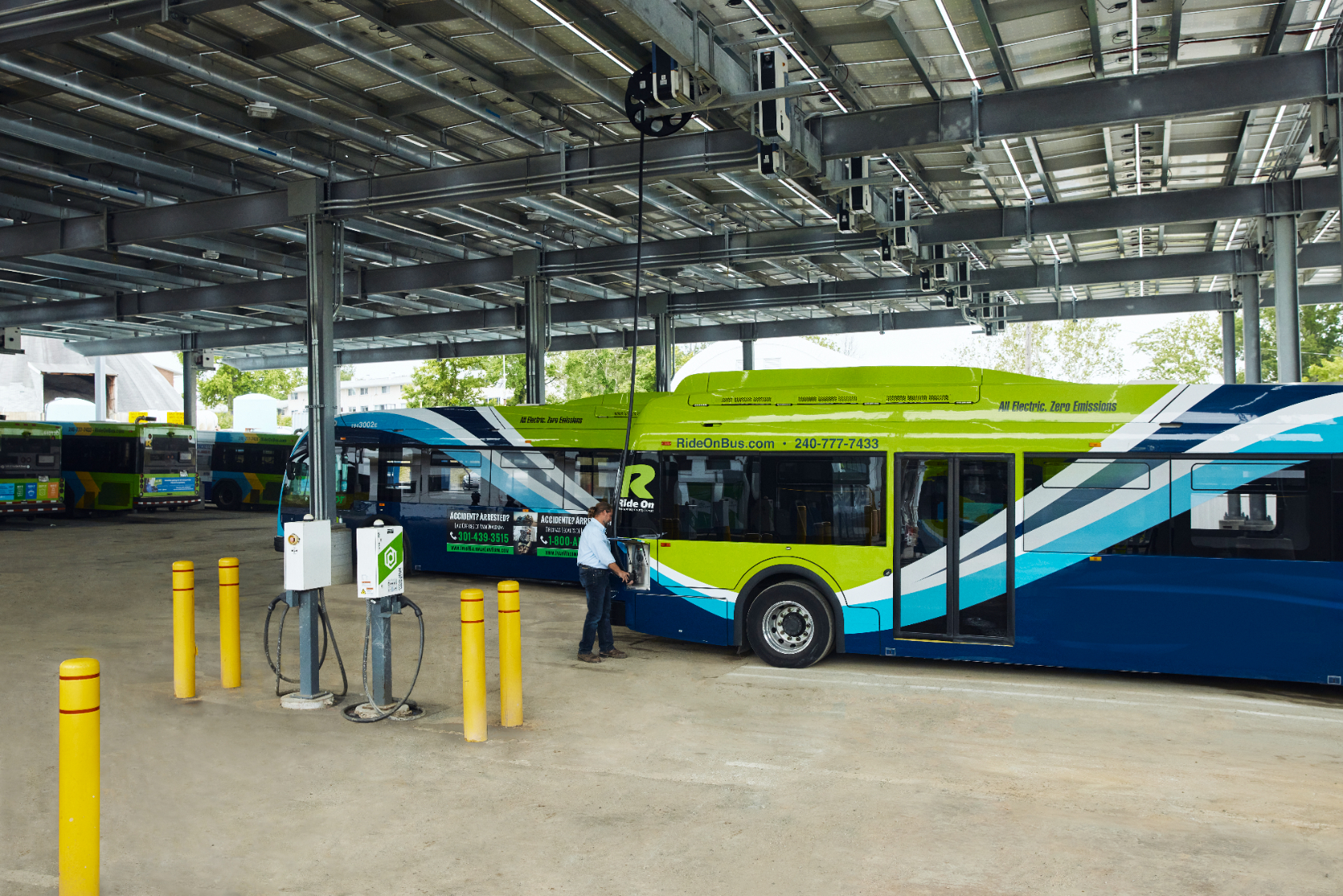
Instead of relying on diesel to fuel its bus fleet, Montgomery County decided to look to the sun. On Monday, county officials, along with federal and private partners, opened the region’s first solar microgrid to power a growing fleet of electric buses.
“My message to folks around the country is it’s not rocket science. If you can figure out the financing and the partners, you can do this,” said Montgomery County Executive Marc Elrich at a ribbon-cutting ceremony.
The microgrid, located in Silver Spring, will house 70 electric transit buses by 2026– out of a total bus fleet of several hundred. Electrifying that many buses would reduce greenhouse gas emissions by 62% over the next 25 years, according to AlphaStruxure, the energy service company Montgomery County partnered with to help finance and build the microgrid.
Currently, the bus depot has 14 electric buses, with the first one being plugged in on Monday, roughly a year after groundbreaking. County officials hope the solar microgrid will help Montgomery County meet its ambitious climate action plan to reduce greenhouse gas emissions 80% by 2027 and 100% by 2035. Per the council, nearly half of all of the county’s carbon emissions come from the transportation sector.
Bus-height canopies of solar panels stretch across the Brookville Bus Depot. The microgrid has over 4.14 megawatts of charging capacity for buses to plug in. The bus depot is one of several microgrid projects in the county that aim to reduce emissions.


Montgomery County touts being at the forefront of relying on clean energy to fight climate change. The county’s school district has the largest electric bus fleet anywhere in the country. The county was also the first in the country to create a green bank to finance clean energy and climate-resilient projects and codify energy efficiency performance standards for buildings, according to Democratic Maryland Sen. Chris Van Hollen, who attended Monday’s event.
“This is a county that has been pushing forward day after day, year after year. Obviously, we still have a long way to go, but they lead by example,” said Hollen.
He said a $6 million dollar federal grant helped to purchase 14 of the 70 electric buses in the electric fleet, which will be housed in the new depot. He also said President Joe Biden’s infrastructure law supports initiatives like the Brookville Bus Depot, as well as delivering $60 million to Maryland for electric vehicle charging stations. The effort is also supported by the private sector, with Montgomery County partnering with AlphaStruxure.
“The construction is over,” said Juan Macias, CEO of Alphastruxure. “But we will be here working over the next 25 years, ensuring that we are delivering safe, reliable, renewable energy so that the county can deliver their important services of ride-on services to their users.”
In addition to the significant upfront cost of the infrastructure for solar panels, electric buses cost around 45% more than standard diesel buses to purchase. Elrich addressed the cost issue when he noted that ultimately electric buses powered by solar are more cost effective, saying “electric buses over a ten year lifespan cost less to buy and operate than any other bus you can buy.” The microgrid would be the third of its kind nationwide.
Montgomery County could enact even more ambitious climate goals. The Council is weighing legislation that would require the county to adopt all-electric building standards for new construction and major renovations by 2024. Officials at Monday’s ceremony remarked that more action is needed given the severity of climate change.