Martin Austermuhle
A proposal to shrink the size of the zones where D.C. residents can get free on-street parking faced some skeptical questions and opposition during a D.C. Council committee hearing last Friday, and its proponents concede that the specifics of the measure will have to change for it to move forward.
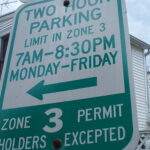
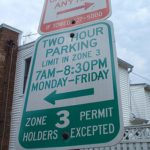
The bill introduced last year by Councilmembers Brooke Pinto (D-Ward 2) and Christina Henderson (I-At Large) would “right-size” the city’s eight residential parking zones (which align with the city’s ward boundaries) by creating smaller zones based on Advisory Neighborhood Commissions where residents with a Residential Parking Permit would be able to park for free. (In RPP zones, non-permit holders can only park for two hours at a time.)
Pinto and Henderson say that D.C. is currently an outlier compared to many other cities and counties in how big its residential parking zones are, which they argue encourages people to drive within their own ward simply because they know they will be able to park for free. And that, said Pinto at the hearing, can shortchange residents.
“The residential parking permit program was established with the goal of ensuring that residents can easily find parking near their homes. However, it’s not uncommon for our residents to have to look for a parking spot for over an hour, and oftentimes park several blocks away from their home,” she said. “The idea is by reducing the size of RPP zones, neighbors will be able to find parking more easily near their homes, and folks visiting the neighborhoods will be able to park for two hours, which will encourage more turnover.”
A number of speakers at the hearing agreed.
Corey Holman, an Advisory Neighborhood Commissioner in Ward 6, said that the existing RPP zones are too big and encourage driving. “Every trip is rational because the policy is irrational,” he said. Another Ward 6 ANC commissioner, Mark Eckenwiler, said the current system incentivizes “Capitol Hill commuting” — residents who from the east end of Capitol Hill and park on residential streets closer to Union Station for the day and then drive back home.
But Eckenwiler and others argued against using ANC boundaries to demarcate residential parking zones, noting that just like ward boundaries, ANC lines have to be redrawn once a decade. “Parking zones should be stable and not be changed every 10 years,” he said. David Alpert, the former director of urbanist group Greater Greater Washington, urged the council to align parking zones with the Office of Planning’s 44 neighborhood clusters; Holman noted that a 2003 city study proposed creating 39 new residential parking zones based on similar groups of neighborhoods.
But other speakers said the bill seemed to be a solution in search of a problem.
“If you live in Ward 6, you should be able to park anywhere in Ward 6,” said Gail Sullivan, a senior citizen who lives on the east end of Capitol Hill. Tamara Blair, an ANC commissioner in nearby Kingman Park, echoed that point. “What I am hearing from my community is they like things the way they are,” she said.
Brian Alcorn, another Ward 6 ANC commissioner, advocated for expanding free parking options for residents.
“On-street parking should be treated as a community good. Why not have a single, all-D.C.-wide [permit] for those who choose to live and work here? Instead of saying Capitol Hill residents can only park on certain sides of the street, let’s allow for parking of D.C. residents across all wards, across all communities,” he said.
And some speakers said no change to residential parking zones would mean much if parking enforcement weren’t ramped up to deal with commuters who already park on neighborhood streets.
In testimony to the committee, DDOT officials unveiled the results of a study on RPP zones they conducted this year. The study said that the existing zones are “simpler to communicate and provide flexibility for residents to find parking anywhere in their zone,” but additionally concedes that “this flexibility can create inequitable parking opportunities and discourage turnover in high-demand areas.”
As part of the study, DDOT surveyed 2,000 residents in an area in and around Dupont Circle, and found opinions split on whether existing residential parking zones should be made smaller — 41% of respondents said no, 46% said yes, and 5% said that the RPP system should be eliminated altogether. Many more respondents, though, said they would support a new system to require non-permit holders to pay for parking (especially in high-demand areas), which DDOT recommended as an option it would like to test.
After the hearing, Pinto told DCist/WAMU that while it seemed clear that using ANC boundaries to delineate residential parking zones wasn’t popular, she remained “open-minded about coming up with a solution” to parking challenges some residents face in their neighborhoods.
Henderson agreed that the bill would have to be tweaked, and likely leave the drawing of new boundaries to DDOT after an extensive community engagement process.
“Anytime we talk about parking, or cars, it’s always controversial. It could be [speed cameras], it could be towing, it could be bike lanes. Parking will always bring an emotional response because changing that is the thing that changes people’s lifestyles the most,” she said.
But Henderson said some type of changes will still have to come to pass since while the status quo may work for some residents, it doesn’t for many others. “People just need to understand that supply and demand are really off here,” she said. “This is the one situation where it doesn’t align, so what are the policies you put in place when that happens?”