Martin Austermuhle
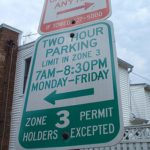
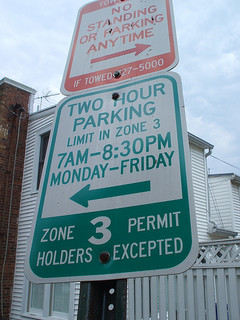 Photo by slack13
Despite Councilmember Mary Cheh’s (D-Ward 3) insistence that the city’s residential parking program is “just broken,” D.C. Department of Transportation officials said today that any significant changes to how and where residents can park probably won’t come until late 2013.
At a hearing on the residential parking permits, Cheh and others argued that the city’s existing zones—which align with wards—are too large, that the annual cost of a pass ($35 per year, or roughly 9.6 cents per day) doesn’t reflect the market value of the on-street spot, that no comprehensive parking plan exists for the city, and the the visitor parking pass program is rife with abuse and fraud.
Residents who testified proposed a number of ideas, from drastically increasing the cost of parking permits to limiting the number of permits per household, while Councilmember Jim Graham (D-Ward 1) floated the idea of incentivizing residents whose homes have garages to actually use them.
But for as many demands for the change as were made, DDOT officials said that they would take the results of recent community discussions and turn them into a comprehensive plan—albeit somewhat slowly. Changes to the visitor parking program could come by October, but any more substantial changes to residential parking probably wouldn’t come to pass until December.
The council could force this issue, but as Cheh recently learned with a bill that would have set aside and charge for on-street parking spots for handicapped drivers, parking isn’t an issue to be approached lightly. “Politically, this is a minefield,” opined Ward 1 ANC Jack McKay, who took part in a 2003 parking task force whose recommendations—including smaller residential parking zones—were largely ignored.
One sticking point may well be cost: while many transportation experts admit that the cost of the parking permits doesn’t even come close to the market value of that on-street spot, Graham seemed hesitant to see prices increase, noting that one in four of his constituents lived below the poverty line. Still, DDOT Director Terry Bellamy hinted that it would have to rise. “The RPP fee is too low,” he said. “Introducing ways to change the price could change the attitudes and practices of RPP.”
There’s also the more difficult task of coming up with a “simple” parking policy for the city. While some of the residents that testified said that there are too many different rules for different wards, Graham, whose ward is the most densely populated in the city, dissented: “One size does not fit all,” he said.