Martin Austermuhle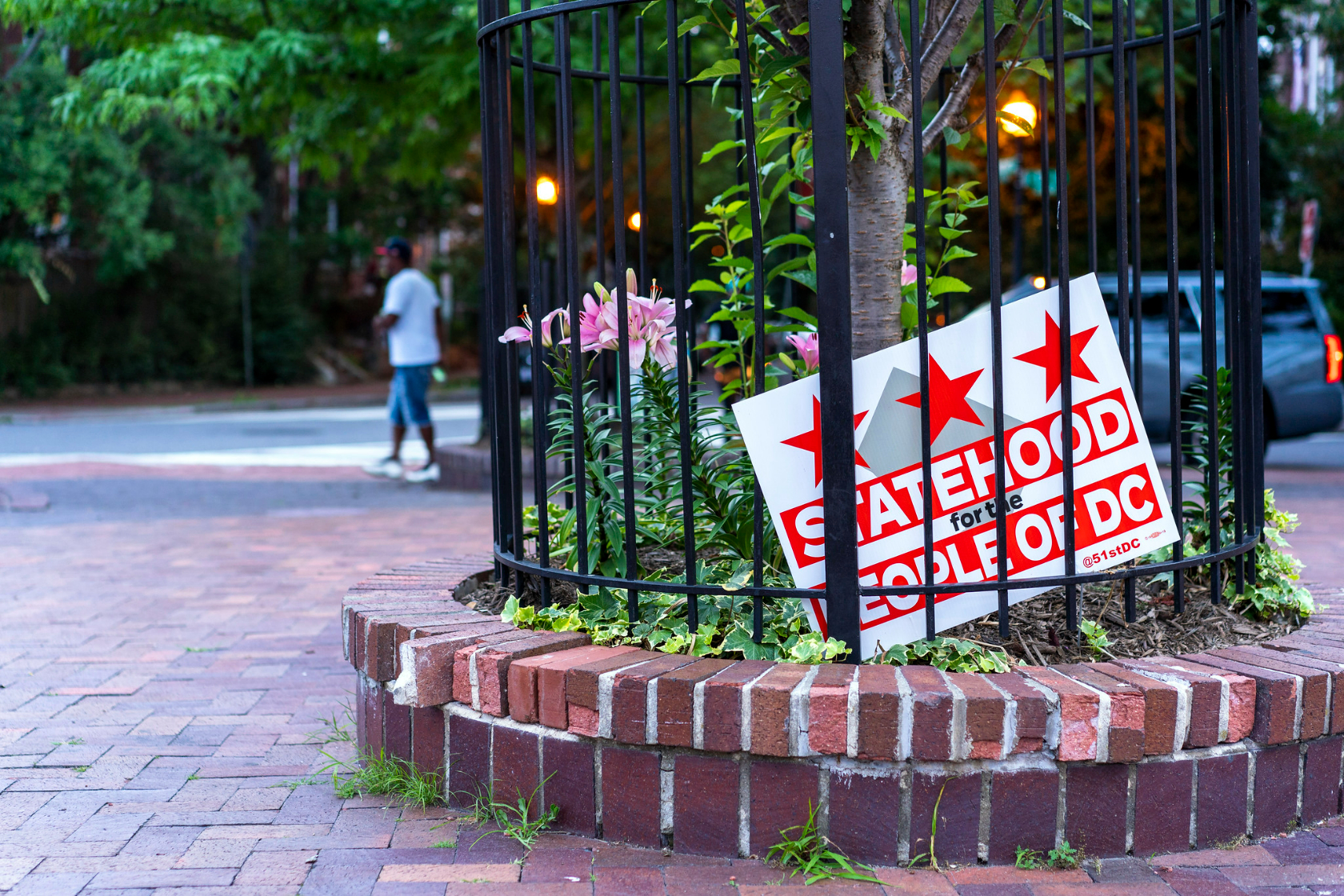
Just over two years ago local officials, activists, and many residents cheered as the U.S. House of Representatives passed a historic bill to admit D.C. to the union as the 51st state. But by next year, they may well be fending off attempts to repeal the city’s ability to govern itself.
That likely political whiplash stems from next week’s midterm elections, in which Republicans have strong odds in favor of retaking at least the House of Representatives and possibly also the Senate. And while either possibility would have likely impacts for Democratic priorities nationwide, D.C. officials and advocates say the city is at particular risk.
“D.C. would be in special danger,” says Del. Eleanor Holmes Norton (D-D.C.), noting that the city lacks statehood and remains under exclusive control of Congress and whichever political party controls it.
City officials and advocates are girding themselves for what they say could be a punishing two or more years of attacks from Capitol Hill waged by a new class of conservative Republicans who have taken a more aggressive line against D.C., a Democratic bastion that has in recent years been thrust into the country’s increasingly polarized political battles.
“Members of Congress, especially the Republican Party, are in this nasty spiral of being mean and petty. And I think there is a renewed focus on the District of Columbia because we’re doing well economically and the statehood movement is stronger than ever,” says Josh Burch, the founder of Neighbors United for D.C. Statehood. “And so this is a pendulum swinging the exact opposite way.”
D.C. has always been at the whim of Congress, even after it gained an elected mayor and legislature in the mid-1970s. The majority of the interference, though, has come from Republicans, and most of it has focused on hot-button social issues, including abortion, needle-exchange programs, marijuana, and public safety.
In her three decades as D.C.’s non-voting delegate on Capitol Hill, Norton has had to fend off many of those attempts by congressional Republicans to interfere in the city’s affairs — sometimes successfully, other times not. But she says the intensity of those attacks has only increased, and now target a broader range of issues and even raise questions about the future of the city’s ability to govern itself.
In just the last two years, the GOP has pushed to overturn education requirements for child care workers, repeal the city’s gun laws, scrap COVID-19 vaccine mandates, and prohibit the city from lowering speed limits and using traffic cameras. In the last two weeks, some prominent Republicans have started organizing to overturn a D.C. Council bill that would allow non-citizens to vote in local elections.
Most notably, Rep. Andrew Clyde (R-Georgia) has said he plans to pursue legislation to repeal the 50-year-old congressional act that gave D.C. a locally elected mayor and legislature, which would effectively undo democratic rule for the city’s 700,000 residents.
Norton says Democratic control of Congress over the last two years has allowed her to defeat those attacks, and also push forward with other priorities for the city, including the statehood bill that was approved by the House on two occasions. (It has stalled in the Senate, though.)
But even full Democratic control hasn’t won the city everything it has asked for. Democrats have failed to remove two provisions in the federal budget that prevent D.C. from subsidizing abortions for low-income women and legalizing the sale of recreational marijuana. Additionally, some of D.C.’s priorities have been derailed by infighting among city officials. That includes a push to have the federal government turn control over the RFK stadium campus to the city and a separate effort to give the city control over parole.
Still, Norton says Republican control of either the House or Senate will be harder on D.C., and possibly more than usual because of how polarized politics have gotten — and how much more influence is wielded by the most conservative Republicans on Capitol Hill. The political context has also changed over the last two years, with D.C. making an easy foil for Republicans waging culture and policy wars over the COVID-19 pandemic, public safety, and even the Jan. 6 insurrection.
The city’s COVID-19 vaccine mandates for businesses and school children both drew criticism and congressional bills threatening to overturn them; one H Street bar became a conservative sensation for refusing to comply. Over the summer, House Republicans demanded that Bowser explain what actions she was taking to “restore order to the nation’s capital,” along the lines of criticism leveled at other Democratic leaders for spikes in crime in cities in the wake of the pandemic.
And Republicans like Rep. Marjorie Taylor Greene (R-Georgia) have become vocal critics of conditions at the D.C. Jail, where some of the accused Jan. 6 defendants have been held pending trial for charges related to the insurrection. (She has raised no similar concerns around conditions faced by the many more Black residents housed there for other offenses.)
“These Republicans are very different,” says Norton. “We don’t see any bipartisanship in the Congress these days. So my fear is that if Republicans take over, especially in the House, they’ll try the most radical of their ideas. My only hope would be that the Senate might might temper what they would try to do.”
Pat Mara, the chairman of the D.C. Republican Party, says he’s less concerned about Republican interference, especially on something like the fate of home rule. He thinks much of the talk is bluster, and that Republicans will be more preoccupied with national issues.
“At the end of the day, Republicans in Congress are going to want to move their own policy agenda and not get locked down on issues in the District of Colombia,” he says “It’s a bit of a waste of time.”
Mara also says that city lawmakers haven’t helped themselves with what he says is the council’s leftward swing, along with rising crime and persistent school challenges in D.C. He says the local GOP will work to establish relationships with congressional Republicans to urge them not to get into the city’s local matters, and he thinks Norton and other city officials should try and do the same — as they done in the past.
“There just definitely has to be more reaching out as opposed to a press conference blaming Republicans in Congress for everything,” he says.
But Burch doubts any type of outreach would work or bear fruit.
“I don’t think the modern Republican Party is civil or decent, and I don’t think they respond to civility or decency. I think it is a race to the bottom, and no matter how nice we are, it’s not going to work because they don’t like who we are, they don’t like what we believe, and they don’t like how we vote,” he says.
Mayor Muriel Bowser says that even if Republicans take the House, the Senate and Democratic White House could still serve as a backstop to head off as much GOP interference as possible. And she tells DCist/WAMU that she will balance working with Congress and trying to keep Republicans out of the city’s affairs as much as possible.
“I have served now with three different presidents and three different leadership situations in Congress,” she says. “Our approach will be the same: we will speak up for D.C. residents, our autonomy, and continue to fight for representation. It could be a very sticky time, but I am ready for it and we have done it before.”