
We’re in the busy theater season, so the following is the first installment of reviews of November shows at D.C.-area theaters. Want to know what else is playing? Check out our monthly theater preview.
The Playboy of the Western World
Review by Nathan Pugh
When J.M. Synge’s The Playboy of the Western World premiered in Ireland in 1907, the play caused a maelstrom of controversy and was maligned for its portrayal of Irish people. It’s hard to imagine a strong public reaction (positive or negative) to Solas Nua’s Playboy currently running in D.C., but the production does retain the play’s power to expose violence lurking in any country.
This version of Playboy is written by playwrights Bisi Adigun and Roddy Doyle; it’s an adaptation that debuted in 2007, is set in the 2000s, and makes its U.S. premiere with this production. The Irish protagonist of the original play, Christy, becomes the Black Nigerian man Christopher (played excellently by Jamil Joseph). After fleeing from Nigeria, Christopher stumbles into a Dublin pub and impresses its patrons with a fantastic tale of murdering his father, even as secrets of Christopher’s past catch up to him.
Adigun and Doyle wisely sharpen Playboy’s fish-out-of-water allegory with the specificity of an immigrant experience. Microaggressions flow quickly from the play’s many native Dubliners, yet Christopher seems content using his status as a racial spectacle to his advantage. We’re asked to consider who in the show is manipulating whom — and who, at the end of the day, truly holds power.
The cast is uniformly great, especially Rebecca Ballinger as a barkeep and Jessica Lefkow as a scheming widow. However, Solas Nua’s production sometimes struggles to find a tonal balance between cringey comedy and dark tragedy. Director Shanara Gabrielle refuses to linger on scenes of racial violence (perhaps out of sensitivity). Still, hatred subtly infuses every part of the script, so the always-snappy energy of this production occasionally doesn’t do justice to its characters’ despair.
Ever since Shakespeare’s Othello, the Western world has been obsessed with stories of racial outsiders and white insiders who cause their downfall. Adigun and Doyle’s Playboy is certainly one of these works, but distinguishes itself by being written from the perspective of the outsiders. Christopher would be proud of how Bisi Adigun, a Nigerian-Irish immigrant himself, has crafted a compelling tale that still feels so true.
The Playboy of the Western World runs at Solas Nua through November 20. Tickets are $5-45. Run time is two hours with an intermission.
People, Places & Things
Review by Nathan Pugh
In rehearsals for a theater production, actors are often given character analysis worksheets. They’re asked to write backstories and find motivation through simple questions: What does your character want? How do they get what they want?
It’s an exercise that Emma, the protagonist of Studio Theatre’s People, Places & Things, might scoff at. She’s a British actor driven by a precarious cocktail of drugs, alcohol, passion, and in-the-moment chutzpah. It’s also an exercise playwright Duncan Macmillan ingeniously questions in People, Places & Things, a show investigating “truth” both on and off the stage.
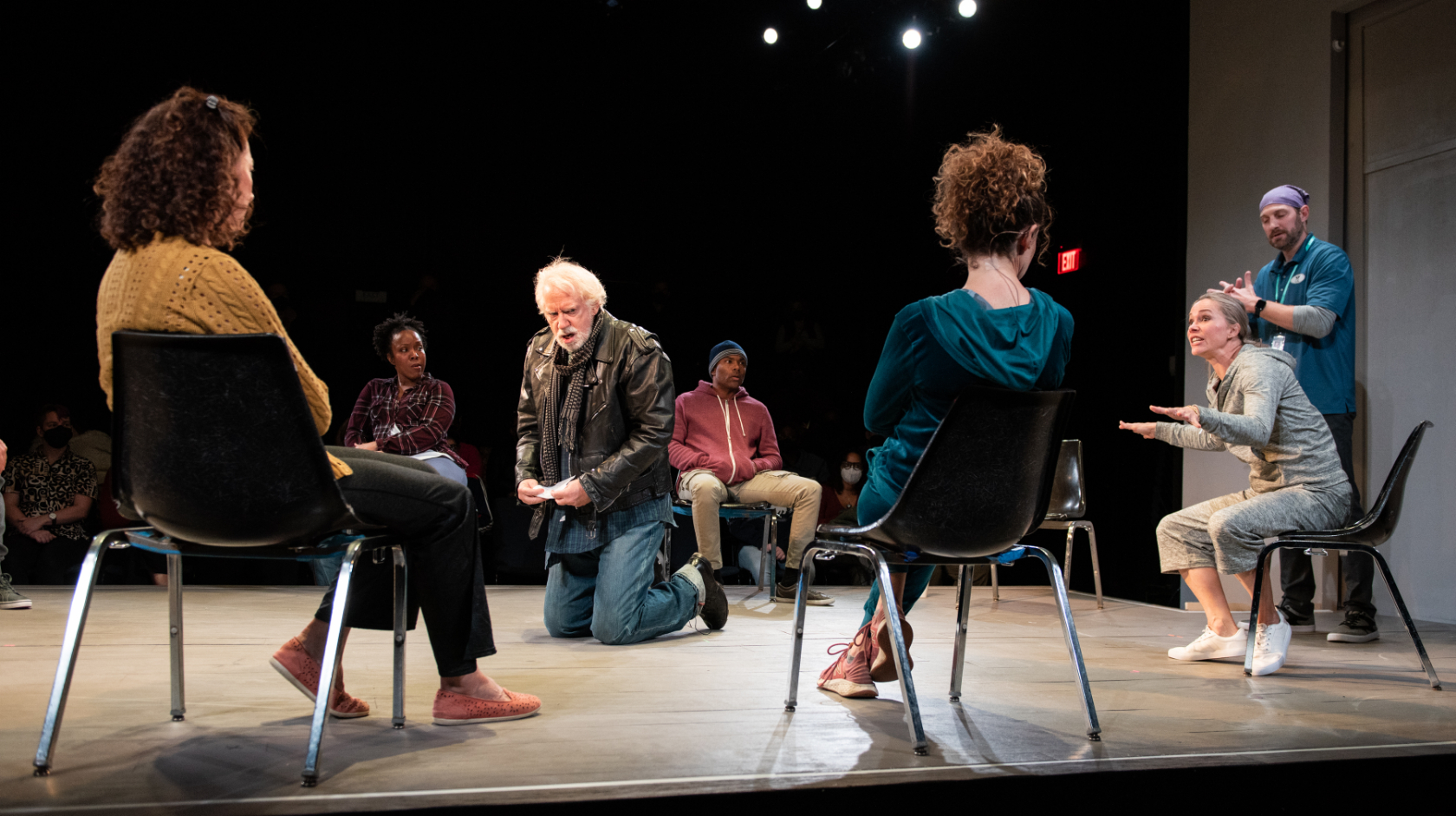
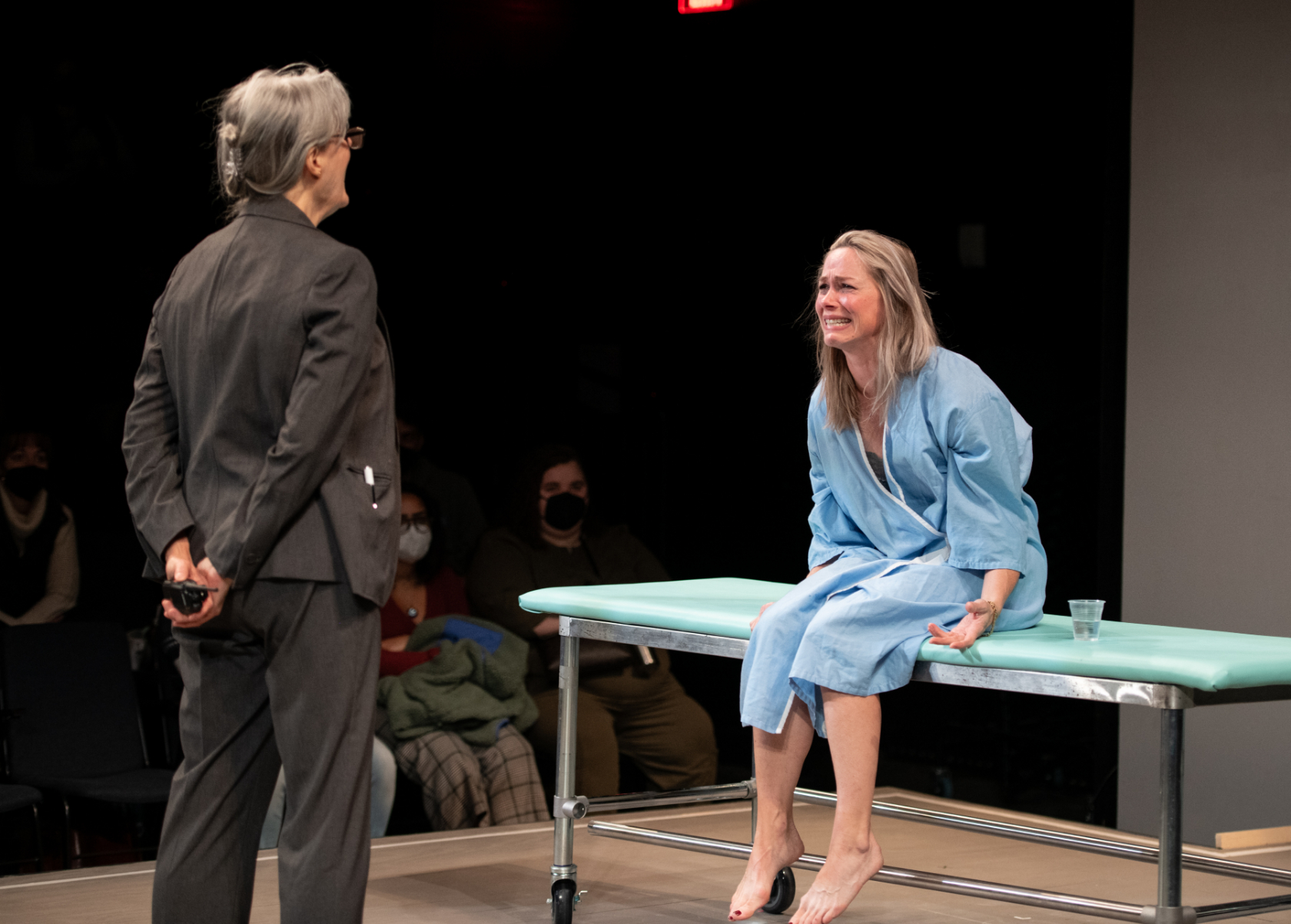
Macmillan’s play might be called a recovery story. After a disturbing incident in the theater, Emma (Kristen Bush) finally recognizes her addictions and checks herself into a hospital. She goes through a painful withdrawal period, after which doctors (all played by Jeanne Paulsen) encourage Emma to stay in a 12-step program. She reluctantly agrees, and forms a tenuous connection with Mark (Jahi Kearse) as they role-play conversations addicts must have with their friends and family.
Director David Muse takes full advantage of Studio’s recently renovated Victor Shargai Theatre, seating audiences on two sides of a central stage. This production’s fantastic design team plunges the viewers into the headspace of Emma through disorienting lights, projection, and seat-rattling sound.
Emma remains an enigma throughout the show. Macmillan purposefully writes her as a tabula rasa, pointing out that everything Emma does is a performance. The character still emerges as a real person because of Bush’s masterful portrayal. At once vindictive, irreverent, and vulnerable, Bush makes Emma feel spontaneous even as she portrays the rehearsal her character requires to seem okay.
Will Emma actually be okay? It’s a question with no definitive answer, given that her performances can always mask bitter truths. Perhaps People, Places & Things is giving us a character analysis worksheet. We, playing the role of the audience, want people like Emma to be okay. How do we, in the theater and beyond, get what we want?
People, Places & Things runs at Studio Theatre through December 11. Tickets are $65-85. Run time is two hours and 15 minutes with a 15-minute intermission.