 Jenny Gathright
When Captain Franklin Porter got to his desk around 9 p.m. on October 23, 2020, it appeared he was in for a pretty normal shift as watch commander for the Metropolitan Police Department. As the supervisor in charge of MPD’s entire Fourth District that night, he began his shift reading and editing an officer’s investigation.
Shortly after 10 p.m., he heard over his radio that a moped was struck on Kennedy Street.
It sounded like “just a regular accident with injuries,” Porter said — something that happens every day in D.C. He had no reason to believe anyone was seriously injured, or that police were somehow involved.
But later that night, two Fourth District cops — officer Terence Sutton and lieutenant Andrew Zabavsky — appeared in the doorway of his office. From the way they were standing there, “it kind of felt like something was not right,” Porter said in testimony at D.C. District Court this week.
Sutton told him that he had been following the person driving the moped — Karon Hylton-Brown — for “a little bit” before the crash, Porter recalled.
“How long?” Porter asked.
About two minutes, he remembered Sutton replying.
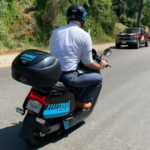
Eventually, Porter looked at the body-worn cameras of officers in the car to see for himself what had happened. What he saw was a chase through the neighborhood of Brightwood Park, with Sutton driving an unmarked car as he pursued Hylton-Brown on a Revel moped. He saw Sutton drive the car the wrong way down a one way street in pursuit of Hylton-Brown. To him, it was very obviously a police chase — which is against MPD policy, except in extreme circumstances where someone is presenting an imminent risk to the public.
It was “very apparent that he was pursuing that moped, not just following him,” Porter said. He began the steps to initiate an internal investigation of the incident.
Meanwhile, Porter continued to rely on Zabavsky – the highest-ranking officer on the scene that night – to help him determine what had happened.
Not once in their early conversations, Porter testified, did Zabavsky say that he had been involved in the chase, driving behind Sutton’s car in a marked police SUV at the beginning of the pursuit. He found that out later, after directly asking Zabavsky. Porter said he would have never relied on Zabavsky for information throughout the night if he knew earlier the lieutenant had been involved — after all, police officers aren’t supposed to be involved in investigations of themselves.
Porter was among the final witnesses to testify in prosecutors’ ongoing case against Sutton and Zabavsky at U.S. District Court. The historic trial of the two D.C. police officers for a combination of second-degree murder, obstruction of justice, and conspiracy charges has lasted for about a month — far longer than initially expected.
The government is expected to close its case in the next day or so, after which the defense will begin to present its side.
Here’s an overview of what we’ve learned so far from the witnesses prosecutors have called to the stand — and what we’re expecting from the rest of the proceedings.
The charges
Terence Sutton, a member of the Fourth District Crime Suppression Team, was driving an unmarked police car with three other officers the night Hylton-Brown was killed. Police said Sutton attempted to conduct a traffic stop because Hylton-Brown was riding a moped on the sidewalk without a helmet. Then, according to video evidence presented by prosecutors, Sutton pursued the 20-year-old in his car for three minutes, taking a twisty route through the Brightwood Park/Kennedy Street neighborhood in Northwest D.C.
Sutton was following Hylton-Brown through a narrow alley when Hylton-Brown collided with an oncoming vehicle as he exited. His injuries were severe, and he later died.
Sutton’s supervisor, Lieutenant Andrew Zabavsky, started off behind Sutton in the pursuit, driving a marked police SUV. His vehicle eventually diverged from Sutton’s, and he ended up arriving at the crash scene on Kennedy Street almost exactly at the moment of the crash.
Sutton, has been charged with second degree murder, obstruction of justice, and conspiracy charges. And his supervisor, Lt. Andrew Zabavsky, has been charged with obstruction of justice and conspiracy, because prosecutors say he helped Sutton delay investigations of the crash and mislead D.C. police officials about what happened.
Testimony from other officers
Perhaps the most damning testimony against Sutton on the second degree murder charge has come from officers who were in the car with him that night. Officer Carlos Tejera, who was in the passenger seat of the car that Sutton drove that night, testified that he wanted to call off the chase and suggested out loud to Sutton that they should just get a warrant for Hylton-Brown instead.
Another officer, Ahmed Al-Shrawi, who was in the back of the car, testified that the chase was “getting ridiculous,” and he “wanted to be done.”
Prosecutors have questioned officers about the possibility that Sutton and Zabavsky were trying to hide the particulars of what happened that night. Patrol officer Nicole Arnone, who was not in the car during the pursuit but arrived at the scene shortly after the crash, testified no one told her there had been a vehicular pursuit. As the most junior officer on the scene, she prepared to write the traffic-crash report — but later, Sutton told her he would be taking care of the report.
“He said you’re doing the report – is that true?” body-worn camera footage shows Arnone asking Sutton.
“Yeah, we’ll knock it out,” Sutton replied.
During the trial so far, prosecutors have played body-worn camera footage from the officers in the car and on the scene. Camera footage from Arnone shows Sutton and the fellow crime suppression team officers in the car, as well as Lieutenant Zabavsky, leaving the scene about 20 minutes after the crash. The footage shows Sutton driving his car over some evidence at the scene – a piece of the destroyed Revel moped.
“They just fucking rolled out on me,” one officer can be heard telling her colleagues at the scene in the body camera footage.
Footage from Sutton’s camera shows him interacting with a crowd of people gathered at the scene who were clearly upset about the pursuit and about Hylton-Brown’s traumatic — and ultimately, fatal — injuries.
“You decided to chase that man … wrong as shit,” a person can be heard yelling in the footage.
“Keep talkin’,” Sutton said back to the crowd. “I hear you talkin’.”
Testimony from MPD’s internal investigators
Other pieces of testimony on the obstruction charges came from internal investigators with MPD who investigate vehicle crashes and officer misconduct. They testified that they were informed about what had happened later than they would have liked. By the time they were informed and arrived at the scene, it was at or after midnight.
They testified that Sutton’s initial police report was false and misleading. And they said that officers let the driver of the vehicle that struck Hylton-Brown go, failed to interview witnesses at the scene, and failed to preserve the scene. They said important evidence like the striking vehicle, the vehicle Sutton drove, and pieces of the moped were moved or absent from the scene — which affected their ability to properly investigate the incident.
Testimony from a friend of Karon Hylton-Brown’s
A friend of Hylton-Brown’s, Kevonn Mason, also testified about the effects that traumatic night has had on him. Mason testified that he was hanging out on Kennedy Street that night and saw Hylton-Brown. He said Hylton-Brown was riding around on the moped looking around for some lost keys, and surveillance video from that night seems to corroborate that account: It shows Hylton-Brown and a friend looking around on the ground with a phone flashlight.
Mason also testified that he heard the crash and went to Kennedy Street to see what happened. What he saw, he said, left him “in shock.” Hylton-Brown’s injuries were obviously life-threatening — he was unresponsive, bleeding profusely, and struggling to breathe.
Until an agent from the US Attorney’s Office found him earlier this year, Mason said he didn’t tell anyone about what happened that night because he “didn’t want to remember it again. It was a bad memory.”
What’s next in the trial
At the beginning of the trial, court officials told the jury to prepare for about three to four weeks. Now it’s been almost a month and there’s no end in sight — in part because there’s been lengthy litigation happening outside of the view of the jury. Lawyers for both sides are vigorously disagreeing about the kinds of evidence that should be admissible in court, and defense attorneys for Sutton and Zabavsky have lodged near-daily objections to pieces of testimony and evidence prosecutors have wanted to bring in. The judge, Paul Friedman, has said he believes lawyers for both sides are responsible for the delays.
But broadly, the next step after the government wraps its case up will be for the defense to present its case, starting next week — though the trial will be interrupted by the Thanksgiving holiday. They’re likely to call other MPD officers and officials, and it remains to be seen whether Sutton and Zabavsky will take the stand themselves. So far, much of the case seems to hinge on the intentions behind what they did that night — including whether they made a deliberate plan to obstruct investigations or withhold information from officials.
This story has been corrected to reflect the that the name of the judge in the case is Paul Friedman.