Martin Austermuhle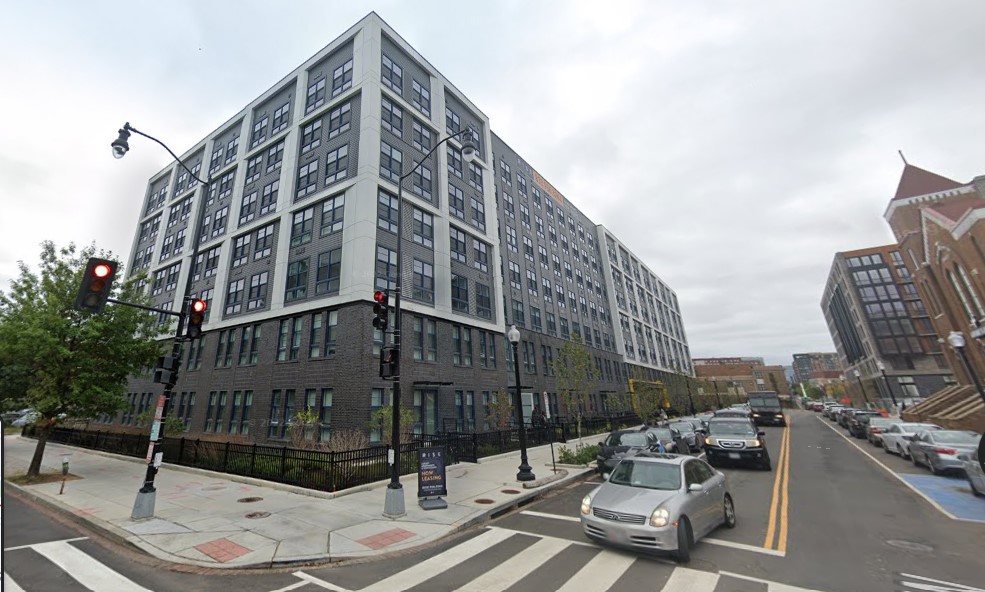
When Nathan Brown and his family left Temple Courts in 2008, D.C. officials promised that they would eventually be able to return to the public housing complex at the corner of North Capitol and L Streets NW — though it would be fully rebuilt. But as construction stalled and little remained other than a parking lot, Brown’s family slowly lost hope.
“After every year passed and mayoral administrations changed and more affordable housing was knocked down in the District, it seemed like just another empty promise,” he said.
Brown, now 38, finally returned to Temple Courts on Monday for a ribbon-cutting of the new seven-story, 220-unit building called The Rise at Temple Courts, the first phase of the broader redevelopment plan of the area known as Northwest One into a mixed-income community — a project that will eventually replace all of the 211 units at Temple Court that were demolished.
“Man, this is stellar. It’s beautiful. I can’t believe I’m seeing something so nice for former residents to return to,” said Brown.
D.C. officials say that of the 65 units set aside for former Temple Courts residents, 61 are now occupied and the remaining four are in the process of being leased. That alone is good news for the project, one of four across the city that are part of the New Communities Initiative — a decades-old push to replace dilapidated public and subsidized housing with mixed-income residential complexes while giving former residents the right to return.
The initiative dates back to former mayor Anthony Williams and was authorized by the D.C. Council in 2006, but it faced a cascade of delays and obstacles ranging from the 2008 recession, to skepticism from residents worried that they wouldn’t be able to return, and legal battles over the fate of some parcels of land. For years, little or no progress was made on any of the four sites: Park Morton in Ward 1, Northwest One in Ward 6, Lincoln Heights in Ward 7, and Barry Farm in Ward 8.
Slowly but surely, though, hints of progress are being seen. The first phase of the Park Morton redevelopment recently received financing needed to proceed, and in September the city broke ground on the first new building of the Barry Farm redevelopment. Further construction is planned on the Northwest One site, which will eventually have 700 mixed-income rental units.
Still, D.C. officials conceded on Monday that the New Communities projects, as well as other construction or redevelopment projects involving affordable housing, can often get bogged down, imperiling the ability of residents to come back.
“It’s a fair criticism,” said Mayor Muriel Bowser. “We have been very focused on eliminating parts of the process that we don’t need, making sure that we have the funding in place that we can acquire the land, that there has been community involvement and input into the planning and design, making sure that the entitlements are in place before residents start to move out. We can’t always anticipate everything that will happen.”
“People have been moved out for a long time. They live somewhere else, they don’t always see themselves coming back, or they’ve changed where they want to live or how they want to live,” she said.
Brown is one of those. While he initially assumed he would return, and helped organize to ensure that other residents would be able to, he eventually decided that he wants to pursue home ownership instead. “That was my whole agenda, making sure people could return,” he said.
Still, the New Communities Initiative has remained controversial. Some critics say that it isn’t offering as much needed affordable housing as is necessary, and others worry that the focus on mixed-income communities is a cover for gentrification and displacement. That concern has tied into broader criticisms alleging that Bowser has cared more about economic development than building housing for low-income residents, though city officials say she has invested more in the construction of affordable housing than any mayor before her.
Last week, Attorney General Karl Racine said Bowser and the D.C. Housing Authority, which manages the city’s stock of 8,000 public housing units and has recently come under fire for how it manages and maintains them, were “sacrificing public housing for the sake of development.” His criticisms came ahead of a Tuesday vote in the D.C. Council on a bill from Bowser to dissolve the authority’s current 13-member board and replace it with a smaller nine-person “stabilization and reform” board to address deficiencies highlighted by a scathing federal audit made public in October.
On Monday, Bowser called the bill’s passage “critical” to the Housing Authority’s future. Brenda Donald, the authority’s executive director, echoed Bowser’s assessment. “I basically need three things: I need an amazing team, I need resources, and I need a supportive board. I have two of those three things right now,” she said.