 Esther Ciammachilli
 Tyrone Turner
 Ayan Sheikh
The whistle starts 16-year-old Maya Werbow’s first wrestling match ever. Her teammates cheer her on from the bench.
Donning protective headgear and her black Jackson-Reed High School uniform — called a singlet — Werbow tumbles with her opponent, each trying their hardest to pin the other. Wrestlers are classified by weight. At 98 pounds, and not quite 5-feet-tall, Werbow is small – even for a girl.
Sadly, her first match ended in defeat. But she said the match was just a starting point for her.
“It was good. It was better than I thought it was going to go. I thought that it’d be one round and I was out. And I think that I can definitely improve for future times, but this was a good first match,” Werbow said.
She is one of two girls on Jackson-Reed’s wrestling team, which means there may be times when she’ll have to wrestle against a boy. It’s something Werbow trains for now. “Well, for one thing in practice, if there’s not girls to wrestle, I wrestle the guys who are much heavier than me.”

DCPS was set to relaunch wrestling in 2020, after about a 30-year absence. But as many stories go these days, the pandemic got in the way. Wrestling comes back to DCPS at a time when it is deemed one of the fastest growing sports among girls in the U.S.
The restart was a joint effort between the school system and the non-profit Wrestling to Beat the Streets D.C., said Geary Fitzpatrick, president of the organization, which works with local schools to introduce wrestling as an after-school activity.
“We felt the most efficient way to affect the most kids was to put it back as a varsity sport in the public high schools. And we did that by purchasing all the mats, the equipment, the headgear, shoes, and everything to get them up and running,” Fitzpatrick said.
And in turn, DCPS provides the infrastructure like hiring referees, providing transportation, access to schools and other wrestling facilities, and insurance policies.

The District’s program feeds a growing movement of girls wrestling in the U.S. The National Wrestling Coaches Association reports that in 2010, there were only around 6,000 girls involved in wrestling. As of 2020, there were more than 28,000.
Tela Bacher was a member of the first women’s Olympic wrestling team at the 2004 Summer Games in Athens.
“Girls like to join wrestling and they kind of fall in love with it,” she said. Now she’s with the organization Wrestle Like A Girl, which works to increase girls’ access to the sport. “[Wrestling is] something that helps girls develop physical confidence, self-confidence, just really owning your mind, and your body, and your voice, and your space.”
As girls grow into women, they also have more opportunities to wrestle at the college level. Bacher said when she went to college in 2001, there were only four women’s programs for her to choose from. Today there are more than 100 women’s wrestling programs, including one at the University of Maryland, Baltimore County.
Bacher added that girls wrestling against boys has its advantages. She thinks back to when she started wrestling as a teenager in Alaska.
“If girls were only wrestling girls at that time, I would’ve hardly been able to wrestle. Wrestling boys gave me an advantage to be able to have time on the mat and challenge myself against people, many different people, who physically challenged me and technically challenged me.”
There are a handful of girls like Maya Werbow wrestling for high schools in the District. Several boys on the Jackson-Reed wrestling team told WAMU/DCist that they like having teammates who are girls.
Sixteen-year-old Duncan Stadler said it’s nothing new to him. He’s been wrestling on teams with girls for a few years. He said he recognizes some people might think that boys and girls shouldn’t be on the same team together. “I think that they’re not very open-minded. I think that it’s just an outdated idea,” he said.
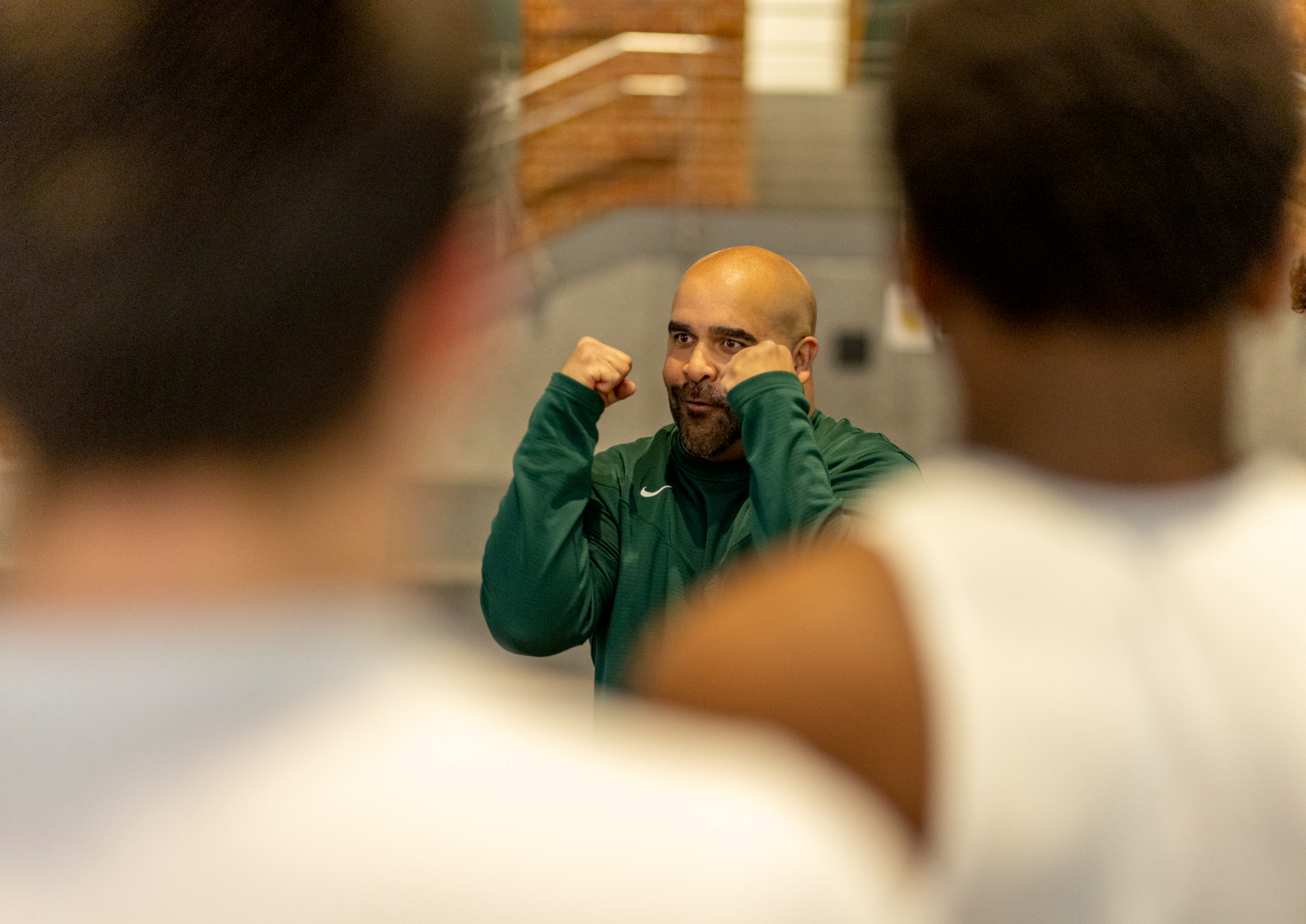
Jackson-Reed wrestling coach Archie Hogan said when it comes to training his wrestlers, he treats them all the same. The main factor in wrestling isn’t gender, but rather size, skill, and ability.
“Gender is a social construct but bone density is real,” Hogan said. “I try to train all my kids to be the best in their weight no matter what their gender is. Some of the girls take pride in beating boys and I want them to do that.”
There are some parochial schools in the D.C. region that don’t allow their boys to wrestle against girls, Hogan said. In those cases, the school would have to forfeit that match and the win would go to Jackson-Reed.
This years marks the 50th anniversary of Title IX, the landmark law that bans sex-based discrimination in public school sports programs. Title IX requires schools to allow girls equal access to a sport, even if a girls’ team is not available. That means girls must be allowed to try out for boys’ teams if there is no girls’ team. However, that doesn’t mean girls are guaranteed a spot on the team.
Tela Bacher with Wrestle Like A Girl became familiar with Title IX at a very young age. In middle school, Bacher went to her school’s wrestling coach and asked if she could try out for the team. The coach turned her away. She told that to another teacher of hers, who then told her about Title IX.
“I did a little research and I realized, ‘Oh. This is the law. You have to have equal opportunity for girls in sports,’” she recalled. “So, I wrote a letter to my school board and I said, ‘Please let me wrestle. I don’t even know if I’ll be any good. I just want to try. There’s this law called Title IX, and I don’t think that you can tell me that I can’t wrestle.’”
And she was right. They allowed her to practice with the team. But she couldn’t compete, which was good enough for her at the time, she said.
Many school systems don’t have the resources to launch separate wrestling programs for boys and girls. And without the co-ed option, Bacher says, girls like Werbow wouldn’t have the opportunity to wrestle at all.
Werbow said she has no plans to continue wrestling after high school, but for now she’s going to continue develop her skills in the sport with Jackson-Reed.

This story originally appeared on wamu.org