Elliot C. Williams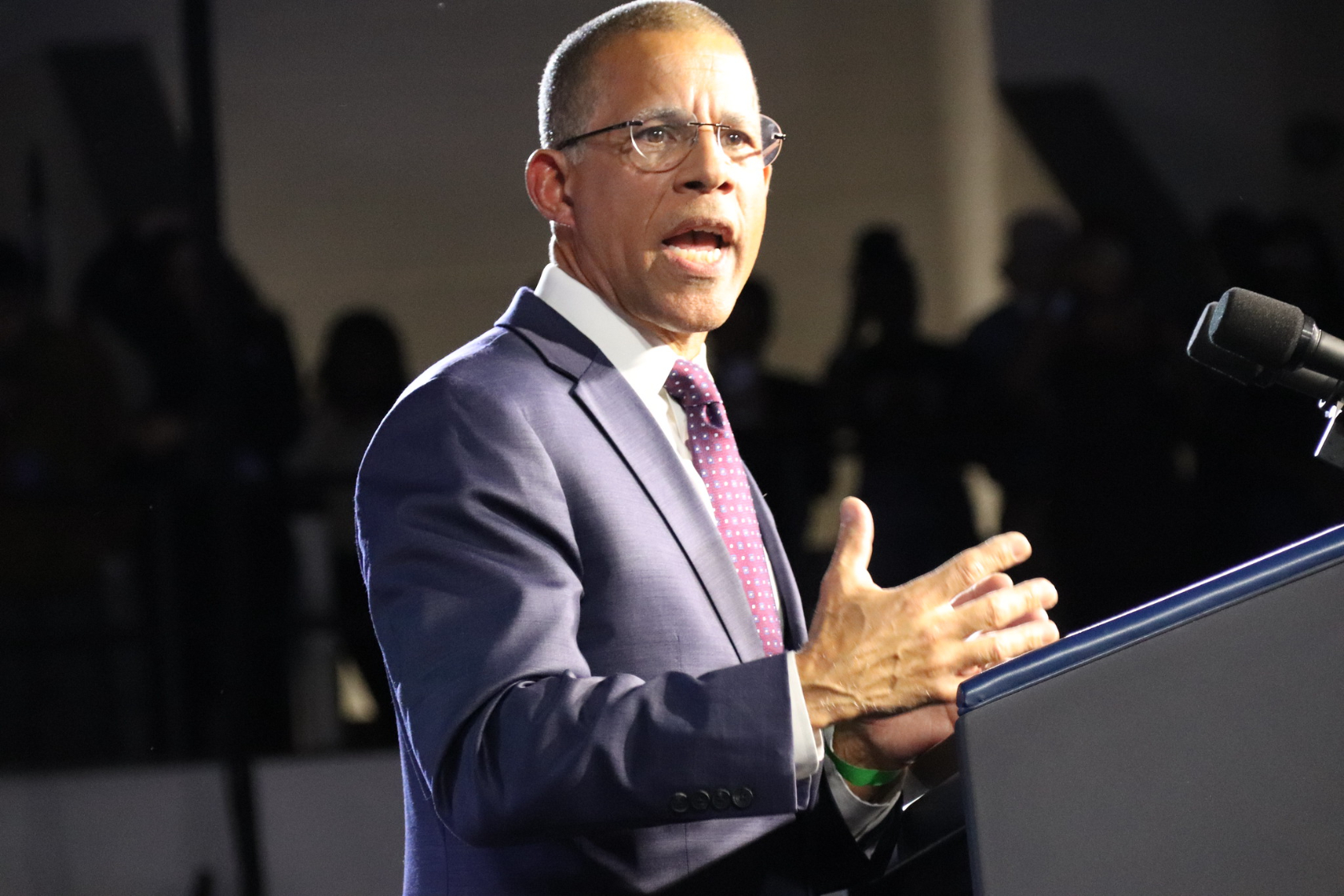
Tuesday marked a notable first for Maryland politics: Maryland’s Attorney General Anthony Brown took office, making him the first Black person to hold the role.
“It is not lost on me that I am the first African American to hold this office and to assume this awesome responsibility,” Brown said in remarks at his swearing in ceremony Tuesday afternoon. “And I do so at such a critical moment in our nation’s history — a moment when extremist views are challenging our democracy and curtailing fundamental rights, and our economy is failing some while rewarding others.”
Brown’s oath is one of several big changes in the state’s leadership. A woman will be comptroller for the first time, and the state’s first Black governor will take office later this month.
But some things will stay the same: Angela Alsobrooks has begun her second term as Prince George’s County Executive, and Marc Elrich will do the same in Montgomery County. Both are Democrats.
Brown, a 61-year-old Democrat, most recently served as the representative for Maryland’s 4th Congressional District, a position he held for five years. He was a member of the Maryland House of Delegates from 1999 to 2007 before spending two terms as the state’s lieutenant governor. He lost to Republican Larry Hogan in the 2014 gubernatorial race. The Harvard-educated lawyer from Huntington, New York, served in the Army and Army Reserve as a young man.
As the state’s top law enforcement officer and the first Black person in the role, Brown has said he plans to focus on justice and equity, abortion rights, background checks for gun purchases, voting access, and decriminalizing marijuana at the federal level. He’s also advocating for legislation that would allow him to sue companies and individuals who break civil rights laws, something the D.C. attorney general’s office does frequently. Employers or landlords who practice any forms of bias and discrimination should be held accountable, he told The Washington Post.
In his swearing in speech, Brown said he will immediately ask the governor and General Assembly for higher salaries for law enforcement employees, and more funding for investigations and training. He also said he’ll partner with the General Assembly, governor, and community to address the “over incarceration of Black and brown men,” pointing out that Maryland incarcerates more Black men than any other state. Brown said he plans to enact police reform and address the history of race and policing.
“I fundamentally reject the idea that keeping our community safe and pursuing ethical policing are somehow mutually exclusive,” Brown said. “We can, and we will, do both.”
To emphasize his point, he shouted out his leadership team, all three of whom are women: Candace Lanham as his chief deputy; Carolyn Quattrocki; and Zenita Hurley, chief of the newly-created Office of Equity, Policy, and Engagement.
“The pursuit of equity and justice is where we in the Office of the Attorney General stand every day, and it’s where I’ll stand until my last day as your attorney general,” Brown concluded.
In nearby Prince George’s and Montgomery counties, meanwhile, two new sheriffs are taking office.
Maxwell Uy, 50, already began tenure as the first Asian American sheriff in Montgomery County — and possibly the state. He ran unopposed after the three-term incumbent, Darren Popkin, stepped down. A native of Fremont, California, Uy has been with the sheriff’s office for nearly three decades, according to an interview with the Post, having joined at age 21.
As sheriff, he now oversees the law enforcement arm of the state’s judicial system, so he manages operations like evictions, court security, and the transportation of incarcerated people between jails. He told the Post the biggest issue he faces in his new role is staffing, “by far.” The office is short 16 sworn deputies, he said, and recruitment has been difficult.
Prince George’s County also has a new sheriff, John D.B. Carr, who has 20 years of experience with the office. The 45-year-old Prince George’s native took over after the previous sheriff, Melvin High, died in November, just weeks before his expected retirement. Carr’s campaign focused on fighting domestic violence, cracking down on violent offenders, and solving mental health issues in the community, according to an interview with the Post: “A lot of times you really don’t see the sheriff’s office in the community because we’re the arm of the courts,” he said. “I want to make sure that we’re definitely involved in the community.” Carr was sworn in last month.
Wes Moore, Maryland’s first Black governor, will be sworn in on Jan. 18 in Annapolis. Brooke Lierman, the new comptroller and the first woman to serve in that role, will be sworn in on Jan. 16.
Montgomery and Prince George’s counties also swore in their new councils in December, including more than a dozen new councilmembers.
The Maryland General Assembly will convene for its 2023 legislative session from Jan. 11 to April 10. In the week that proceeds the session, state lawmakers are frantically engaged in fundraising, even though the next election is nearly four years away, Maryland Matters reports. At least 45 state politicians have campaign events on the books, since they’re banned from fundraising during the three-month session.
New laws have taken effect in Maryland, including the decriminalization of marijuana and an increased minimum wage — $13.25, up from $12.50 an hour, for businesses with 15 or more employees. The minimum wage will bump up again in 2024.