 Jordan Pascale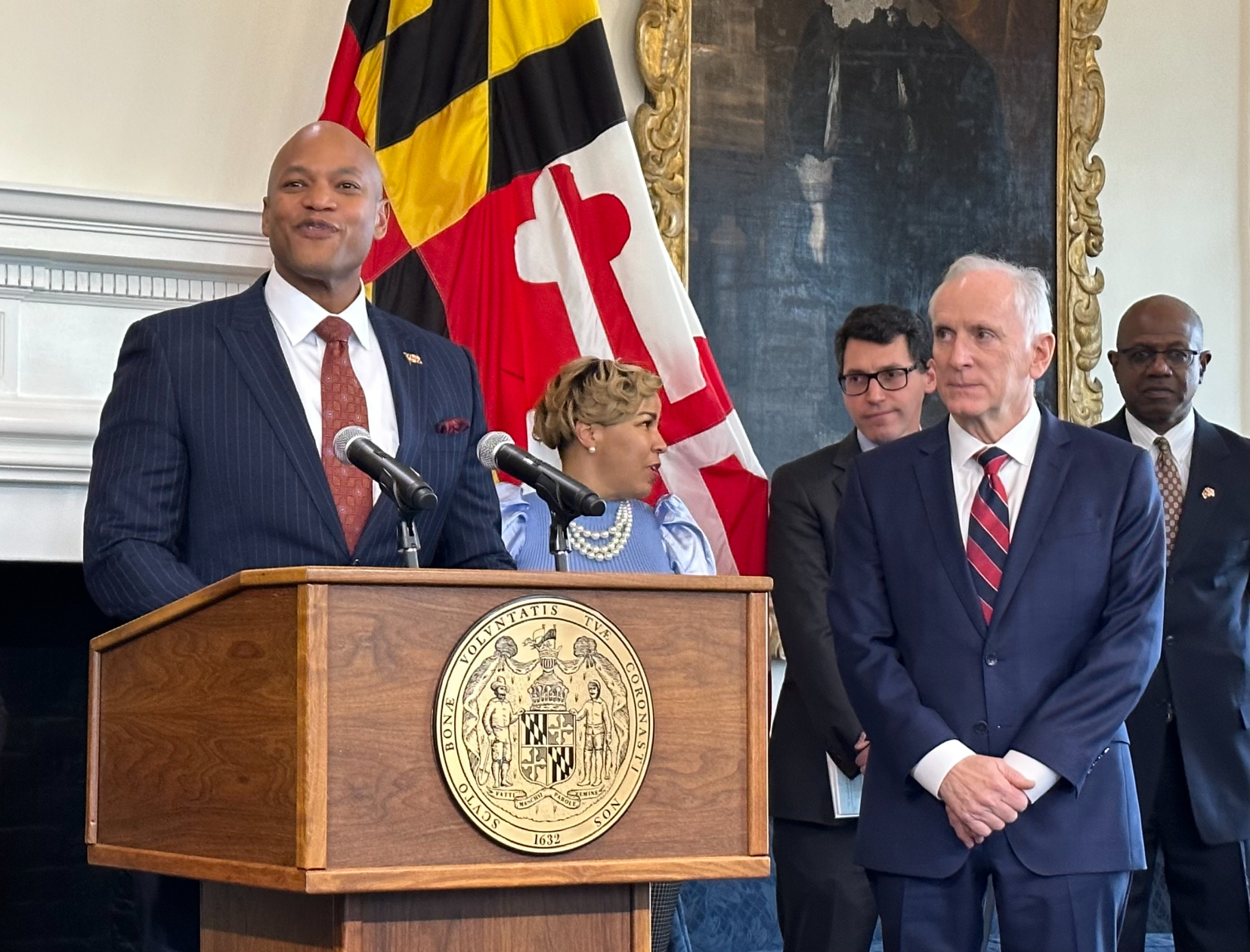
Paul Wiedefeld is Maryland’s next transportation secretary, new Governor Wes Moore announced Tuesday afternoon during a statehouse press conference.
The former Metro general manager, executive director of Baltimore/Washington International Airport, and Maryland Transit Administrator, will be head of the six transportation agencies under the Maryland Department of Transportation. DCist reported Wiedefeld’s imminent announcement on Saturday. His appointment will need to be confirmed by the Maryland Senate.
In brief remarks, Wiedefeld said he and the Maryland Department of Transportation will “work in partnership and in transparency with communities.”
“We are here to serve as a department that delivers services and facilities to meet (Moore’s) goals of social equity, environmental protection, and sustainable communities, and most importantly, a department that enhances the economic opportunities for all the citizens of Maryland.”
In a phone interview Tuesday night, Wiedefeld, 67, says he wanted the job because he values public service and comes from a family of public servants. “It’s sort of in my DNA,” he said.
He said his vision for transportation in the state also closely aligned with Moore’s, citing equity, environment, engaging with communities, and getting things done on time and on budget. Wiedefeld also was excited about working with six different transportation departments with different types of challenges. He said he’d be a “hands-on, walk-around-type” manager that likes to work closely with department officials and front-line workers to understand issues from top to bottom.
Wiedefeld didn’t divulge much about the next steps for the region’s two biggest projects, the Purple Line light rail and the I-495/I-270 toll lane project. He said he needs to get more familiar with the details of each project before sharing his perspective.
“We’ve got to get it built and get the schedule back tight and get the budget tight,” he said of the Purple Line. As for the toll lane project and the Red Line project in Baltimore, he said he’ll have to be a quick study. “We’ll get on those pretty darn quick.”
Wiedefeld’s background, vision fit job
Last May, Wiedefeld resigned from Metro earlier than his planned retirement after it was discovered that the transit agency had not kept current on rail operator safety training. In October, he took a job at HDR, a construction design firm, as director of the transportation practice in the Northeast U.S.
He was head of WMATA for six years, shepherding it through some of the agency’s roughest times, including years of painful track shutdowns and infrastructure rehabilitation, a pandemic that decimated ridership, and safety issues like a derailment of one of Metro’s 7000-Series trains in October 2021. As a result, Metro’s oversight body forced all the series off the tracks, which represented 60% of the fleet. This led to severe service shortages.
At the time, Wiedefeld said he wasn’t told about the issue and that it didn’t rise above middle management because it was treated as a wheel warranty problem, not a safety problem.
Asked about the safety concerns at Metro, Moore said he and his team fully vetted the pick. He noted that Wiedefeld would be able to move with speed to evaluate every single transportation project in the state.
“We believe firmly and deeply that Paul is a person that’s going to help us, that can help lead us here,” Moore said. “We’ve done our diligence in our vetting and are excited to move forward with Paul as our secretary.”
As transportation secretary, Wiedefeld would be in charge of several high-profile transportation problems in the capital region. The Purple Line light rail project is years behind schedule. The I-495/I-270 toll lane project is in limbo and it’s unclear what its fate will be. He would also likely be key to reviving the Red Line in Baltimore, which Moore has signaled he wants to bring back after former Gov. Larry Hogan killed the project years ago.
“We know that in this moment, it’s not just that progress matters, it’s that accountability matters,” he said. “So from the recent cancellation of the Red Line to the massive delays on the Purple Line to MARC (commuter rail) service disruptions that happened just the past week, it is increasingly clear that we need real changes if our transportation system is going to live up to its true potential.”
The Metro boardroom could also become an interesting scene. Wiedefeld, as Maryland’s transportation secretary, would be one of eight representatives on the board. This means that Metro’s current General Manager Randy Clarke would report to his predecessor. Clarke has been trying to refresh Metro’s image and bring people back to using transit in recent months.
Wiedefeld said he thought he could bring a unique perspective to the board given his background. He also thought he could help Clarke “get some things across to the board” since he also has the background of a former general manager.
“I also think I can challenge the organization to do things better because, like everything else, when you stand back a little bit further, you see things differently, right?” he said. “So I think that’s a value to the agency and a value to the region.”
Wiedefeld may also be a key cog in figuring out Metro’s financial future. With ridership declining, the transit agency may have to lobby the Maryland and Virginia legislatures, D.C. Council, and Congress for dedicated operating funds in the future.
Public officials praise the choice, but some residents aren’t so sure
The announcement drew near-universal praise from public officials, despite Wiedefield’s unceremonious exit from WMATA.
Montgomery County Council President Evan Glass, who also chairs the transportation committee, says Wiedefeld’s institutional knowledge of public transportation and in-depth understanding of regional transportation challenges and needs “make him an ideal nominee for this position.”
“I look forward to working with Gov. Moore and Wiedefeld on a holistic approach to relieving traffic congestion in our County and across the Washington metropolitan area,” he said in a statement.
Metro’s union president, Raymond Jackson of ATU Local 689, said at the press conference that he considers Wiedefeld a friend. He noted a rough start with Wiedefeld — the two tangled over union contracts — but over the years they were able to work things out. He recalled late-night phone calls during the pandemic with Wiedefeld, making plans to keep workers safe. Only five of Metro’s 13,000 workers died during the pandemic.
“I would put those numbers up against any in the country,” he says.
Delegate Marc Korman from Montgomery County also emphasized Wiedefeld’s resume and Maryland background.
“He will lead with multi-modalism (and is) working for a governor who wants to partner (with the community),” Korman said.
Former Montgomery County Council President and current Washington Suburban Transit Commission Vice Chair Tom Hucker said Wiedefeld is “the ideal choice to lead Maryland’s transportation network into the future.”
“He combines a profound understanding of the current agency with a contemporary appreciation of the urgency of climate, equity, and economic development,” he said. “He has the experience we need to modernize MDOT into an engine to create jobs, wealth, and equity by connecting Marylanders to hope and opportunity every day — whether they get there by foot, bike, bus, rail, or airplane.”
Hucker worked with Wiedefeld to end turnbacks on the Red Line and said he looks forward to working with him on the Commission, which acts as a liaison between the state, Prince George’s County, Montgomery County, and WMATA.
The Greater Washington Partnership, a multi-state large business group, said they are encouraged by the appointment.
“As the Greater Washington Partnership continues to push efforts to enhance regional mobility, and infrastructure and strengthen Maryland’s transportation system, we are encouraged by Maryland Governor Wes Moore’s appointment of Paul Wiedefeld to serve as Maryland Secretary of Transportation,” CEO Kathy Hollinger said in a statement. “Mr. Wiedefeld led WMATA during some of the organization’s most challenging times.
“There has been tremendous collaborative momentum with our Maryland leaders as we work to create a safe and reliable transportation network in our region. We look forward to working with Mr. Wiedefeld in his new capacity.”
The reaction from people on Twitter was less receptive, with several saying they didn’t approve of the job he did at WMATA, so he doesn’t deserve a higher-profile job.
This story has been updated to include quotes from Wiedefeld and Governor Wes Moore from today’s press conference.