Colleen Grablick
Solar panels are coming to more than 500 homes in Ward 8 — an investment the city’s energy officials say will reduce both greenhouse gas emissions and residents’ utility bills.
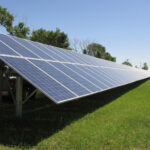
DC Green Bank, a city initiative that finances clean energy projects, announced the investment on Thursday, which will funnel $12.4 million into the installation of 2.2 megawatts of solar energy at four D.C. affordable housing properties in wards 5 and 8.
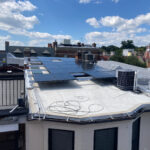
Rooftop solar panels will be installed at the Arbor View complex located near United Medical Center and at the Randle Hill apartments in Congress Heights. Meanwhile, solar carports and new electric vehicle charging stations will come to the Overlook at Oxon Run in Ward 8 and the Edgewood Commons in Ward 5. Construction is expected to be complete by the end of 2023, according Gary Decker, the director of strategic engagement at DC Green Bank. In addition to an estimated yearly reduction in greenhouse gas emission of roughly 1,8000 tons of carbon dioxide, the project will offer residents at the 536 units a 25% discount on their electric bills.
The four properties are managed by Enterprise Community Development, an affordable housing nonprofit. Enterprise will foot the bulk of the project’s bill, while DC Green Bank is supporting $3.75 million in construction costs.
“We know that a clean, renewable, and affordable future for the District will require portfolios of projects like this to be replicated citywide,” Brandi Colander , chair of the DC Green Bank Board of Directors, said in a statement Thursday.

The investment is the latest in a series of projects spearheaded by DC Green Bank since it was established by the D.C. Council and Mayor Muriel Bowser in 2018. It’s also another effort to transition the city’s energy to more renewable options while not leaving behind low-income residents, for whom solar options are often too expensive. (According to the Solar Energy Industry Association, the price of installing solar panels on average-sized home in the U.S. is around $20,000.)
“Not many residents can afford to put solar on their roof,” Jean Nelson-Houpert, DC Green Bank’s interim CEO and chief financial officer, told DCist/WAMU. “For residents in affordable housing, [solar] would be even more prohibitive, so financing projects like this helps these communities that would’ve been left behind.”
In 2021, the publicly funded bank financed the addition of solar panels to six condos in D.C.’s Hillcrest neighborhood, along with funding from a renewable energy developer and D.C.’s Department of Energy and the Environment. Last year, DC Green Bank announced various investments across the city, including a partnership that would provide loans to small businesses using clean energy, a $500,000 project to revamp energy systems at Ward 2’s Shiloh Baptist Church, various other residential projects that would bring solar energy to D.C. homes.
The bank’s investments come as one avenue toward Bowser’s lofty goal of making D.C. carbon-neutral by 2050, meaning there’s no net release of carbon in the atmosphere. The bank, which received $20 million in city funds last year, also assists with Bowser’s Solar For All program, aiming to make solar options affordable (read: free) to renters and residents living in multi-family units. Her goal is to make solar energy available to 100,000 low-to-moderate-income families in the next 10 years. (To be eligible for Solar For All, residents must have a household income at 80% of the area median’s income. So far, the program has added solar to 9,000 homes, and cut their electric bills in half.)
Meanwhile, in December the D.C. Council passed its own solar energy bill, despite criticisms that the legislation would burden low-income residents of color. The Local Solar Expansion Act increases the amount of local solar required by law in the city. Previously, 10% of D.C’s electricity was required to come from local solar by 2041; the bill upped that requirement to 15%. It also added a penalty that electricity providers must pay if they miss that target. A racial equity assessment of the legislation claimed that the bill would up residents’ electric bills by $4.50 over the next five years, prompting concerns that the move would largely benefit wealthy homeowners, who could access solar at cheaper rates, and increase their home value. However, one provision of that bill stipulated that the funds generated by out-of-compliance penalties would be funneled into the Solar For All program, as well as the city’s energy assistance trust fund, that helps low-income residents pay utility bills.
The issue of funding solar energy while not excluding low-income residents or residents of color — those who bear the worst impacts of climate change — is not a problem unique to D.C. Montgomery County established its own Green Bank in 2015, designed to be a local non-profit that would use public dollars to fund private investments in renewable energy projects. (Across the U.S., green banks work similarly to regular banks, using public or quasi-public money and lending those funds to investments in private sector clean energy construction.) In February 2022, the Montgomery County Council passed a bill that would use 10% of the money generated from an energy tax to fund the Green Bank, with a stipulation that a certain percentage of those Green Bank funds go toward projects in low-income neighborhoods or other areas with high populations of minority residents.
Nelson-Houpert of DC Green Bank hopes that by making investments in affordable housing units, the bank can serve as a model for other financers and lenders — even those that aren’t quasi-publicly funded with the express purpose of boosting renewable resources — to consider funding solar options.
“When we look at the District, we don’t have a lot of land space — it’s a built environment — so getting solar installed on buildings is really a critical mission for us,” Nelson-Houpert said. “There is opportunity for other financiers, other financial institutions, to use this as an example to start funding more solar projects.”
Previously:
A D.C. Council Bill Intended To Increase Solar Energy Divides Environmental Advocates
More Solar Panels Coming To Southeast D.C. Homes
This story has been updated with comments from DC Green Bank officials.