 Jenny Gathright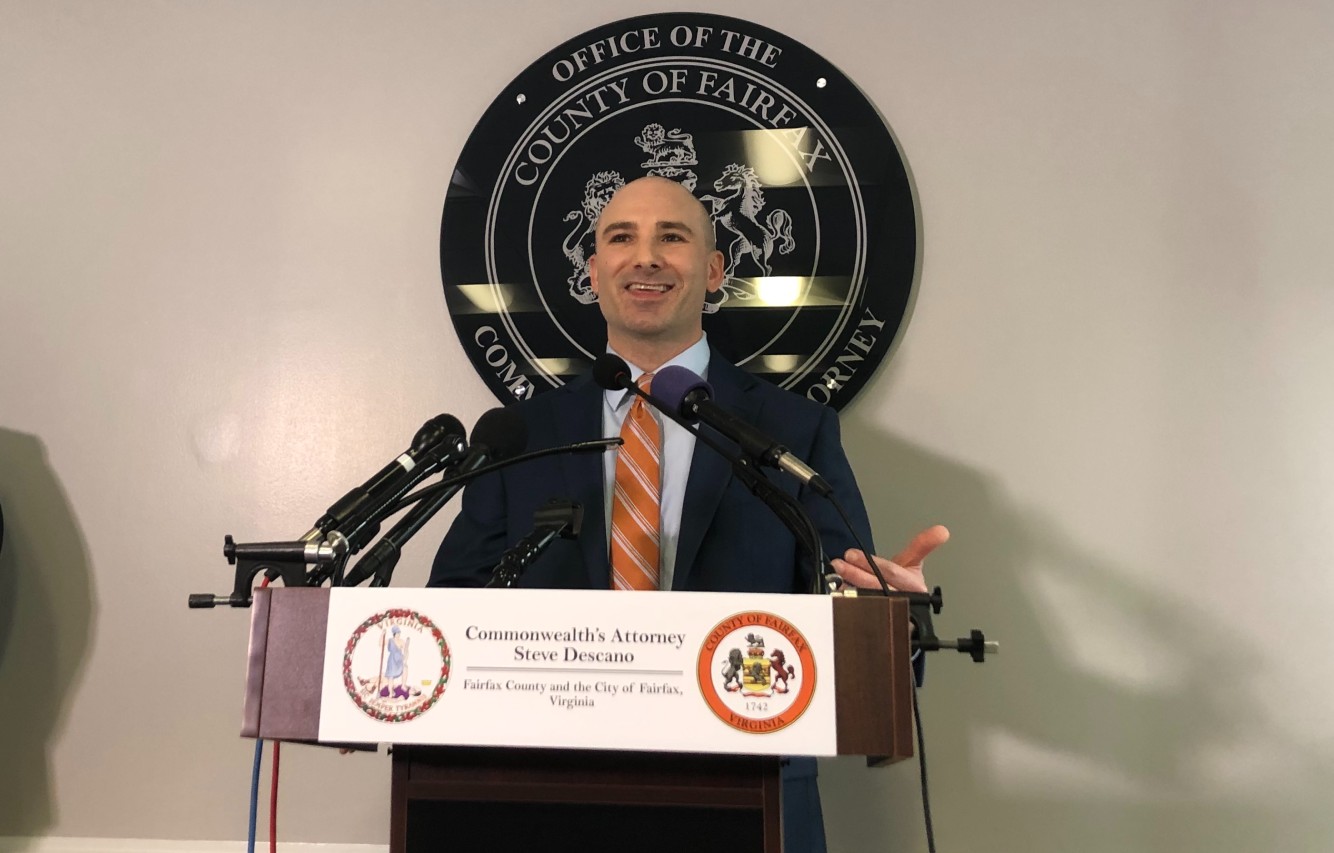
Fairfax County’s top prosecutor says his office is now recommending fewer people sit in jail for minor and nonviolent crimes — and he has the data to prove it.
The data, released Monday morning by the office of Commonwealth’s Attorney Steve Descano, is a follow-up from data released in October. At that time, Descano said he felt the data showed his office could do a better job following its bond policy, which favors release for people accused of nonviolent offenses except in cases where there’s specific evidence that release could be dangerous. Descano’s office says the new numbers show that prosecutors have come closer to meeting that goal: as of the final quarter in 2022, they are recommending fewer people accused of nonviolent crimes be held in jail as they await trial.
Descano says the purpose of sharing the numbers — a new practice in the office — is to provide some more insight into Fairfax prosecutors’ decisions and to allow the public to track whether he is meeting his promises. Descano was part of a wave of self-described progressive prosecutors elected in Northern Virginia in recent years; He campaigned on a platform of justice reform.
“Data is a tool for us as well as the public,” Descano said in a press release. “This new release affirms that data has a real role to play in prosecutorial reform as we continue to build towards an equitable system.”
The numbers show that for people accused of nonviolent misdemeanors — like trespassing, or vandalism — Descano’s office recommended release 63% of the time during the third quarter of the year. The data released Monday shows that for the fourth quarter, that percentage rose to 86% — a 23% increase. In the last three months of 2022, prosecutors started recommending release more and more often for these types of minor offenses. In September, for example, prosecutors asked for release 64% of the time. By October, that number was 80%. And in December of 2022, prosecutors recommended pretrial release for 95% of people accused of a nonviolent misdemeanor.
For people accused of nonviolent felonies — which include minor theft cases and drug possession cases — Fairfax prosecutors recommended release 63% of the time in the last quarter of the year – a 12% increase from the previous quarter.
When the first round of data was released in October, the county’s lead public defender told the Washington Post that she was disappointed by the numbers on nonviolent misdemeanors. While the data showed Descano’s office was recommending release for the vast majority of nonviolent misdemeanors — 77% of them — it showed that prosecutors were still recommending detention 23% of the time. Meanwhile, judges opted to detain people only 18% of the time (though they also asked for cash bail in exchange for release in 9% of cases. It’s unclear for the available data how many of these people were able to pay and were released, and how many remained in jail because they couldn’t pay). “Our judges are more progressive than a progressive prosecutor’s office,” she told the outlet.
But the new data shows prosecutors are now more aligned with judges in terms of the percentage of these cases where they recommend detention: judges and prosecutors agree on who to release pretrial about 80% of the time. Ten percent of the time prosecutors recommend release for a person the judge wants to detain, and another 10% of the time prosecutors are still the stricter party, recommending detainment in cases where a judge decides to release.
The release of the data also comes as Descano’s reelection campaign is underway. He faces a primary challenger, and attacks from both sides of the political spectrum: Public defenders and advocates for criminal justice reform have said his reforms have not gone far enough, while his conservative critics have argued that his office has been too lenient on crime.
In Virginia, a combination of parties – magistrates, judges, prosecutors, and defense attorneys – weigh in on whether someone accused of a crime should be detained in jail as their criminal case proceeds. Ultimately, a judge makes the final determination about pretrial detention. But prosecutors’ recommendations carry significant weight, and advocates for criminal justice reform say that prosecutors have a leading role to play in reducing jail populations. Studies have found that even short periods of jail time can dramatically alter people’s lives and make them more likely to touch the criminal justice system going forward — which is why many advocates are pushing prosecutors to use their discretion and not recommend pretrial detention in cases where people are unlikely to pose any risk to the public.
When his office released the October data, Descano acknowledged that his office was “not where we want to be” when it came to some of his promises. He felt the data showed prosecutors under his purview were recommending pretrial detention more than necessary for nonviolent offenses.
In an interview, Descano said that in the last quarter of the year, the office made a concerted effort to retrain its prosecutors and make sure they were adequately assessing the real risk that people posed to public safety when making recommendations for pretrial release.
“If you have a policy and you see data that may not be matching up, what you want to do is train around that policy to see if it’s adherence to the policy or if it’s the policy itself,” Descano says. “What our numbers are showing is that it wasn’t the policy itself [that was the problem] — it was just making sure that people were being faithful to the policy.”
Advocates for releasing more people pretrial argue that holding people in jail unnecessarily is both expensive and unjust — and tends to disproportionately burden people who are poor or people who struggle from addiction. But there are proponents of a system that favors more pretrial detention, including those who argue that it helps deter crime and ensure that people show up for court. Evidence in D.C., which hasn’t had cash bail for decades and releases the vast majority of defendants pretrial, shows that people who are released overwhelmingly show up for court and do not reoffend.
Descano says he believes less pretrial detention for minor offenses makes the county safer.
“If somebody is held unnecessarily, it’s certainly not going to keep the community safe because that person’s eventually going to get out, and they’re going to be in a worse place, and they’re more likely to commit crime,” Descano says.
In the nonviolent cases where Descano’s office does recommend pretrial detention, there’s usually more context to consider, he says. For example, sometimes there’s evidence that someone may be “walking down the path towards violence,” because they may have violated protective orders and there may be domestic violence concerns.
For people accused of violent crimes, prosecutors’ recommendations remained similar to the third quarter of the year. During Q4, the office recommended that 75% of people accused of violent felonies remain in jail ahead of trial. And they recommended pretrial detention for 88% of people accused of sex offenses.
While conservative critics of Descano’s have argued that his office has been too lenient on people accused of violent crimes, violent offenses are the area where there are the most significant differences between prosecutors and judges. For example, in 22% of violent felony cases in the bond dashboard, judges opt to release someone pretrial over the objections of prosecutors.
Overall, across all categories of crime, prosecutors in Fairfax are recommending detention more often than judges actually impose it. About 6% of the time, judges want to jail someone that prosecutors want to release pre-trial. And about 17% of the time, prosecutors want to jail someone that a judge thinks should be released pending trial.
Another distinction between judges and prosecutors in the county is that judges are still imposing cash bail in some cases, even though Descano’s office never asks for it. Prosecutors in Fairfax stopped asking for cash bail two years ago, arguing that the practice exacerbates racial and economic inequality in the criminal justice system. He has said repeatedly that the decision to detain someone pretrial should be based on their potential danger to public safety and not on their ability to pay.
While the data offers a view into prosecutorial decision-making, it only captures a small percentage of offenses in the county — the cases that make it to a bond review hearing. This is because in Virginia, magistrates and judges make the first decisions about pretrial detention before prosecutors get involved in a case, and before defendants have the opportunity to be represented by a lawyer.
Typically, when someone is arrested in Fairfax County, they go before a magistrate – one of the judicial officers who staff Fairfax County’s jail 24/7. Without any lawyers present, the magistrate makes an initial determination about whether someone should remain in jail. Then, they go before a judge at an arraignment, who also makes another decision about whether they should be jailed or released. Lawyers don’t get involved in bond decisions until the next step in the process – a bond review hearing.
This means that the people whose cases are on the dashboard have already likely spent some time in jail by the time they make it to a bond hearing: A magistrate and later a judge likely decided to jail them or set a bond amount they couldn’t pay before they retained an attorney, and before prosecutors got involved in their case.
Descano said it was “frustrating” to him sometimes, “that there is not somebody with our philosophy there right at the beginning at the magistrate’s office to argue for releases in some of these cases.”
But he also acknowledged that magistrates are operating on significantly less information than prosecutors, who have access to a person’s entire criminal history and more information from police by the time they are making release recommendations.
The release of the data comes at a time when Descano’s office has an interest in proving its track record. Like other self-described progressive prosecutors in Northern Virginia, he faces a primary challenger for the upcoming election. The top prosecutors face criticism and challenges from both those who say they haven’t fully lived up to their promises of reform or haven’t been running their offices well, and from others who say the reforms go too far.
In recent years, Descano has been the subject of persistent political attacks from conservative groups and members of Virginia Gov. Glenn Youngkin’s administration who argue he’s too soft on people accused of crimes. For example, he’s one of three prosecutors in Northern Virginia facing a recall effort by the conservative group Virginians For Safe Communities. The group wants to unseat Descano, along with Parisa Dehghani-Tafti and Buta Biberaj in Loudoun, and argues that their policies have made Virginians less safe.
In December, the group sent a letter to Virginia Gov. Glenn Youngkin and Virginia Attorney General Jason Miyares — who has also been a vocal critic of Descano’s — asking them to investigate Descano’s office for potential violations of crime victims’ rights. In their letter, they highlighted cases where victims of crime believed the plea deals struck by prosecutors and defense attorneys resulted in sentences that were too lenient, and cases where victims wanted defendants to receive more prison time.
Descano’s office has pushed back against the conservative groups’ characterization of these cases, arguing that there are many factors involved in criminal cases — and sometimes, convictions are difficult to secure because of other factors, including the quality of police investigations.