Margaret Barthel
The workers at more than two dozen local farmers markets run by the nonprofit FRESHFARM have unionized with United Food & Commercial Workers (UFCW) Local 400.
“With our union, we will have a greater voice in the workplace and the opportunity to collectively address our working conditions, pay and benefits,” the organizing committee said in a statement. “We look forward to negotiating our first union contract with the same energy, unity and camaraderie that made our union possible in the first place.”
Roughly 25 workers who run the markets themselves, not the individual vendor booths, will be included in the new union. The group’s union card drive concluded in December, with a majority of workers calling for a union election, which was conducted last month.
There are 28 FRESHFARM markets around the D.C. region, including more than a dozen in the District, several each in Arlington and Fairfax counties, and one in Silver Spring. The full list is available here.
“We really care about having an equitable food system and caring for our community,” said Ariana MacMartin, one of the new union’s organizers. “I think that the top way we can do that is to ensure that the farmers market managers who are running these farmer’s markets are knowledgeable, professional people who love their job.”
MacMartin is a market manager for three markets in the spring and summer and one in the off-season, a job that includes extensive coordination with farmers, running the market information booth, de-escalating conflicts that might arise, and managing FRESHFARM’s program that doubles benefits for food stamps recipients. She said workers were especially interested in bargaining for better pay and more job stability, particularly given the wide variation in work from season to season — a dynamic that she said results in high turnover and loss of institutional knowledge.
Even in the regular season, she’s taken on freelance work to help make ends meet, and she currently does online work for FRESHFARM and works a service industry job in order to support herself while managing a single market during the winter.
“It’s almost impossible to have a salaried job and also run three markets where two of them are on the weekdays and then one is on the weekend,” MacMartin said.
But she loves the work, which aligns with her values about environmental justice and sustainability and her desire to feed underserved communities in the region.
“In D.C. there’s a lot of racial inequity, and that’s manifested in … having a lot of food deserts and just walking through different regions of DC where, you know, the grocery shelves are empty, where people aren’t getting fresh fruits and vegetables, and we see richer, whiter communities having these well-stocked grocery stores,” MacMartin said. “It’s awful.”
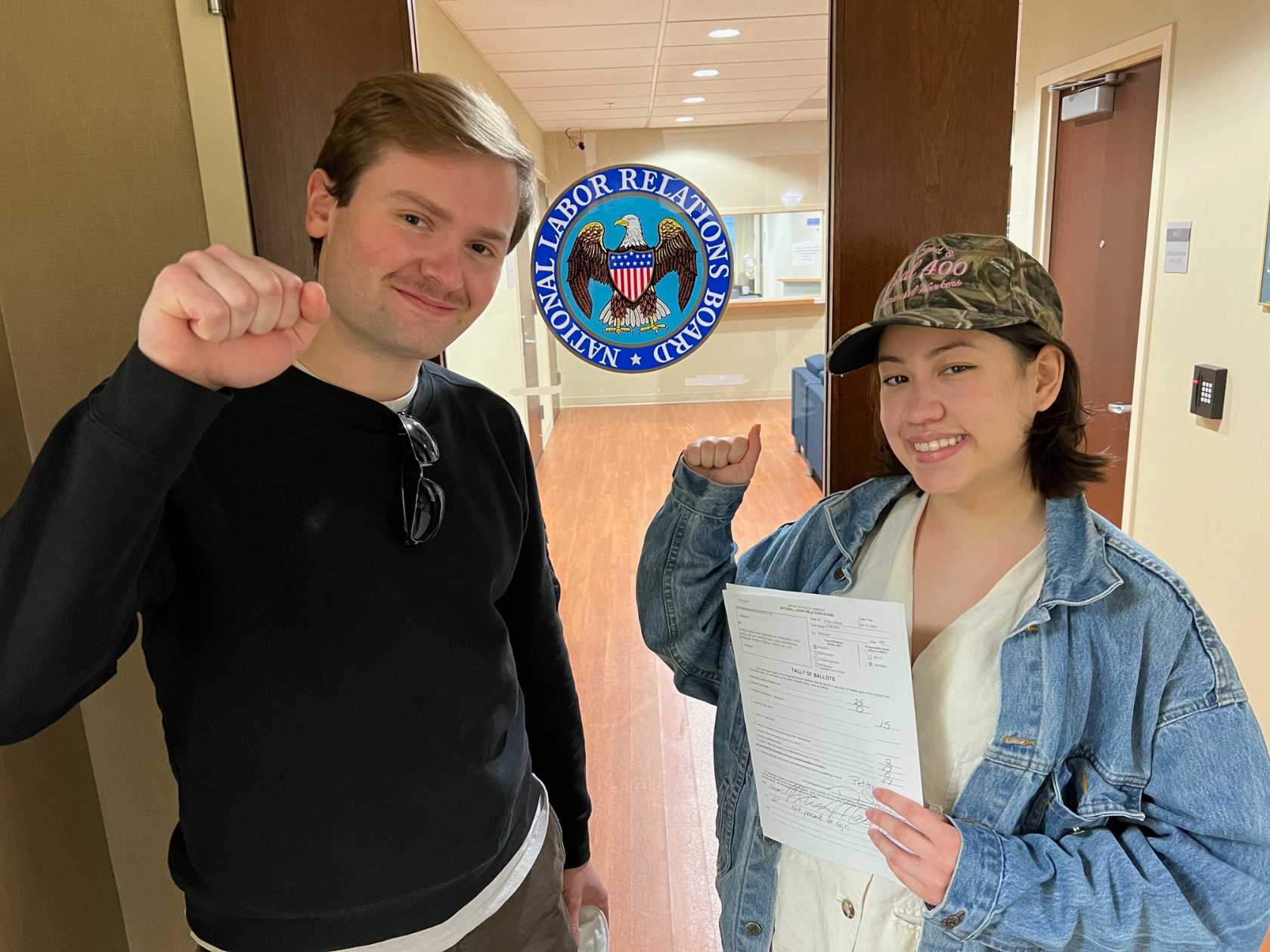
FRESHFARM said in a statement on Instagram that the organization was “pleased” that workers voted to unionize and “enthusiastic about working with a collective bargaining unit committed to our mission and shared values of improving our workers’ conditions.”
“The organization strives to create the best farmers markets in the region, and having a professional, well-trained workforce is front and center of these efforts,” the statement said. “We look forward to strengthening FRESHFARM, increasing equity, and fostering organizational accountability to build a just and sustainable food future for the region.”
MacMartin said she’s encouraged by FRESHFARM’s supportive response — as is Jonathan Williams, the communications director at UFCW Local 400.
“To their credit, the employer has not interfered in the organizing process that these workers have undertaken, and that’s how it should work,” Williams told WAMU/DCist.
UFCW represents 25,000 food and grocery workers and workers in other industries across the Mid-Atlantic, but Williams said the FRESHFARM group is their first farmer’s market to organize — and possibly the first in the country.
“We have done our best to research this and have been unable to find any other farmer’s market workers who have unionized,” Williams said.
The FRESHFARM workers join a wave of new union activity around the D.C. region.
In Northern Virginia, General Assembly legislation passed in 2020 made it possible for localities to approve collective bargaining for their employees for the first time in more than four decades. Since then teachers, first responders, and government employees have been pushing local governments to pass ordinances that create a bargaining process — and some have successfully won contracts — in a region-wide push that could ultimately impact tens of thousands of workers.
Starbucks workers in Northern Virginia have also sought to unionize, some successfully and some unsuccessfully. Staff at D.C.’s prominent independent bookstore, Politics and Prose, won their first contract in September. Workers at several Union Kitchen locations successfully unionized last June, after an ugly fight with their employer. Area universities have also seen some union activity in the last year, with staff at American University and Howard University threatening strikes in an attempt to speed up lagging contract negotiations. (American University holds WAMU/DCist’s license.)
“I think a lot of workers lately have come to realize that unions are not just for people who wear hardhats or work in plants or in black and white photos from the thirties,” Williams said, reflecting on the surge of union activity over the past few years. “Unions are for everybody.”