Colleen Grablick
Metropolitan Police Department officer Reinaldo Otero-Camacho won’t face charges for fatally shooting 31-year-old D.C. resident Kevin Hargraves-Shird in Brightwood Park last summer.
The U.S. Attorney’s Office for the D.C. announced on Thursday that there is “insufficient evidence” to bring federal or local charges against Otero-Camacho, who killed Hargraves-Shird in Ward 4’s Fort Slocum Park last July.
“After a careful, thorough, and independent review of the evidence, federal prosecutors have found insufficient evidence to prove beyond a reasonable doubt that the Sergeant Otero used excessive force under the circumstances,” reads the release from Matthew Graves, the U.S. Attorney for D.C..
Cases of police shootings are automatically referred to the U.S. Attorney’s office for review to determine civil rights violations or criminal charges, after which they are passed to MPD for an internal review and possible discipline. A spokesperson for D.C. police told DCist/WAMU Friday morning that Otero-Camacho is currently on a non-contact status (meaning he cannot patrol or engage with the public), pending an administrative investigation.
Officials originally offered few details about what happened on the afternoon of July 30. In compliance with D.C. law that requires body-worn camera footage from any officer involved in a use-of-force incident to be released within five days, D.C. police released the footage last summer, but admitted it clarified little about the killing. Footage showed Otero-Camcho pursuing a white sedan after a call had been placed to 911 about a shooting of two juveniles minutes earlier at Georgia Ave. and Longfellow Street NW. (At the time, police couldn’t link Hargraves to that 911 call.) The sedan crashed into a curb on Madison Street NW, and the occupants of the car ran into Fort Slocum Park. While still in the vehicle, Otero-Camacho pulled his gun out. He quickly exited the police car yelling “gun, gun, gun, gun,” and almost immediately fired a single shot that killed Hargraves-Shird.
When the footage was first released, D.C. Police Chief Robert Contee stressed that he would not weigh in on Otero-Camacho’s actions because he hadn’t yet been questioned, and because he said body camera footage sometimes does not show something an officer may have perceived to be a threat. A gun was recovered from the scene which officials initially said Hargraves-Shird was carrying, although it was impossible to confirm through the footage. Hargraves-Shird’s friends and family questioned the claim that he was holding the gun, and demanded that police release video from other officers responding to the scene. (Contee refused to release additional footage, as the department is not legally required to do so.)
According to the USAO’s explanation of its investigation, which included a review of police and civilian eyewitness accounts, physical evidence, body-camera footage, radio and foresnic reports, and an autopsy, Otero-Camacho was responding to the call about the shooting at Georgia Ave. and Longfellow Street that afternoon. Based on radio broadcasts and information “known to MPD,” according to the USAO, an individual involved in the shooting fled in a white vehicle. Otero-Camacho observed the fleeing vehicle and attempted to make a traffic stop, the USAO said. He engaged in a chase when the vehicle did not stop, and the car then struck the curb near the edge of Fort Slocum Park.
Three people got out of the vehicle, including Hargraves-Shird, who appeared to return to the vehicle to “look through it for something,” according to USAO. When Otero-Camacho arrived, Hargraves-Shird fled. Otero-Camacho screamed “gun, gun, gun, gun,” and fired one shot, striking Hargraves-Shird in the ear. The USAO’s report says Hargraves-Shird was likely facing Sergerant Otero-Camacho at the time he fired his weapon.
A gun with Hargraves-Shird’s DNA on it was recovered a few feet from where he fell to the ground, according to the USAO, but the report doesn’t clarify where it came from or if Hargraves-Shird was holding it.
The report also doesn’t clarify Hargraves-Shird’s involvement in the shooting that Otero-Camacho was allegedly responding to. The USAO’s explanation also omits that Hargraves-Shird was handcuffed after the shooting before first-aid was rendered, and doesn’t include whether Otero-Camacho issued any warning before firing, other than yelling “gun” multiple times. DCist/WAMU has reached out to USAO and they had no additional comment.
A sister for Hargraves-Shird could not immediatley be reached on Friday morning. His friends and family have described him as a strong family man, who was deeply loved by his children and siblings. He was known for making people laugh, cheering them up, and mentoring kids in the community.
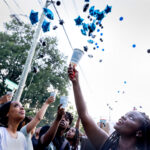
“Kevin was a family man who kept his children, his family very close,” Serena Hargraves, his sister, said at a vigil after his death in July 2022. “He was honest with everyone, who helped anyone… Kevin’s character was hilarious.”
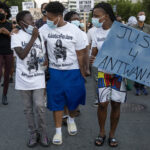
The announcement from the USAO comes two weeks after activists and family members of other residents killed by D.C. police gathered to protest the killing of Tyre Nichols by Memphis police, and demand accountability from local leaders on several local cases still under investigation. Before the protests, which took place downtown, Jay Brown, the uncle of Jeffrey Price, a man who died after being chased by police in 2018, called on the Metropolitan Police Department and the U.S. Attorney’s Office for D.C. to provide updates on cases like Hargraves-Shird’s and An’Twan Gilmore, a 27-year-old man fatally shot by a D.C. officer in August 2021. He told DCist/WAMU officials never responded to that reach out.
Upon seeing the USAO’s determination on Thursday, Brown described his emotions as “triggering.”
“We’ve laid their bodies to rest but we haven’t had the opportunity to lay their souls to rest. It’s like they’re still lingering, looking for us to help provide the justice that we seek, to bring peace,” Brown told DCist/WAMU on Friday. “It’s just fucking hurtful.”
Brown said these investigations need to be conducted by an outside body, rather than the USAO relying heavily on MPD in an investigation to determine if a case will be prosecuted. There also needs to be more transparency provided throughout the investigative process and in its determinations about prosecution, he said. (The USAO does not offer information about cases as they are being investigated.)
“What standards were not met? Educate me,” he said of the USAO’s decision.
He referenced the recent investigation into the killing of 13-year-old Karon Blake, who was fatally shot by D.C. Department of Public Works employee Jason Lewis in January. Before officials had released the name of the shooter — who is now charged with second-degree murder — Police Chief Robert Contee delivered an impassioned plea to the public about preserving the integrity of the investigation and not spreading misinformation. Officials called on the public to come forward with any video footage or additional information they might have to assist the case, and Brown said he’d like to see this same level of vigor applied to investigations of MPD officers.
“You stress how important that investigation was, how it important it was for them to make sure they get all of the information they need to present a case… that leads me to believe that you did not do all that you could to have put a case together against this officer,” he said.
D.C. police have been responsible for several high-profile killings and use-of-force incidents in recent years. There is still no update in An’Twan Gilmore’s case from the USAO, nor the case of Troy Bullock, a 28-year-old Black man who was shot and killed by an off-duty FBI agent at Metro Center in December. Last summer, weeks before Hargraves-Shird was killed, Commander Jason Bagshaw, known in the community for using aggressive tactics while policing protests, fatally shot 23-year-old David Lazarus Wilson while he was off-duty. Charges have not been filed yet in that case either.
Only one police killing in recent memory has led to a conviction in the District. In December, D.C. police officer Terence Sutton was convicted of second-degree murder in the death of Karon Hylton-Brown. Hylton-Brown was killed in a chase by Sutton in an unmarked car through Brightwood Park in October 2020. Hylton-Brown was driving a scooter, and while being chased by Sutton (officers are prohibited engaging in traffic pursuits except in extreme circumstances) collided with a vehicle after turning onto a street. He died in the hospital days after the crash. Sutton and his supervisor, Lieutenant Andrew Zabavsky, were also found guilty of obstruction and conspiracy. They are awaiting sentencing and will likely appeal the verdict.
Meanwhile on Friday morning, a D.C. police officer shot and wounded a man on Good Hope Road in Southeast D.C. The man is conscious and breathing, and was transported to a local hospital. Police said they are investigating whether all policies and procedures were followed.
Previously:
D.C. Releases Body Camera Footage Of Fatal Police Shooting As Victim’s Family Demands Answers
Loved Ones Mourn, Demand Justice For Kevin Hargraves-Shird, Fatally Shot By D.C. Police