Martin Austermuhle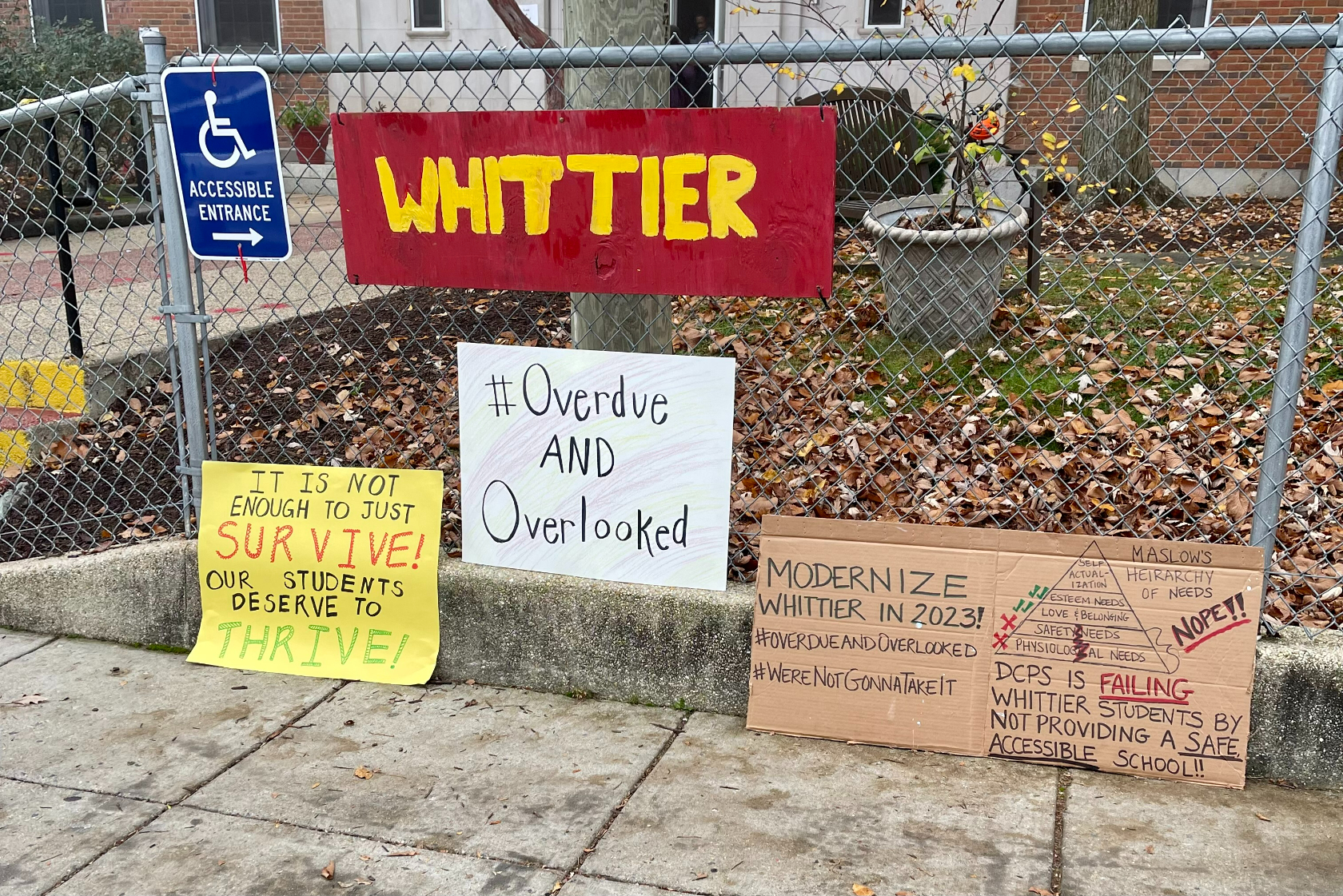
When Taí Alex showed up at Burroughs Elementary School in Brookland earlier this month to drop off her four-year-old daughter, she got some bad news: A gas leak had closed the school for the day. The same happened the day after.
And it wasn’t the first time.
“There’s been a lot of emergency things that have affected the school’s ability to stay open,” says Alex, citing a burst pipe that flooded some classrooms, boiler issues that have impacted the building’s heating system, and other issues that have bedeviled the 101-year-old building.
“Burroughs is a fantastic school,” she says. “There’s a reason why parents are so engaged. It’s just the building maintenance issues we’re having.”
And it’s much the same situation at Whittier Elementary School in Takoma — built in 1926 — where for months parents, students, and staff have been contending with repeated maintenance issues that have shuttered the school and fixes that are often derided as mere Band-Aids. In November, they protested outside the school. In January, a sewage pump in a pre-kindergarten classroom broke; on the Facebook page of the school’s parent-teacher organization, one parent complained that it smelled like the “inside of a rectum.”
“I’ve been a parent there for almost about five years, and there’s not been a year where there hasn’t been something major going on,” says Alicia Bolton, the vice-president of the Whittier PTO and parent of two children at the school, in kindergarten and third grade. “For too long the school has been ignored.”
Yet there may be no satisfying and quick solution for either school.
While many parents are asking for the schools to be fully renovated, the city’s schedule for modernizations has both Burroughs and Whittier set to start in 2025 — and existing law, funding demands, and the availability of temporary space makes it difficult at best and unlikely at worst that those projects would be moved up. And in the shorter term, some D.C. lawmakers say the problems at the schools exemplify broader concerns they have with how the city maintains facilities — especially aging ones like Burroughs and Whittier.
“The reality is these schools are very old, and the correct amount of preventative maintenance isn’t done with them,” says D.C. Councilmember Janeese Lewis George (D-Ward 4), who represents the area where Whittier is located and now chairs the council committee that oversees the D.C. Department of General Services, which is responsible for maintenance and modernization of city-owned facilities. “And also [D.C. Public Schools] isn’t really investing in small capital projects, because to fix some of these is a small capital project. If we can’t do it through modernization we still have to make the investment and not put Band-Aid fixes because it’s going to continue to happen.”
Some of the concerns that lawmakers have with DGS are longstanding.
Last summer, the council pushed the agency to respond more quickly and comprehensively to a spate of HVAC issues at schools. In October, Lewis George proposed a bill that would have required DGS to get a school-based staffer or foreman to sign off on any repairs done, a means to ensure that no issues are skipped over. And last November, the D.C. Auditor released a report in which it said the agency’s system for tracking work orders had “serious shortcomings” that led to “multiple failures” to address maintenance issues at government buildings like schools and recreation centers.
“I have been unsatisfied with the progress that DGS has had with a number of schools,” says Councilmember Zachary Parker (D-Ward 5), whose staff toured Burroughs with DGS workers to assess the gas leak and other persistent problems in the school — some of which have also been evident at nearby Langdon Elementary. “What we’re seeing is a backlog. I think we need to have real conversations around how we’re going to support this agency to meet aging infrastructure and the demands that are being put on it.”
“We have to start looking at when we don’t have people doing the maintenance work that they need to do,” said Lewis George about contractors hired to do maintenance work. “If a vendor is not delivering quality services to our schools, we have to be able to step in and make a change.”
In a statement, DCPS and DGS said they are working to address issues at both schools.
“When facilities issues persist as they have most recently at Whittier Elementary School and Burroughs Elementary School, DCPS works closely with DGS to address urgent repairs as swiftly as possible to prevent disruption to in-person learning. As we develop plans to ensure the long-term effectiveness of our remediation, we sincerely apologize for the inconvenience facilities issues have caused our families. The safety and well-being of our students and staff is our top priority. We will continue to collaborate with schools to identify priority needs, set project timelines, and minimize impact on families,” the agencies said in a joint statement.
More broadly, though, parents at both Burroughs and Whittier say the city needs to reconsider moving up the scheduled modernizations as an alternative to completing repeated fixes of problems as they emerge in years to come.
“We want Whittier to be moved up to begin its modernization process in the fall of 2023. We are willing to work very creatively with the city to figure out where we could temporarily relocate while construction is being done,” says Bolton.
But that’s easier said than done.
Some two decades ago, D.C. was criticized for the “disastrous” shape its public school buildings were in. Since then, the city has undertaken a multi-billion-dollar campaign to modernize schools, sometimes fully rebuilding facilities. That campaign has seen its fair share of criticism, both in terms of the quality of the modernizations, how money was spent, and also which schools were modernized first.
The city’s current schedule of school modernizations is limited by annual budget capacity and the availability of other buildings that can be used as schools are renovated. And that schedule is set via criteria established by a 2016 law — known as the PACE Act — passed by the council to ensure that political considerations don’t influence when a school gets modernized.
Under the act, weighted criteria are used to develop the schedule. They include the current condition of the school, with schools that have never been modernized being considered first; how many students are enrolled and how much of the building is being used; and how many in-boundary students currently attend and are expected to attend in the future.
Late last year Lewis George asked DCPS to recalculate the criteria for schools, noting that they last time that had happened was in 2018. “The inputs are a bit old at this point,” she says. There are some 30 other schools in roughly the same situation as Whittier and Burroughs — they’ve had some limited upgrades made in the past, Burroughs in 2009 and Whittier in 2010, but are slated next for full modernizations.
Parker says he’d like to see the law reworked altogether to better focus on equity. Bolton says that’s what she’d like to see also.
“There is no way that you can have buildings like ours, buildings like Burroughs, that are not meeting building codes. They are not ADA compliant,” she says, citing an elevator that hasn’t worked properly. “They pose an immediate risk and danger to students and to teachers.”