Martin Austermuhle
 Matt Blitz
The U.S. Senate voted Wednesday to block a D.C. bill that overhauls the city’s century-old criminal code, sending the first congressional disapproval of a local bill in three decades to President Biden, who has said he won’t veto it.
The Republican-sponsored measure drew overwhelming bipartisan support, with dozens of Democrats joining the united GOP caucus, following a similar pattern when the House of Representatives voted on its own disapproval resolution last month. The final vote in the Senate was 81 for, 14 against, and one senator voting “present.”
The lopsided vote was a stunning rebuke of D.C.’s years-long effort to revise and modernize its criminal code, an initiative that ran headfirst into a national political buzzsaw that Republicans were eager to wield to more broadly to paint Biden and Democrats as soft on crime.
For their part, Democrats were forced to play defense, largely abandoning their usual support for the city’s ability to govern itself. Only two Democratic senators spoke on behalf of the city’s bill during a debate on Wednesday afternoon, while more than a dozen Republicans inveighed against it and darkly painted D.C. as crime-ridden and a “scarcely recognizable shadow of its former self,” according to Sen. Joni Ernst (R-Iowa).
Sen. Roger Marshall (R-Kansas) echoed that concern.
“Republicans in Congress have taken an important stand to not stand by and watch the radical D.C. Council further inflame the crime wave engulfing our constituents’ capital city. I myself am afraid for my own wife to walk from her apartment to the Capitol. I’m afraid for my own staff to walk from working here to their own homes. This last Christmas, I gave every woman on my staff a special device to be able to defend herself should she be attacked,” he said. “This is real. We see it every day in this city. We see the crime. Everywhere we go, this city is no longer safe. The city no longer belongs to the people. The city now belongs to the criminals.”
Republicans have broadly attacked the revision of D.C.’s criminal code as being a gift to criminals at a time of rising crime in many cities. The overhaul — which started some 16 years ago, and was unanimously approved by the D.C. Council late last year — repealed outdated offenses and clarified others, created a new slate of penalties, eliminated almost all mandatory minimum sentences, expanded the right to a jury trial to people charged with misdemeanors, and expanded the ability of people in prison to request a sentence reduction.
The Republican senators who spoke against the bill on Wednesday largely took aim at provisions that reduce maximum penalties for certain violent offenses, focusing in particular on armed carjacking. The revised code decreases the current maximum penalty from the current 40 years to 24 years.
“In the midst of ongoing crime, the D.C. City Council thought that now was an appropriate time to rewrite the criminal code instead of enforcing law and order,” said Sen. Shelley Moore Capito (R-West Virginia). “The D.C. Council found it fitting to lessen the punishment for violent criminal offenses. Hard to believe, isn’t it?”
But the two Democrats who spoke in favor of the revised criminal code said Republicans were mischaracterizing the effort for political purposes, especially on the penalties.
“Looking at the totality of this bill, it is impossible to say that it isn’t about making D.C. safer and having tougher penalties on crime. It actually quadruples the maximum penalty for attempted murder. It triples the maximum penalty for sexual assault because people in D.C. see those as serious crimes and they want to seriously increase the consequences for,” said Sen. Cory Booker (D-New Jersey).
Booker and Sen. Chris Van Hollen (D-Maryland) also pointed out that D.C.’s new penalties for armed carjacking would actually be higher than in many states represented by Republican senators speaking against the bill.
“By rejecting this law today, by voting against this, people in the name of being ‘tough on crime’ are actually the people that are preventing a city from better protecting itself, better protecting its children, its sexual assault victims, its police officers. I mean, think about that. I have not in my ten years in the Senate seen such a distortion of facts, such a misrepresentation of what something is,” said Booker.
In a statement after the vote, D.C. Attorney General Brian Schwalb criticized Republicans and Democrats for blocking the revised criminal code.
“Local autonomy and self-governance are fundamental American values. Any attempt to replace District residents’ will with that of federal politicians elected hundreds of miles away violates the basic freedoms and principles on which this country was founded,” he said in a statement. “To overturn our local, democratically enacted laws — the product of 10+ years of collaboration between law enforcement, judges, and policy experts — without any independent analysis, review, or alternative proposal, is not only undemocratic, but also careless.”
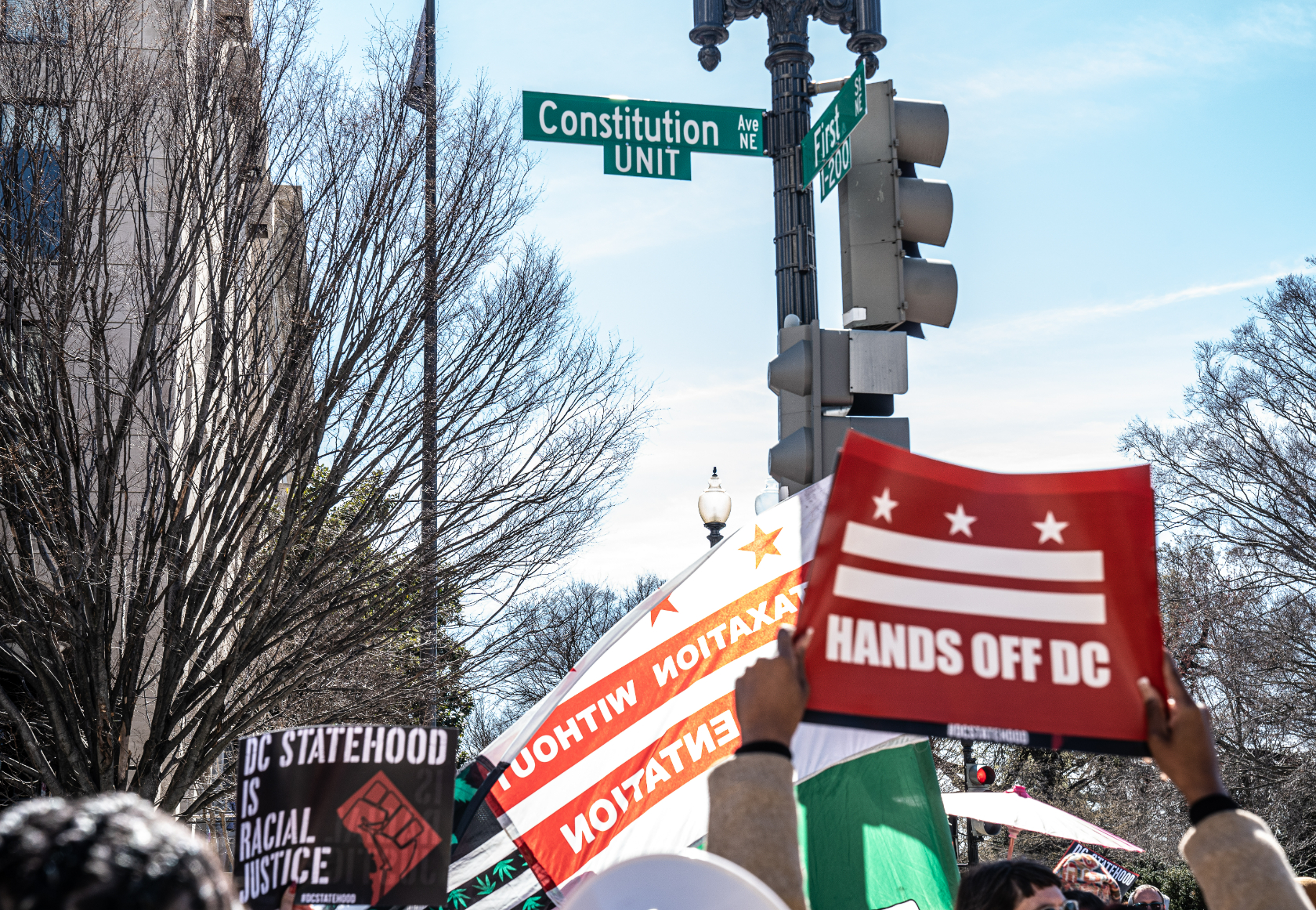
Ahead of the Senate debate, some 200 residents, activists, and elected officials rallied outside Union Station and marched to Congress, where they protested congressional interference in the city’s affairs.
Speaking at the rally, Councilmember Robert White (D-At Large) touched on the dual complaints from many residents and activists: Congress was getting involved in a local matter, and doing so based on a misunderstanding of what the revisions to the city’s criminal code would do.
“Congress feels that they need to come and say, ‘No, we know better than what you know.’ They don’t. They’re not accountable here. We don’t know them, we don’t see them in these streets,” he said. “They’re condemning a law as extreme when the law is stricter than the laws in most of their states. Yeah, these laws in this revised criminal code are more restrictive than the laws in most of their states.”
Speaking inside the building where the rally goers gathered, Van Hollen similarly made the case that Congress should not interfere in the city’s local affairs.
“We all have governors, we all have state legislatures. No one here would appreciate [Congress] interfering and overturning decisions made by their state representatives or local representatives, even if we disagree with their decision,” he said. “While I may not have supported every one of these provisions… I’m not sitting on the D.C. Council, and neither is any of the other senators in this chamber.”
Sen. Ben Cardin (D-Maryland) voted against the Senate disapproval resolution, while Virginia two Democratic senators, Tim Kaine and Mark Warner, cited Mayor Muriel Bowser’s opposition to the revised code in saying that it “wasn’t ready from prime time” and that they would vote to block it.
At the rally, activists also expressed a growing concern that if Congress is willing to block this bill passed by the D.C. Council, other laws could be next. Hannah Chichester Downs with the D.C. Abortion Fund said that she worries that Congress could restrict abortion access in the region, especially for abortion care later in pregnancy, which the D.C. area is a haven for.
“That’s why it’s so important that we give D.C. statehood, because if the federal government overturns abortion care in D.C., then there’s really no other place for women to go other than maybe like two other states,” Chichester Downs said.
The passage of the disapproval resolution marks a new low in D.C.’s half-century of self-governance. Congress has only stepped in to block local bills on three occasions since the city gained an elected mayor and legislature in the mid-1970s, and no such effort has been successful over the last three decades. Past disapproval resolutions that cleared Congress included one to stop a building near the FBI headquarters that would have been 20 feet taller than the city’s height restrictions traditionally allow, and another bill that would have restricted where foreign embassies can be located.
But it does fit a broader pattern of Republicans targeting D.C., a majority Democratic city, on a range of hot-button social issues. In the mid-1970s, congressional Republicans unsuccessfully tried to block a D.C. bill that banned handgun ownership in the city. A decade later, they tried to overturn a D.C. bill that pulled any investments out of apartheid South Africa, and another that gave people who tested positive for HIV access to health insurance. More recently, a Republican-led attempt to block a D.C. bill that legalized physician-assisted suicide was stymied by the Senate.
Josh Burch, a local statehood activist and founder of Neighbors United for D.C. Statehood, worries that the congressional move to block D.C.’s revised criminal code sets a bad precedent for the next two years of Republican control of the House.
“The only place that this irrational and irresponsible House GOP will have legislative successes is as it relates to D.C., and those successes will be bad for us. They’re not going to be able to pass legislation that has national impact, but they can pick on D.C.,” he said. “Democrats who support statehood are also setting a bad precedent by going against D.C., because they will now pick and choose what lines they can cross. This is going to be a really weird system going forward when they’re going to choose when to meddle in D.C. based on political convenience back home.”