Amanda Michelle Gomez
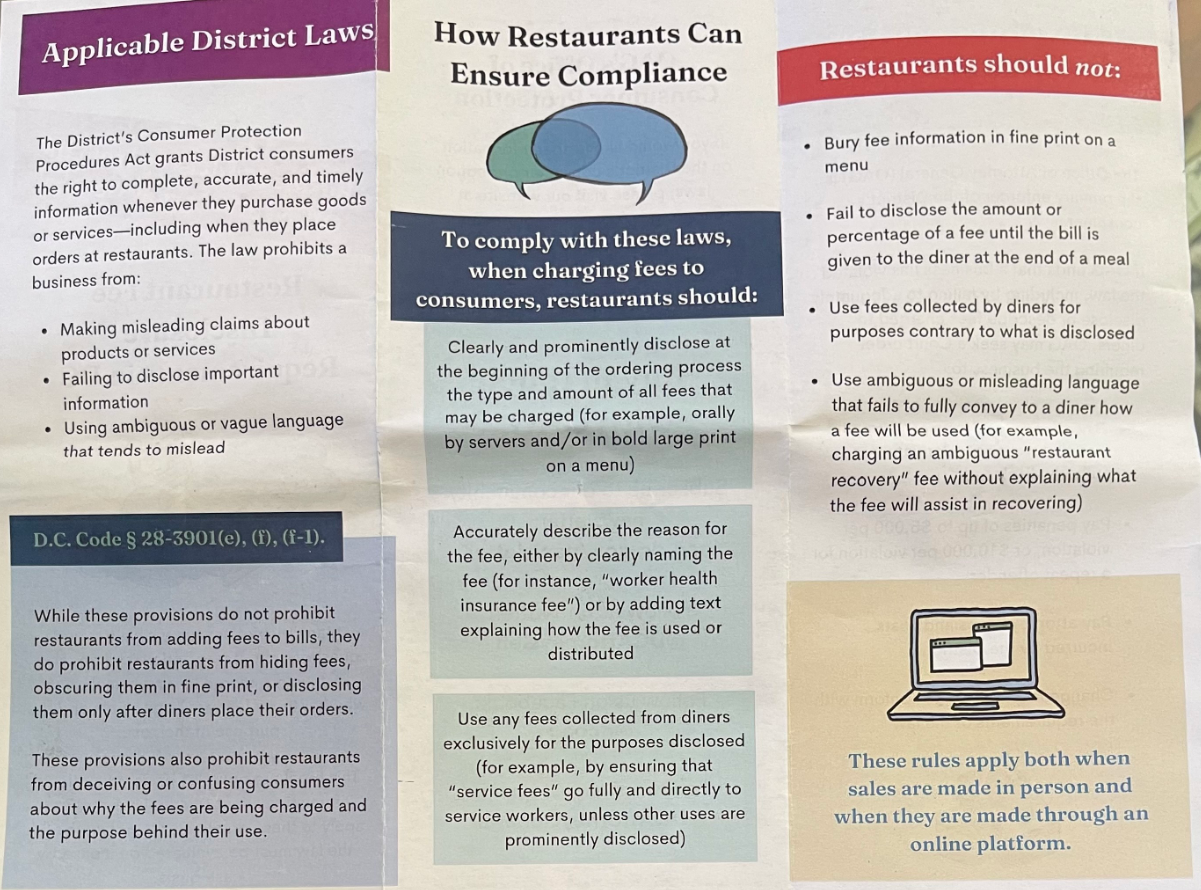
The Pug owner Tony Tomelden got a letter this week from an unexpected source: D.C.’s Office of the Attorney General. The letter and accompanying fliers sought to educate and warn businesses about service charges — fees that became increasingly common since the pandemic hit and could become standard practice with the implementation of Initiative 82, which phases out tipped wages.
While service charges and other surcharges are not illegal in the city, the OAG says in the letter that the fees may violate D.C.’s consumer protection law if they are not “predominantly, clearly, and accurately disclosed to diners before diners place an order.” The move appears to mark the first time the D.C. government has publicly weighed in on service charges, a nebulous concept that’s not strictly defined — unlike tips, which are legally required to go to tipped workers. (Revenue from service charges de facto goes to the employer, and there are no rules about how they are distributed.)
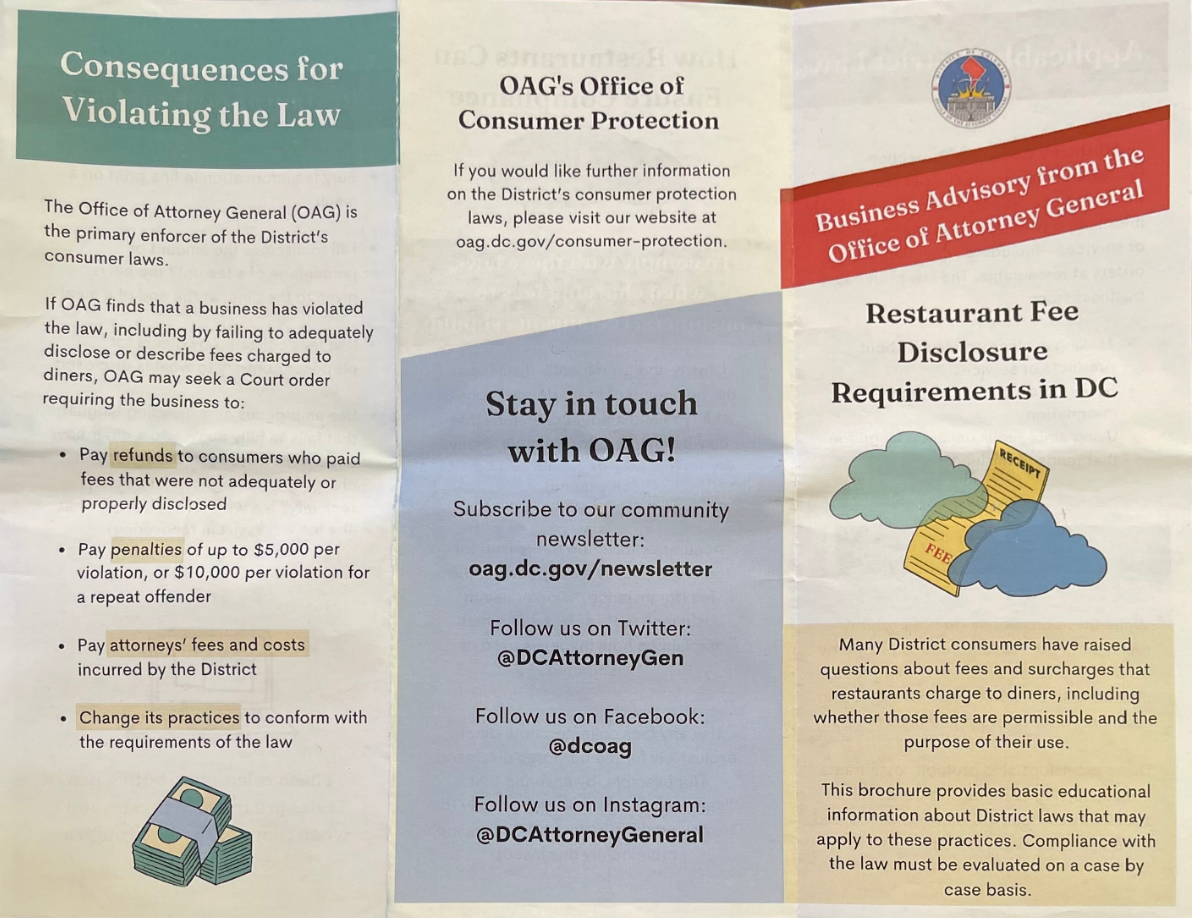
Fliers accompanying the letter directed businesses that charge service fees to:
- Disclose the fee at the beginning of an order, either orally or in bold, large print on the menu
- Accurately describe the reason for the fee, either through its name (“worker health insurance fee”) or in text describing what the money is used for
- Only use the fees collected from diners for those purposes specified
Violators of the law would have to refund customers or pay penalties up to $5,000, the flyer notes.
“We look forward to working with consumers and the restaurant industry to ensure transparency and fairness in the marketplace,” reads the letter from OAG Consumer Protection Director Adam Teitelbaum, which was shared with DCist/WAMU. “We also stand ready to enforce the law where violations are found.” (Barred In DC first reported the news of the letter.)
Tomelden’s dive bar on H Street NE does not have a service charge. He says he still pays his bartenders the tipped minimum wage of $5.35 per hour, but they earn tips that put them over the city’s prevailing minimum wage of $16.50. His and other establishments have to increase their tipped workers’ wages to $6 per hour beginning in May, one of several stepped increases brought on by Initiative 82, a ballot initiative approved by D.C. voters in November.
“I haven’t raised my guys’ rates yet because I don’t have the money right now,” Tomelden tells DCist/WAMU. “I’ll have to take it as it comes … I think there’s only so much more I can charge for a Miller High [Life] at the sloppy ass Pug.”
Tomelden doesn’t know if he’ll add a service charge, but agrees fees have been a Wild West for owners, workers, and patrons. Businesses have taken different approaches to the onslaught of industry changes. Amidst a national conversation about junk fees, like those charged by airlines and concert promoters, Tomelden cannot help but wonder why D.C. Attorney General Brian Schwalb is targeting bars and restaurants now. The letter especially stung, he says, because he recently took a Lyft that tacked on a $4.39 “DC City Fee.”
“I’m not questioning the motive,” says Tomelden of the OAG letter. “I’m just questioning the timing of it. I’m questioning, like always, why I’m going to get hit with that note, but Lyft hasn’t gotten hit with that note.”
Schwalb tells DCist/WAMU that his office sent the letters to every D.C. restaurant (2,400 in all) in an effort to proactively educate an industry that’s vital to the local economy and culture. His office also notified the public via a consumer alert in part because they’ve heard complaints about vague and confusing service charges, he says.
“My desire in pushing out an alert is to educate and to avoid having to bring enforcement actions or litigation,” says Schwalb. “My hope is that with the benefit of full information about the laws and the issues, restaurant owners can make sure they and their employees are following the law and they can make sure their diners and consumers — who I know they care about — feel good about coming to their restaurant.”
Schwalb, who took office in January, previously told DCist/WAMU that protecting consumers was a priority — a continuation of his predecessor’s work.
While some people applauded the OAG for ensuring D.C. was regulating bar and restaurant fees — and empowering the public to report potential bad actors — others, including the Restaurant Association Metropolitan Washington, questioned the OAG’s timing or interpretation of the law. Some owners were also confused by some of the provided information.
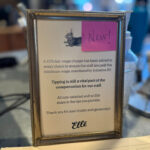
Service charges can vary widely, from how much a business charges to where the money goes to how the operator decides to communicate those fees to the public. Some establishments simply call the fee a “employee wellness charge” on the check, while others offer lengthy explanations.
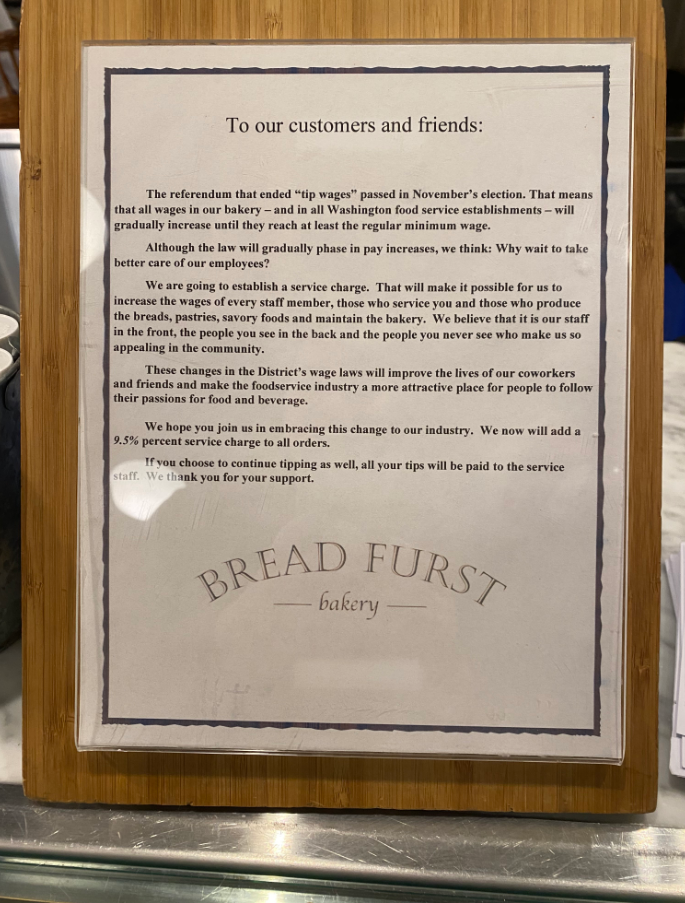
Bread Furst on Connecticut Avenue NW, for example, offers patrons several paragraphs on why they are adding a 9.5% fee to all orders. The explanation is on display at the register, as well as printed on sheets of paper if a patron wants to read on the go.
Bread Furst general manager Scott Auslander says they offered the explanation because it’s good business practice. “As an operator, it benefits you that your customers understand that you’re giving this money to the staff,” he says.
Auslander understands where the OAG is coming from with the guidance, but even he got tripped up. For example, he read it as saying that the service charge has to go to front-of-house workers such as servers, unless other uses are prominently disclosed. He’s not the only one who interpreted it that way.
“One of the things that I think excited the restaurant operators and employees was the idea that these service charges could be shared with the back of the house,” Auslander says, adding that Bread Furst’s fee is distributed amongst every employee, which has been good for morale.
Schwalb clarified D.C. law does not define service charge, or how the fee be used, but dictates that the fee be “be clear and transparent in that intended use.”
Longtime bartender Maxwell Hawla, for one, appreciated the guidance ahead of I-82 implementation even though he ultimately opposes service charges. Hawla hopes the OAG stops businesses from faulting the initiative when explaining their service charges, which he says is misleading because it hasn’t kicked in yet and doesn’t require owners to pay their tipped workers the full minimum wage until 2027.
“Nothing’s changed yet,” says Hawla. “Don’t be shady.”
The restaurant association, meanwhile, disagrees with the OAG’s timing — and part of its interpretation of D.C. law. For example: Andrew Kline, the association’s general counsel, doesn’t think the law dictates that fees and explanations be in bold large print on the menu. RAMW is considering whether to advocate for explicit statutory language defining the term to prevent accusations of deception.
“We don’t want anyone misled,” Kline says. “But we are puzzled as to why this would be one of the first initiatives of our new attorney general.”
Consumer protection attorney Brendan Klaproth of Klaproth Law is also skeptical of some of the OAG’s guidance. “I don’t think they need to disclose what the purpose of the fee is,” he says.
He reads D.C.’s Consumer Protection Procedures Act as only dictating that businesses can’t surprise or lie to patrons about these fees. “As long as they’re upfront that the fee is being charged, and not misstating the purpose of the fee, I don’t think that it would run afoul of the consumer protection law,” he says, adding that it is somewhat of a gray area in the statute.
Schwalb says he’s not surprised that the restaurant industry disagrees with his interpretation of the law in regards to how much disclosure is necessary — but he stands by the interpretation, and believes a lot restaurants are already acting accordingly.
“What I’m saying is that if you’re going to charge fees to your diners, make sure they know in advance what those fees are before they order, clearly disclose the existence of the fees, explain what they are and where those dollars are going,” he says.”What I think is really important about that is for many, many restaurant owners in the city, they’re already doing that. And I want to make sure that everybody who is engaged in business in the District of Columbia is playing on a level playing field.”