 Jordan Pascale
A new report from the D.C. Auditor finds that the District’s Vision Zero program has not been successful at reducing traffic deaths because it has lacked funding, staffing, and oversight.
The report, released Thursday, says while District leaders made a public commitment to Vision Zero, “implementation was delayed by a failure to establish the bureaucratic infrastructure within DDOT,” and a failure to fully fund a 2020 law, the Vision Zero Omnibus Amendment Act. D.C. Auditor Kathy Patterson called on Mayor Muriel Bowser and the D.C. Council to fund that bill.
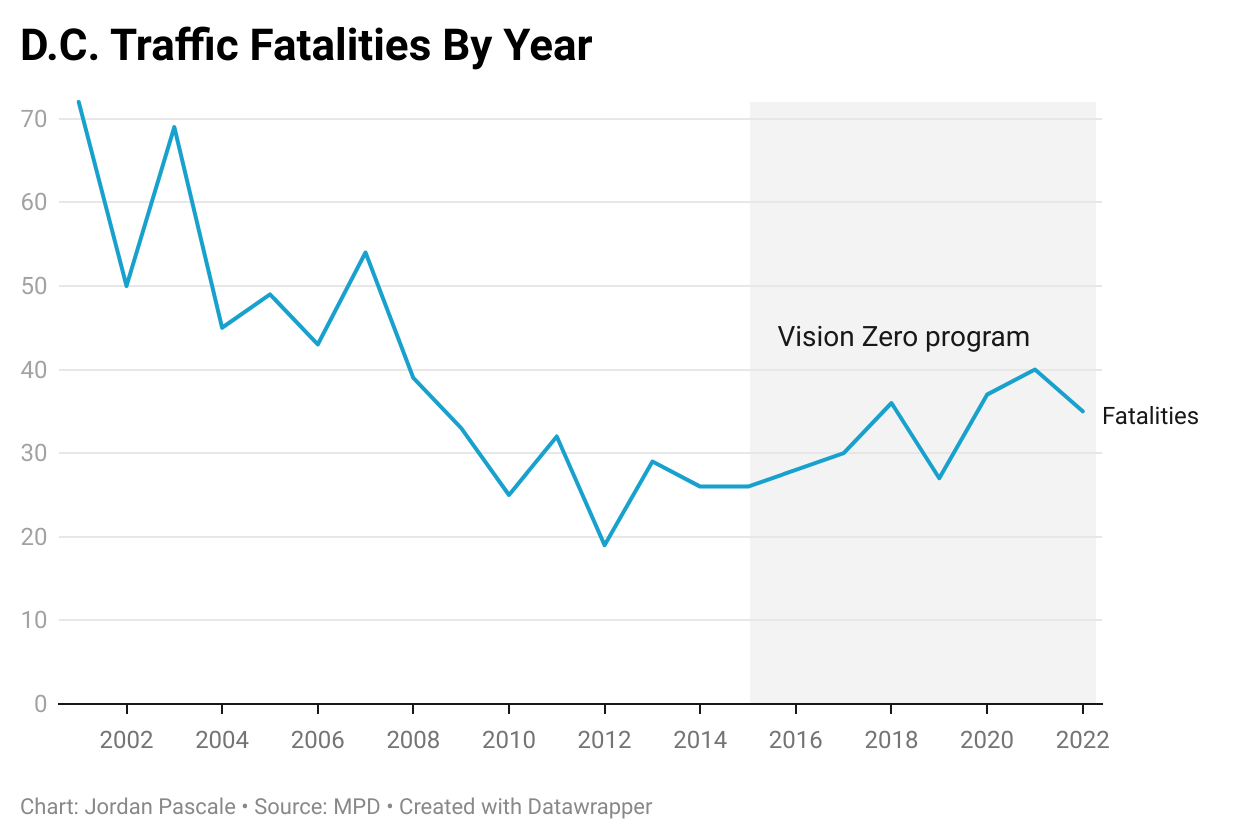
Bowser launched the initiative to eliminate traffic deaths and serious injuries by 2024, a goal that will not be met. Traffic deaths haven’t fallen below the 2015 mark — when 26 people were killed on the streets — since the program launched.
“The Bowser Administration failed to follow the ambitious announcement in 2015 with appropriate resources in both funding and manpower,” Patterson said in the report. “Commitments have improved significantly in the months since our audit scope after a full six years without an updated action plan.”
The report came out just days after a deadly high-speed crash on Rock Creek Parkway that killed three people. The driver who caused the crash was fleeing police for unknown reasons. The vehicle the driver was in had amassed 43 speeding camera tickets and a red light ticket in less than a year and accrued nearly $12,000 in fines. The vehicle was eligible to be booted and towed.
The crash highlighted several issues with preventing traffic deaths — having safe roads (Rock Creek Park is four lanes wide, infrastructure that enables cars to travel at high speed, especially late at night when the crash happened), failing to educate the driver that speeding is dangerous, or enforcing consequences for the traffic laws.
At-large Councilmember Christina Henderson tweeted about the situation saying, “I think we need to have an honest conversation as a community about what it will really take to get to Vision Zero.
“I don’t want people to just pay fines,” she wrote. “I want them to change behavior. But any enforcement proposal beyond booting keeps getting knocked down. Do I think the ATE (Automated Traffic Enforcement) program needs reform (ie, lower the fines) and more transparency (provide data for camera locations)? Yes. I’ve called for that.
“But if someone gets clocked going 25 over the speed limit, can we all agree that’s a problem and not predatory? We’re not there.”
Councilmember Charles Allen said he was angry about the circumstances of that crash.
“They have no business being on our streets,” Allen said. He was on the losing end of a vote last year that allowed people to renew licenses with outstanding fines. “That person shouldn’t have been on the road. Period. That’s a dangerous driver. We need to have our tools, enforcement, and accountability set up so that we can get somebody like that off our streets.”
Allen praised Bowser for “planting the flag and setting a Vision Zero goal” but said echoed the auditor’s report that D.C. has not done enough to meet that goal. He said it is still an achievable goal and solutions are sitting on the shelf unfunded or unused. Allen sponsored the Vision Zero Omnibus bill, which outlined several solutions but cost $171 million over four years. Mostly only the free to cheap portions of that law have been completed.
“I need to see leadership from or structure within DDOT to reach Vision Zero,” Allen said in a press release. “That’s especially important as billions in federal infrastructure funding comes to the District over the next few years.
“We need to be guided by high-quality data and best practices. Beyond reckoning with serious crashes and fatalities, we’re not taking seriously the pervasive way that speeding and dangerous driving wear on our residents and detract from their quality of life.”
The audit was launched in Sept. 2021, after safety advocates sent a letter with 200 signatures asking the auditor to look into the failing program. The audit looked at three years of data and work since 2018.
Among the 21 recommendations:
- Create databases for traffic studies and keep track of D.C.’s most dangerous roads to “target, track, and document traffic safety investments which delayed action to mitigate traffic danger.”
- Create realistic budget targets. The auditor’s office says the 2015 plan included just $500,000 a year, and that budget was never adjusted to meet the actual goal of zero deaths. DDOT told the auditor’s office it is difficult to quantify how much is needed.
- Analyze outcomes. D.C. didn’t update its action plan until six years after launch. The auditor’s office says that missed opportunities to assess the investments and strategies so far.
- Add equity data and goals. Earlier this year, DDOT added a new process to requesting traffic safety improvements that added an equity component. But for years, DDOT did not have equity data for completed projects, nor did they have equity goals for small to medium size projects.
- Better communication with stakeholders. While DDOT cleared a backlog of traffic safety requests, the agency did not consistently communicate the decision and inform the public of the results of the project before closing the request, according to the report.
- The Mayor should hold quarterly Vision Zero check-ins to make sure agencies have the necessary funding and resources to implement Vision Zero, the report said.
- DDOT should have enough employees in the Traffic Engineering and Safety Division to keep up with safety requests, document the investigations, and communicate the results to residents. Allen says DDOT has several vacancies that need to be filled.
For the most part, DDOT agreed with the recommendations, and Deputy Mayor for Operations and Infrastructure Lucinda Babers said the department “already have processes in place that address each of them.” The department hit a reset button on the program last year, laying out a new vision.
DDOT has previously made numerous changes like reducing local streets to 20 mph speed limits, banning right turns on red lights in many intersections, building more bike lanes, taking over the Automatic Traffic Enforcement camera program, evaluating high crash areas, and other efforts to curb deaths. The department hired a Vision Zero director in 2019. The Council also passed a sweeping Vision Zero safety bill but it has largely gone unfunded by the Mayor’s office.
Patterson noted that DDOT has made “significant strides over the last two years in particular and we are hopeful that our report will help ensure those efforts are sustained.”
This is the first audit of DDOT’s program, which focused on changing infrastructure and staffing. A second audit, which might come out next year, is looking at the District’s enforcement strategies under the police, the Department of Public Works, and DDOT.
This story was updated with additional comments from a press conference.