Dee Dwyer
 Sarah Y. Kim
It’s a good – or better – time for women entrepreneurs.
Over the last few years there has been growth in women-owned businesses across the country. Kristi Whitfield, director of the DC Department of Small and Local Business Development (DSLBD), says the same is true in D.C.: and more and more women have been seeking small business assistance from her department.
“There’s a new recognition of the talent and the ingenuity that women bring,” she says. “Women see the gaps in the marketplace, and women are about creating solutions.”
As of 2021, women owned 47% of small businesses in D.C., according to the U.S. Small Business Administration.
Whitfield says part of what’s fueling this growth is that many workplaces aren’t giving women the flexibility they want. She began running her own business – D.C.’s first mobile cupcake truck, Curbside Cupcakes – when she became a mom.
“When you’re the boss, having your kid there in their little carrier is not something you have to ask permission for,” she says.
But being the boss comes with its own challenges. Women are less likely than men to have access to the credit and capital to set up and grow their businesses. And on average, businesses owned by men still earn more revenue. “The patriarchy remains alive and well,” Whitfield says.
It’s even harder for women of color living in under-resourced communities. There is great talent east of the Anacostia River, but it needs fertile ground.
Whitfield says her department has worked to level the playing field. There’s the Dream Grant program, for example, that awards up to $10,000 to business owners in Wards 7 and 8. DSLBD also set up a crowdfunding loan program with nonprofit microlender Kiva, which helps small business owners build credit.
“The people in [Wards] 7 and 8 are amazing and strong and smart, and are doing really cool and innovative things,” Whitfield says.
There are women driving the local fashion scene, women opening bookstores. There are women opening hair and nail salons, women in manufacturing.
Ramunda Young, the co-owner of Mahogany Books, says when you’re a Black woman and starting your business, you find yourself entering rooms where you aren’t heard.
Now, she says she gets to choose which rooms to enter, and which to stay in.
“It’s crazy out here as a woman. People second guess your intelligence. They second guess your integrity,” Young says. “We always have to show up in a room and be bigger and badder, so to speak, or bolder, just for somebody to recognize our value.”
Jheri Taylor, who founded nail salon She Nail’d It, says it’s not easy to access capital, and that getting grants can be a lot more complicated. But Taylor says she and other Black women have the skills, and each other.
“I do see a lot of women welcoming and banding together,” Taylor says. “I’m proud of us.”
This women’s history month, DCist/WAMU heard the stories of five business owners: how they got to where they are, the challenges they’ve overcome and continue to face, the support they need, and what inspires them.
Their responses have been lightly edited for length and clarity.
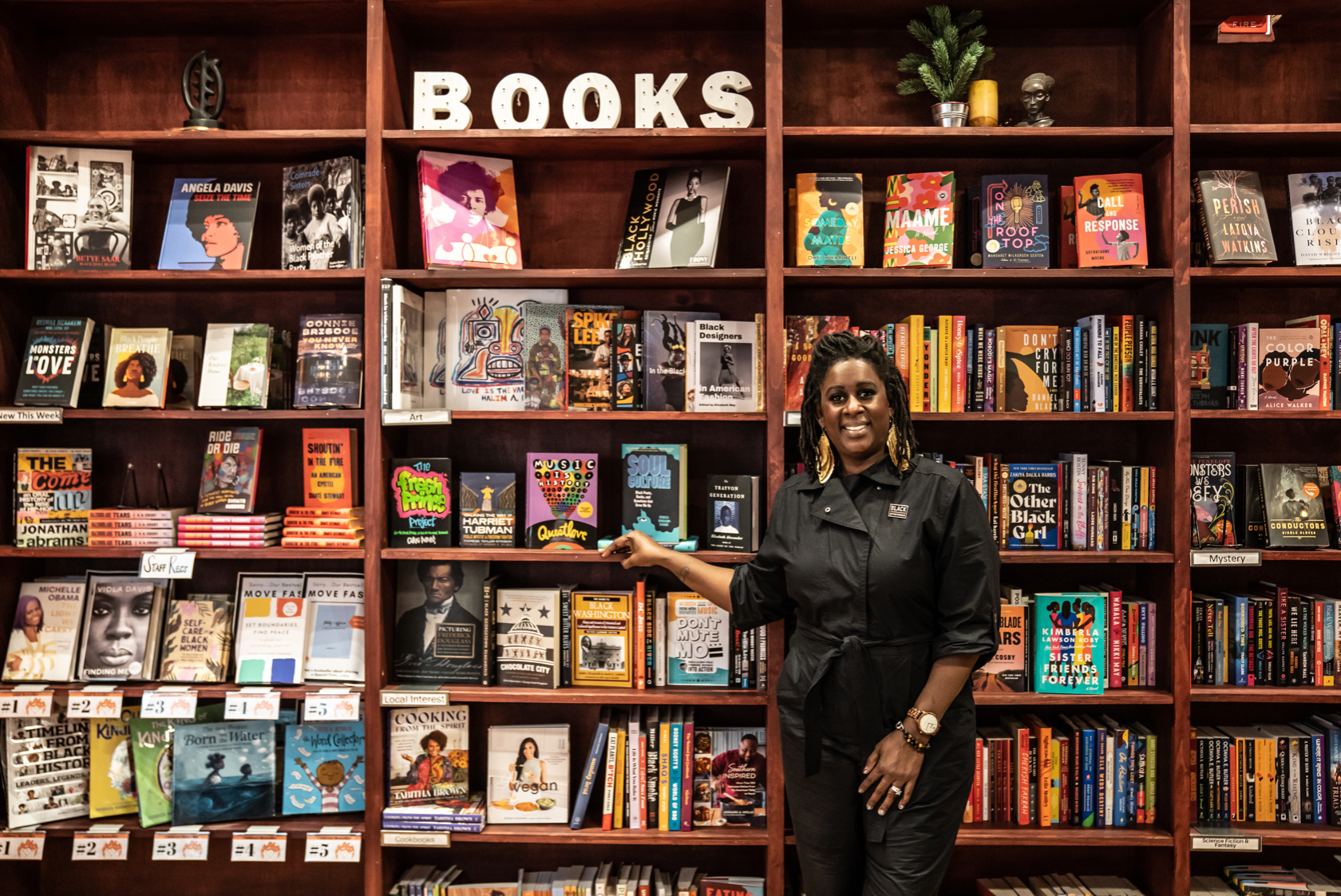
Ramunda Young – co-owner, MahoganyBooks
What made you set up shop in Ward 8?
We were looking at literacy stats, and the literacy stats are kind of crazy over here. And it may be for a lot of different reasons…access to printed materials is a huge thing. And so not having a bookstore in this community for over 20 years really spoke to us. We were out looking at this spot in Virginia, but [we thought] what about over here, what about home – and I say home from my husband’s perspective, he was was born and raised in D.C.
Why not be here? Our people are here, our community is here, Black people are here. And so we felt like it checked all the boxes to be in this space.
You could have set up any kind of shop, why books?
Ever since I was a little kid, I loved reading, but I did not have access to Black books until I got to college. I went to a HBCU in Oklahoma called Langston University, and so when I started reading Black books, my life just changed. I felt like ya’ll couldn’t talk to me! I know so much more about who I am now. One of the books that really impacted me was Nile Valley Civilization by Dr. Tony Browder. It was just mind boggling for me to read the contributions that Black people, that African people, have contributed to this world. So that’s my perspective.
Then my husband’s perspective – he was raised in D.C. His mom took him to bookstores all the time in D.C. I’m from Oklahoma, so it was a totally different. His experience was reading Black books. We had two voracious readers coming from two different perspectives and we both have a commitment to community; we both have a commitment to culture. Books was this kind of crossroads that met us both. We used to go on dates in bookstores before we even talked about wanting to do this. I mean, we’d sit in bookstores for hours and just sit and read. And so, when we tossed around ideas of what we want to do as far as a business, books was an easy one for us.
Because of the extensive impact Black books had on him growing up and then me from college, it just made sense to delve into that micro niche [Black books] and not just be a general bookstore. We could have been a ‘Black and Noble’, so to speak, but we said, ‘No, we want to dip all the way down into Black books.’ I worked at one of the biggest bookstore chains in the world and what I saw was Black books being removed from the shelves. The inventory was getting smaller and smaller.
The biggest thing was why would we let somebody else be in control of our narrative? If they don’t think our books are important on their shelves, why would we leave it up to them to say it’s not worth it? So for us, we said we don’t want to be in that position. So,opening our own bookstore was saying we want to take this into our own hands.
What are some of the challenges of being a business owner, as a Black woman?
Going to get financing. There were so many questions. Yes, I get you’re supposed to be questioned to find out the financial viability of a business. I get that. But we’re giving you all the proof! We’re showing you that books are billion dollar business, and to still get turned down and have them say, ‘No, you’re competing with another big online behemoth,’ and not really understand our business. That’s the Black cloak that I say that I have to wear – I wear it all day and I’m proudly Black – but then to add the woman layer on it, not having your voice heard in rooms, I would walk into rooms and people kind of looked at me like, ‘Okay, why are you here?’
Why shouldn’t I be at this table? Always being second guessed when I was at the table was hard as a woman. It was just crazy to me. I think that’s a hurdle that women always have. We always have to show up in a room and be bigger and badder so to speak – or bolder – just for somebody to recognize our value. So that is a thread that has continued. I get into rooms a little bit easier now, but I now choose the rooms.
It’s crazy out here as a woman, people second guess your intelligence. They second guess your integrity. But if a man or white person walks into a room, they automatically are steps above, as far as credibility and viability. And that’s just from many, many, many centuries of intrinsic racism – how people see us, how they think we’re not smart enough, and that’s not the case for us. But oh, well, we’re here now, 16 years and counting!

Jerri Evans – owner, Turning Natural
How long have you been in business and how did you get your start?
It will be 10 years in December, and I’ve been juicing now for over 25 years.
It essentially started with my mom. My mom started juicing because she was diagnosed with stage two breast cancer in 2001 – and juicing wasn’t a fun thing for us; she had her Jack LaLanne juicer and they made a whole bunch of noise. She was juicing for health, because during her remission of stage two breast cancer, she couldn’t eat anything, she was very nauseated all the time. Juicing was a big part of her, one, getting nutrients in, and two, having something in her body that could help her as she goes throughout the day taking chemotherapy and radiation.
When my mother passed away, at the time I was still an aeronautical engineer. I had no concept of,’I’m about to start a business.’ I quit my job maybe seven months after my mother passed and everyone was like, ‘Are you freaking crazy? What are you doing?’ I just wasn’t there. I wasn’t mentally there. I wasn’t in a place where I wanted to continue to do work in that way. I was living in Atlanta, and decided I wanted to come home. I knew that I wanted to do something centered around health, but I wanted it to be fun. I wanted it to be something that people could do every day.
I came up with the concept, okay, maybe I can open a juice bar. But mind you, I left D.C. at 17. I’d never paid bills in this city, so I never truly understood how expensive it was to live here, let alone open a business. The first spot that I looked at, two Ethiopian brothers owned it, and they wanted $7,000 a month. I’m like, ‘I’m sorry?’ And you don’t know at the time what a triple net lease is. You don’t know at the time that you have to have a million dollars in in general liability insurance. You don’t know that you must have all of these different things. So, it’s not just $7,000 a month, you have an electric bill, you have a gas bill, you have all these other things. I was like ‘Yeah, I’m gonna stay in my kitchen.;
But then I realized, as we were growing so fast, I have to have a space. My godfather had a church that had like a 350 square foot space, and we turned that into technically our first juice bar. And it’s been up since then!
How has it been being a Black women in business?
Let’s start with the beauty: I have had an indescribable amount of support from people, and there’s something about Black people… there’s a lot of things magical about Black people. But when it comes to that support and how we stick up for each other, how we really truly ride for each other… I came into this thinking, Oh, I’m just going to have one juice bar. And, you know, a lot of the customers came from the church. A lot of customers came from people that my mom knew and that I knew. But then when I started to see faces that I just did not know, they would come in and just order juices or order smoothies. I was like, ‘What’s happening? Like, this is a real business?’
And I think that’s the beautiful part about it: We have Black people who want to be a part of something, whether it’s on the customer side, whether it’s on the vendor side, whether it’s on the staffing side. Like it’s really a conglomerate. You literally see nothing but Black faces. We do have customers who are not Black, but it’s just something about watching us come in and support and rally and creating something that is specifically Black identifying.
I think people are afraid to talk about the success part. Like, this business has afforded me a life that I probably would not have lived. Yeah, I was aeronautical engineer and I made money, but we’re scared to talk about that. I get to travel, and I get to go to a grocery store and not worry about how expensive eggs are because they’re expensive right now.
Of course, for balance, it has to come with the ugly side. And it’s you just don’t know what you don’t know. There’s not enough conversation around the things that you don’t know that you should know. Either you learned them through hitting a brick wall or experiencing hardship, or you’re like lucky enough to find somebody to say, ‘Hey, here’s how I did it and this is the way that it should go.’
Which Black women inspire you?
Oh, there’s a lot. There’s so many in in so many different genres of life. I’m an avid reader, Toni Morrison, Audre Lorde, Octavia Butler, bell hooks are some of my favorites. What I love about them is how they write about Black women. I can see myself in their writings. I can identify with how they speak. I identify with how they describe how I look.
I am forever inspired by my mother. I think that I’m learning more about her in death that I have in the 24 years that I had with her. She had desires, she had goals, and she had dreams. You [often] don’t look at your parents that way, specifically your mother.
Why did you choose to set up shop in Anacostia?
I’m from Anacostia. We started talking to a few people and they were like, ‘You know, Virginia would be great.’ And I’m like, ‘I’m sorry, what?’ This is not to say that people in Virginia do not have access to healthy food options, but I have a personal responsibility. I told my team we’re going to Southeast. I drove them around – I saw for lease sign, and I was like, let’s see. I’m peeking in, then I see two eyes looking back at me. They came to the door, and we started talking. Don’t get me wrong, I was scared. We just got this first location, it’s up and running, I won’t say it’s running smoothly but it’s running. The audacity, I’m thinking. I’m about to do another location – financially, how does that work?
We made it work. So that was one of my main reasons of coming into Southeast, because we deserve good things. We talk about gentrification often and my biggest issue with gentrification is displacement. We’re not included in these plans. I wanted something that replicated what is traditionally white, right? Traditionally it is not something that our culture is involved in. And like that first day and first weeks I was like, ‘Oh my God, where are you people coming from and why do they want this?’ Like, you’re literally sitting back and you’re having this imposter syndrome. I wanted to make sure that I included a community that grew with me to give back to.
What advice would you give Black women looking to open a business?
People think that they have to have something perfect to present. Start where you are with what you have, then you can make it better later. We were writing labels on bottles with Sharpie pens. I didn’t have labels.
Cultivate a community of people, not just entrepreneurs. Like there’s a community of people that I have never personally met but know my name and support my company and I can never truly put into words what that means to me. I hope the words ‘Thank you’ never become redundant – I tend to say thank you a lot to people because it still surprises me that people wake up and choose Turning Natural.

Jheri Taylor – owner, She Nail’d it
What inspired you to start your own business?
This March makes the 6th year that I’ve been an entrepreneur. It fell into my lap…no – I was more so forced into it. I’ve been fired from every job I’ve ever had, getting 15 or 16 W2’s a year. I knew that the work force wasn’t for me. I feel like I’m a Type A personality. I dislike things that aren’t done a certain way, I like them structured. I use my voice to speak up if things aren’t right and if I feel things can be done a more efficient way. I don’t mind speaking up. So sometimes, that’s shunned upon, especially being a Black woman in a majority caucasian setting.
I got fired like a week, a week and a half after I did everything for “She Nailed It”. I think it was destiny. God will push you and make you so uncomfortable if you’re not operating in the world that he has for you. I definitely feel like that’s what happened for me.
That first year was rocky. The first three months were crazy: my wife had gotten locked up, incarcerated, and from there literally everything was on me. I was going to school….she got locked up while I was in class. So, when I graduated I had to take the savings and go get some supplies.
I started out mobile – initially I was thinking to myself, ‘What can I do to be different?’ One, I didn’t know there were so many sisters in the nail tech industry. I did not know that. But we’re all tucked away in our homes operating that way. I was trying to figure out a way that I could separate myself from the masses. Clientele was was slow, super slow, but I would still promote. I’d put fliers on people’s cars. Instagram was a thing and so was other social media, but not like how it is set up now for content. My clientele grew from word of mouth.
It was a journey. When my wife came home, I wasn’t making any money, so we were $10,000 behind in rent. And [it was] like, one of the scariest times of my life. And this is the first year – so hectic for her to come home to. Good thing for her savings! But things turned around, which I’m super grateful for. Clientele grew, my skill set grew, which is then what made people start wanting to get services done by me. And again, this has been a journey.
What have some of the challenges been, and also some of the glow?
Some of the challenges have been pushing through when we don’t feel like it. You don’t feel encouraged. That’s been a challenge because especially through the pandemic, or even before that. When I didn’t have a clientele set I still got up and made a post or did advertising on foot or whatever. It was pushing through to get success. The challenges are internal, definitely, because you don’t have anybody to motivate you – as far as the structure from the corporate world where you have a boss that’s telling you, ‘Hey, this needs to be done, this needs to be turned and you have a deadline.’ You don’t have that on the entrepreneurial side. So just being my own driving force, if you will.
Sometimes I feel like some girls like to tussle in the beauty industry, just from my experiences. I think collaborating sometimes is a little bit hectic, it’s not really welcomed and fostered. It’s taught me, maybe everyone’s not for you or that’s just not your tribe. It hasn’t been super welcoming for me across the nail tech industry.
The good things are I’ve made connections with a lot of entrepreneurial women in other fields that have taught me so much. They haven’t been gatekeepers. Whatever it is they struggle with, they are pretty much the blueprint so that you don’t have to make those same mistakes – you know how to navigate it should it come about. I’ve gotten to connect with some amazing women.
Being able to be creative in my own way has created such a freedom in thinking and my mind. Overall it’s changed my perception, I used to think ‘my way or the highway’, now I’m open to different perspectives on things.
How do you feel you can be supported more as a Black woman owned business?
Access to capital or easier access to capital. Making the [grant application] process easier. You would need to hire a professional or know someone to get through it. It’s enough to actually discourage someone. I know that the funds are there, why is it so difficult to get them to people?
But sometimes we’re in our own way, too. For me it was not having any overhead, I didn’t have to pay anyone else except for me. Sometimes that can keep us in a place of comfort and not even wanting to reach out and see what opportunities are out there for us, also.
I do see a lot of women welcoming and banding together. We’re definitely repping, representing each other well and putting each other on for more opportunities. We’re aware of our work and I’m proud of us. Yes, ladies, I’m proud of us, 7 and 8 Wards!
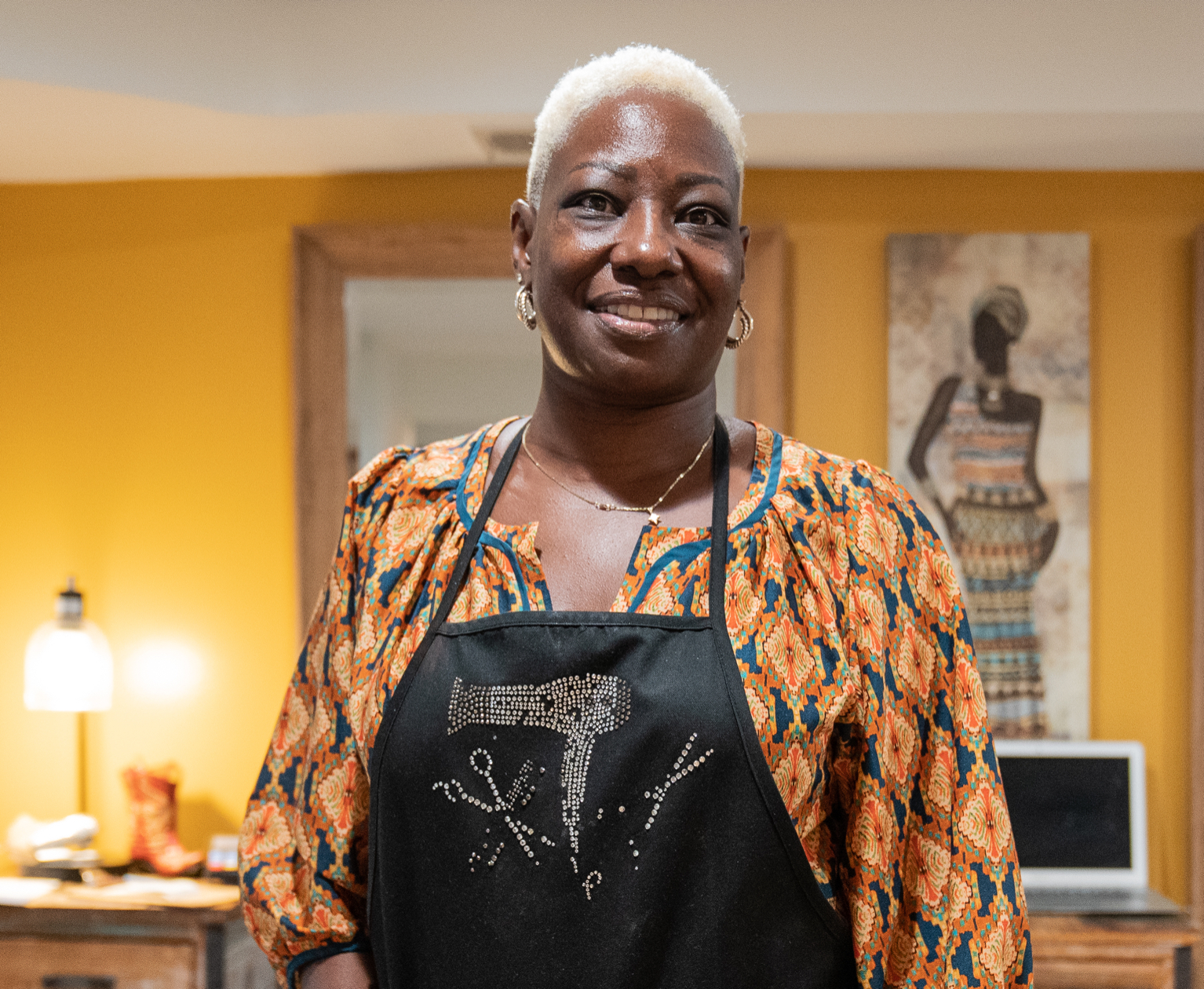
Shannon Evans – owner, Natural Kinks
What’s your experience been like as a business owner?
I’ve had Natural Kinks for 20 years. We specialize in natural hair and natural haircare. It’s been good. It has its ups and downs. This is is my third location due to the gentrifying of the neighborhood. I have lost two salons to developers. They sold the building and didn’t renew my lease. Hopefully this person won’t sell and I’ll be good. Just staying in this area right here on Capitol Hill has been hard. It’s like you get a space, you just pray that you can renew your lease when your lease is up and they didn’t decide to sell. So that’s the only thing. But I love doing hair, been doing it for over 20 years I’ve had a business for 20 years. Having a lot of clients that’s been supportive, continue to repeat and come back, [is why] I’m still here.
What made you get into this business?
I’ve always been into the hair. As a little girl, I started out braiding hair. Then I stopped braiding hair because I decided to go natural. I started working at a natural hair salon to get educated on natural hair.
What are the challenges you’re faced with and how can you be supported more?
It’s hard to even get a stylist. It’s hard to find a space that you can afford. It’s hard to find the grants and things that can help you out with it. Unless you know somebody, who knows somebody, who knows somebody. Other than that, a lot of young ladies are going and getting suites. That’s been the big thing now – they finish [school], they get they get their license, and they go and do their own thing.
Everybody wants to work for themself in this industry now, they don’t want to work for nobody or be in someone else’s space. [They] do their own marketing on social media and that’s it. It’s hard getting people. To get more staff, to get more young ladies who’s willing and want to learn. I have the clientele support. I just don’t have the staff support. They’ll come long enough to build the clientele and then they want to leave.
What would like to say, about being a Black woman in business in D.C.?
Work hard and abide by the rules and regulations, make your customers happy and they’ll keep coming back. Hold on to your customers and your staff.
I like decorating, I decorated all the shops. I like to make them (customers) feel comfortable, where you can come in the place and feel like you’re not in a salon. I want you to feel at home, I want you to feel welcome, like family. I try to have a warm environment for the customers to walk in here and still work like they are working from home. I have two or three of them out there. They always pop the computer open or are on a meeting or whatever.
What is your ‘why’? What keeps you going?
It’s a passion. I love doing natural hair. I love making people look good, feel good, be able to sit in my chair and let their hair down. They might want to share something that’s going on in their life. The good things, bad things, all the way around. I get it all, I just listen, you know? I’m there for them like a therapist, but not a therapist. When they say stylists are therapists, [they mean] we hear it all. I just have to learn not hold on to what people are going through.
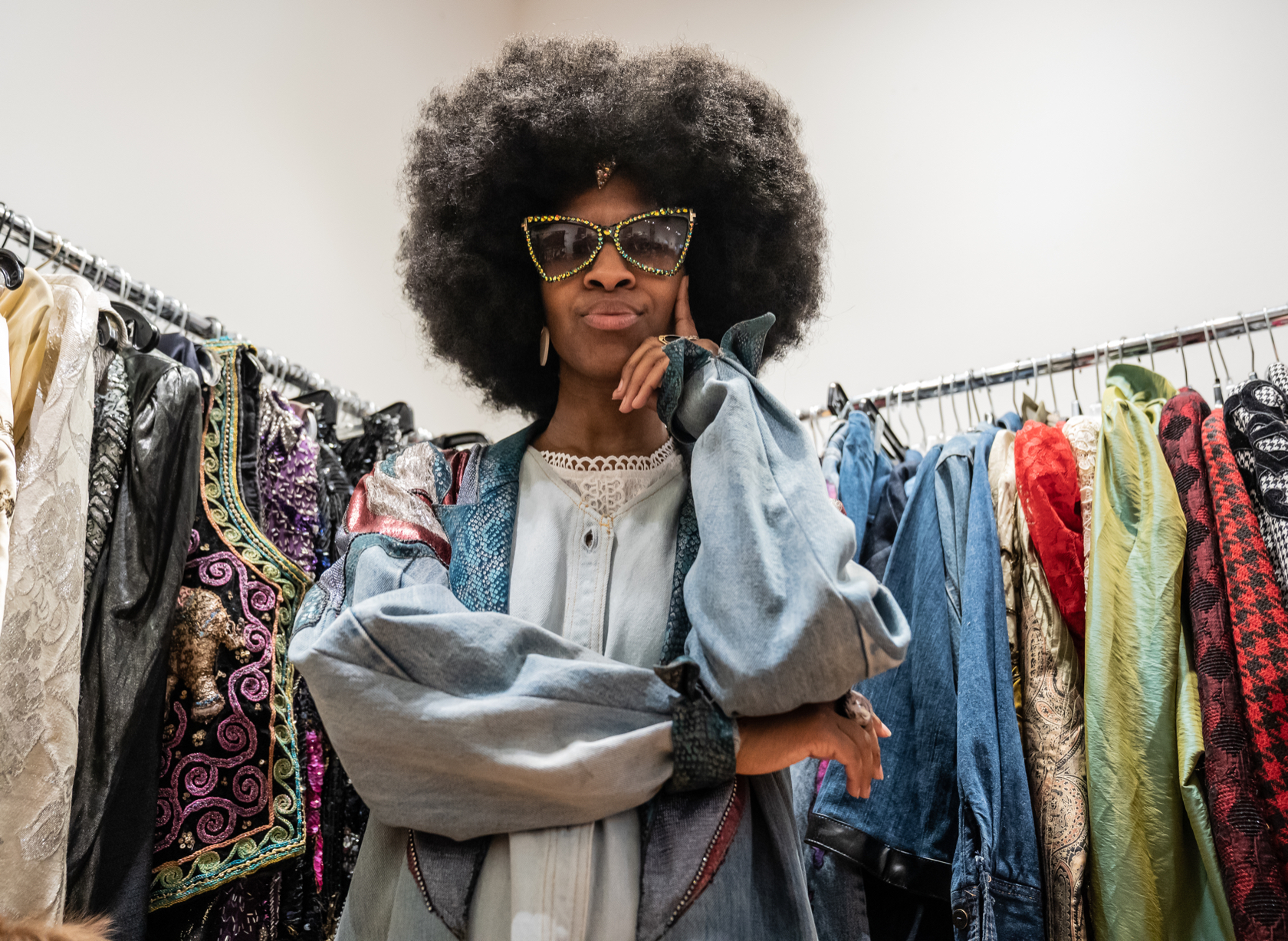
Jenelle Henderson – owner, Dressed to Manifest
Tells us about your business and the role that it plays in the community.
My business is called Dress to Manifest, and it is a style and image consulting business that utilizes sustainable fashion to make women feel beautiful and align their wardrobes with what they want manifested. I then partner with vendors, vintage stores, sustainable fashion brands, and handmade brands to create looks for my clients. Everything we do is only sustainable fashion.
I believe everything we need has already been created and I don’t want to be a contributor to waste. I believe we’re put here to be good managers and stewards of what we already have. While I love clothes, I hate the idea of fast fashion and retail waste and Black people being the largest consumers of anything, but [especially] of retail.
We are also the largest consumers of waste, but we don’t profit off of our waste because we then give our things back to white owned organizations for them to profit again off of us. Goodwill is a multibillion-dollar brand. My business and my model are to provide an alternative for our community that actually goes back to our community.
What are the challenges you’re faced with?
Being in Southeast, I had no idea it had such a stigma. I’m from Atlanta originally, but I love Southeast. I also love us and we are here, Black people are in Southeast. Black people who have businesses and own homes are in Southeast. I’m from Atlanta, where there’s a large percentage of Black people doing well. That’s how I grew up. I want to be surrounded around brown and Black people doing well. But people are really scared of Southeast.
I’ve had some comments they’ve been made, especially since I’m back in the area, that I’ve really have felt like, well, don’t bring yourself over here because we don’t want your business anyway. There’s a little self-hate going on. I think that one of the challenges is that there seems to be a stigma about this area that extends beyond the community into Black people and even into the politics here, that disgusts me.
I just believe that if we don’t pour into this community, this community is going to be taken from us like other communities have been. If we don’t see the power and the love and the beauty in Southeast, then we’re not going to have it. And that’s going to be very sad because I see so much of D.C. having already been lost to people who don’t give a ‘F’ about our communities.
I think the biggest challenge is to break that stigma up. I’m bout to bring all of my gifts to Southeast because I think it’s important that Black people do well here and that we shine a light into this community, because I hate some of the growing pains that I’ve experienced just from being over here.
It’s a lot of jewels over here and it’s a lot of community over here. I have felt more community living in Anacostia than I have anywhere in D.C. and I’ve been all over this city. I feel safe walking up and down the street. People speak. People are taking pictures of me. People are putting me on to stuff. There is love in this community, and I just want to be one of the people who shine the light on the love that is here.
How did you get involved in fashion?
Me putting together looks was an outlet, and everybody started knowing me as the fashion girl, like in school and law school. Once – I was an attorney – my judge called me the fashion princess. At some point I realized because I was getting stopped so much, getting asked about where I was shopping, I realized it could be a business.
It was getting my legal career kind of stripped from me that made me say, ‘O.K. God, what do you want me to do?’ And I heard him say, ‘Make women beautiful.’ I’ve been in this thing since. I got business cards made the next day and got clients the same month, just dressing people. I had to learn some business – but the fashion thing… You know, clothes are a manifestation tool. That’s why I refuse to walk away from them at this point, because I know the power and the energy they possess, especially when you talk about secondhand clothing. You can make some shit shake, some rooms move, some doors open off the energy of clothes.
So that’s why I love them. That’s why I’m in fashion. That’s why we have this store, because I just want to pour into women. And I know how much I can do now. I can only give so much of myself. But I do know I have a gift of of manifestation through wardrobe, and so if I can share that gift and teach some people about just the power of what clothing can do…Yeah, we’re going to be in fashion for a while.
How could you be supported more?
I’m one of those people, I’m not asking for a handout. Although I would say I have a pretty affluent clientele, I have people in my circle who are well taken care of. I don’t want an investment that is not genuine and not in alignment to what my purpose is.
I do find it hard to tap into funding, particularly because I service women and because I’m not in tech and because how I move is not traditional. What I do is so spiritual. It ain’t a lot of money for spiritual businesses, I’m just putting it out there! So either you’re going to have to figure out how you get it for yourself, or you’re going to have to trade in some of your your business to really kind of fit into the mold of what they want to give money to.
I need a space at this point. How I get a space, whether it’s through money, someone gifting me, I just need a bigger space than what I’m in now. I need a warehouse. We need to be able to donate back to a Black owned thrift store. We’re in a Black owned community, we need to be able to donate back. I need to work like a Goodwill or Salvation Army – on a larger scale – which means that I need people in place who understand the business model and a lot of people don’t. This business model is not sexy because it’s used clothes, but baby, Goodwill is a multi-billion dollar business with a B and their CEO makes multi-million dollars as a salary. I’m just trying to tell you that the average thrift store is not a mom and pop it’s bringing in $100,000 a day. If we want to talk about building Black wealth, then we need to learn how to recycle wealth and recycle our goods.
Black girls, we’re here to unite, fly girls we’re here to unite. I’m trying to give to as many Black women businesses as possible. It’s enough of us who make beautiful things, who have beautiful gifts, and we’re just not being seen, so come over here and let me get you dressed so you could be seen on the scene. That’s what it’s about. I’m just here to give you my gifts so that you can act in yours.
If you’re a Black woman and you’ve got a business and you’re still in the game, or you’re still trying to figure it out – I just love you for being a Black woman, because it’s a lot for us.