Elliot C. Williams
Last month, Karen Toles, a Maryland state delegate representing Prince George’s County, introduced a bill requiring the state to develop a swimming curriculum for public school students in grades 8 through 12. In a committee hearing this month, Toles cited the horrible statistics showing swimming disparities within majority-Black communities like hers.
To back the bipartisan bill, just one member of the public provided testimony: a man named Nicholas Askew. Askew appeared on Zoom from a van in Elkhart, Indiana.
“Drowning is the number one cause of death among toddlers aged 1 to 4 years old,” Askew told the committee, citing Centers for Disease Control and Prevention data. “And it is 100% preventable.”
Askew isn’t just a big fan of water safety. He’s the head coach for the men’s and women’s swimming and diving teams at Howard University, the only HBCU — historically Black college or university — that still has an NCAA swimming program. (Askew called into the hearing from the road because members of his team were competing in the National Invitational Championship, their last competition of the season.)
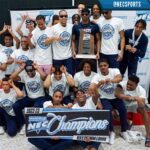
And he’s not just any swimming and diving coach, either. Under Askew’s leadership, Howard’s men’s swim team won its first conference championship in over 30 years this season. The men and women broke 31 team and conference records at the meet, restoring pride to a program that, just a decade ago, was virtually incapable of winning and on the verge of being shut down.
“It’s just been a long year, a lot of challenges to overcome,” says Miguel Davis Jr., who swims breaststroke and freestyle for the team and is from Prince George’s County. “With this championship win, it feels like all that hard work and the trials and tribulations paid off.”
“It’s amazing, honestly,” adds senior Courtney Connolly, who specializes in the 100-meter fly. “Most of us have been swimming since we were 4 to 6 years old. So to come to a team like this and see us getting some recognition here, a shine on us, it’s really an amazing feeling.”


But the Howard swimming story is about more than how “Coach Nic” — himself a former Howard swimmer and Olympic qualifier — took over the program in 2014 and broke its losing streak. It’s more than a comeback story. It’s about how a program built around trust and self-improvement has inspired the community around it and become a symbol for Black excellence. The world has taken notice; Sports Illustrated put the team on its cover because of its status as the only all-Black collegiate swimming program in the country, and ABC News covered the team’s historic conference win.
But even with those accolades, the team is just as gratified by seeing the real impacts of its efforts to combat swimming disparities in underserved communities.
“There are so many people who have reached out and thanked us, who said we’ve inspired them, that they have signed their kids up [for swimming lessons],” Askew says. “And we even had some people who have said, ‘Listen, I’m 75 years old. I never learned how to swim, but I just signed up at my local YMCA because of you all.’”
The mission starts on Howard’s campus, where all undergraduate students in the College of Arts and Sciences are required to pass a basic swimming course to graduate, a policy dating back to the late 1950s, Askew says.
Toles was inspired by programs like Howard’s when drafting her Maryland House bill, she says. After she saw the Sports Illustrated feature on Howard’s breakout season, she got in touch with Askew through his older brother — whom she already knew — and asked the Howard coach for his support.
Her legislation would create a framework for all counties to implement a swimming elective in public schools by the 2025-2026 school year, allowing them to partner with local parks and recreation agencies to access more swimming pools. D.C. Public Schools launched a similar pilot program in 2017 and expanded to schools in wards 7 and 8 in 2019, reaching 1,400 students across 24 schools.
Toles never learned how to swim, even though her family had an above-ground pool in their backyard when she was a child. She admits she still gets nervous when children in her family get near water. Studies show that if a parent does not know how to swim, their child will likely be unable to swim as well.
“That fear has been passed down from generation to generation,” she says.


A staggering 64% of Black children in the United States can’t swim, compared to 40% of white children, according to a study conducted at YMCAs by the USA Swimming Foundation and the University of Memphis.
But contrary to the popular narrative, swimming has deep roots in the Black community — West African cultures thrived along waterways long before European enslavers exploited their swimming traditions. Eventually, African Americans were deprived of these traditions as the Jim Crow laws that spanned from the 1910s to the 1960s kept Black swimmers out of public pools. Today, Black children drown at three times the rate of white children, according to the same USA Swimming Foundation study.
“Our goal is to continue to work towards breaking that cycle,” Askew says. “Legislation is one of the most impactful ways that we can do that.”
Another way is through free swimming clinics, which Howard offers at various points throughout the year through partnerships with organizations like YMCA.
Since 2018, Askew has hosted the Nic Askew Swim & Dive Camp each summer for more competitive swimmers who aspire to swim at the collegiate level, forging relationships with coaches and student-athletes from across the region and beyond. It’s part of an effort to not only spread the word about the sport in the Black community, but also create a pipeline for a program he hopes will continue to grow.
He says at least 20 campers have gone on to join the Howard swimming team over the years, including Taj Benton, a freshman from Baltimore who attended the camp’s first session as a rising ninth grader.
“I was looking at schools like University of Texas before I heard about Howard’s program,” says Benton. Over time, the coaching staff convinced Benton he had a future as a Howard Bison. Benton says attending the camp was the “best decision that I’ve ever made.”
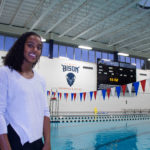
Similarly, Courtney Connolly, the senior fly swimmer from Michigan, says she was looking at bigger programs at predominantly-white institutions like Villanova, North Carolina State, and Rutgers universities before her mother forced her to visit the storied HBCU in the nation’s capital. She witnessed how the atmosphere surrounding the relatively small, six-lane Howard pool in the Burr Gymnasium resembled a Miami club — a hired DJ plays hits for packed crowds during home meets, and teammates are allowed to select the playlist during practices.
“My mom was the one that was like, ‘You need to make Howard one of your recruitment trips,” Connolly says. “I came here and I fell in love with the people, the energy, the swim team, everything. So then, a few weeks later, I went on a PWI [predominantly white institution] trip, and it did not compare.”


While winning the conference championship feels great, Askew, 44, says his eyes are on a bigger prize — a financial one. He’s looking for more more people to fund the swimming program, since its future partially relies on individual donations, he says. He wouldn’t be mad if someone with major spending power decided to directly fund the team — after all, NBA star Steph Curry’s financial commitment helped launch a successful Howard golf program.
Plus, Askew wants his team to compete with national powerhouses that make headlines in March each year. Mid-major teams like Howard’s don’t typically have athletes who qualify for the NCAA Division I Swimming and Diving Championships. Howard’s best swimmer, senior and Olympic-hopeful Miles Simon, was close to qualifying for this year’s NCAA championship — but he’s now looking to transfer for grad school in hopes of making the NCAA tournament and Olympic trials in 2024.
The Bison placed 52nd out of 57 teams at that invitational in Indiana earlier this month. But with more money comes better equipment, facilities, travel arrangements, and a more seamless recruiting process to bring top-tier swimmers on board.
Still, even the ambitious Coach Nic — who somehow also manages to coach Howard’s tennis program — can’t deny this season was spectacular. “This season has been a season of destiny,” he says. “You know, all the things that we’ve done in the last nine years since we took over the program have really led us to this point.”
At one of the last Howard swim practices of the season, on a Monday morning, soul music blasted and spirits were high. Askew ended practice with a “kudos” session, inviting swimmers to offer praise to their teammates for a job well done. Seniors recognized freshmen and relayers hugged each other for “putting in that work.”
Askew let the feel-good moment last for as long as the team wanted. At the end, he smiled.
“It’s Monday,” he says. “It’s a good day to be a Bison.”