 Jenny Gathright
In the scheme of government-funded grants, $5,000 is very little. But James Dunn was able to stretch it pretty far.
Last year, he was given a $5,000 award — called a “mini-grant” — from a city-run program called Building Blocks DC, and he used it to take five teenage boys on a trip to New York City. “The Streets to Wall Street” took the teens on a tour of the city and a visit to a private equity firm, where they met a partner who grew up in D.C., just like they did.
The grant covered their travel expenses, and Dunn used the rest to give each boy $250 to invest. The private equity firm they visited also matched Dunn’s contribution, so the teens got $500 each.
“It was just a beautiful experience, and these kids had never even heard of anything like this — that you can put money aside and make it grow annually and compound over time,” Dunn says.
But for Dunn, the true value of the trip wasn’t the money. As soon as they left the District, he says, the boys became visibly calmer.
“If you can get them away from D.C. and not worried about somebody that they may have a problem with, they can relax,” Dunn tells WAMU/DCist. “I wanted to have it give them a different experience … to make them feel comfortable that they were with a group of people that love them, that care for them, and ultimately wanted to help them overcome whatever it is that they’re dealing with in their life.”
Why mini-grants?
The Building Blocks grant program, launched in 2021, was announced as part of a broader D.C. government framework that promised to direct resources towards the people and neighborhoods suffering most intensely from gun violence. In two years, it has distributed more than $1.6 million to a total of 162 grantees. Many have praised the community-driven work made possible by these grants—but others who work to prevent gun violence in D.C. argue the D.C. government is throwing money at the problem of gun violence without a clear, evidence-based strategy.
All of the grantees are small organizations or individuals focused on providing job training, recreation, and other kinds of support to residents. Their programming has ranged from film screenings to yoga and mindfulness classes to trips outside the city, like Dunn’s.
The purpose of the grants is to make government funding accessible to a group of residents who are closest to gun violence (and traditionally excluded from other grants and the broader nonprofit world). And it seems to be accomplishing that goal – recipients of the mini-grants have praised the simple application process and the city’s willingness to bet on their ideas.
Linda Harllee Harper, who leads the D.C. government’s non-police violence prevention efforts, says the mini-grants are part of a broader strategy to build goodwill and empower residents in a city that has “lost its sense of community” in recent years.
“We need some help with our community building,” Harllee Harper says. “I think that that is a key part to preventing gun violence.”
Harllee Harper says that when she assumed her role as Director of the Office of Gun Violence Prevention at the start of 2021, she found many residents were trying to organize neighborhood events and programs out of their own pockets. These grants, she says, were made to support those people.
She chose $5,000 for the grant size, she says, because she wanted it to be enough to relieve some of the financial burden without getting so big that “managing the money became the hardest part of the grant process.”
Another hope, Harllee Harper says, is that going through the process of applying for and receiving the grant will lead small community-based organizations or residents without formal nonprofit experience to apply for more grants in the future.
“Part of this whole process was to be a learning opportunity,” Harllee Harper says. “Grant processes can be intimidating.”
Thandor Miller, one of about 35 grantees who have received the Building Blocks award multiple times, says the application process was simple.
“The way their granting process is set up, it is not complicated,” Miller says. “The questions and the prompts don’t keep you running to the dictionary … they make it accessible and non-threatening, so you don’t have to go find a grant writer.”
Most Building Blocks grantees have been one-time recipients, though as of February, 36 out of 162 recipients had won the award more than once, like Miller. Harllee Harper says staff in the Office of Gun Violence Prevention monitor the performance of grant recipients by sitting in on programming and interviewing participants.
Miller describes himself as a “Master Facilitator of Youth/Life Work Practice”– basically, someone who works with others to help them achieve goals and gain confidence in their lives. His workshops focus in part on the issue of low self-esteem, and how that can be a root cause of harm and violence in D.C.’s communities.
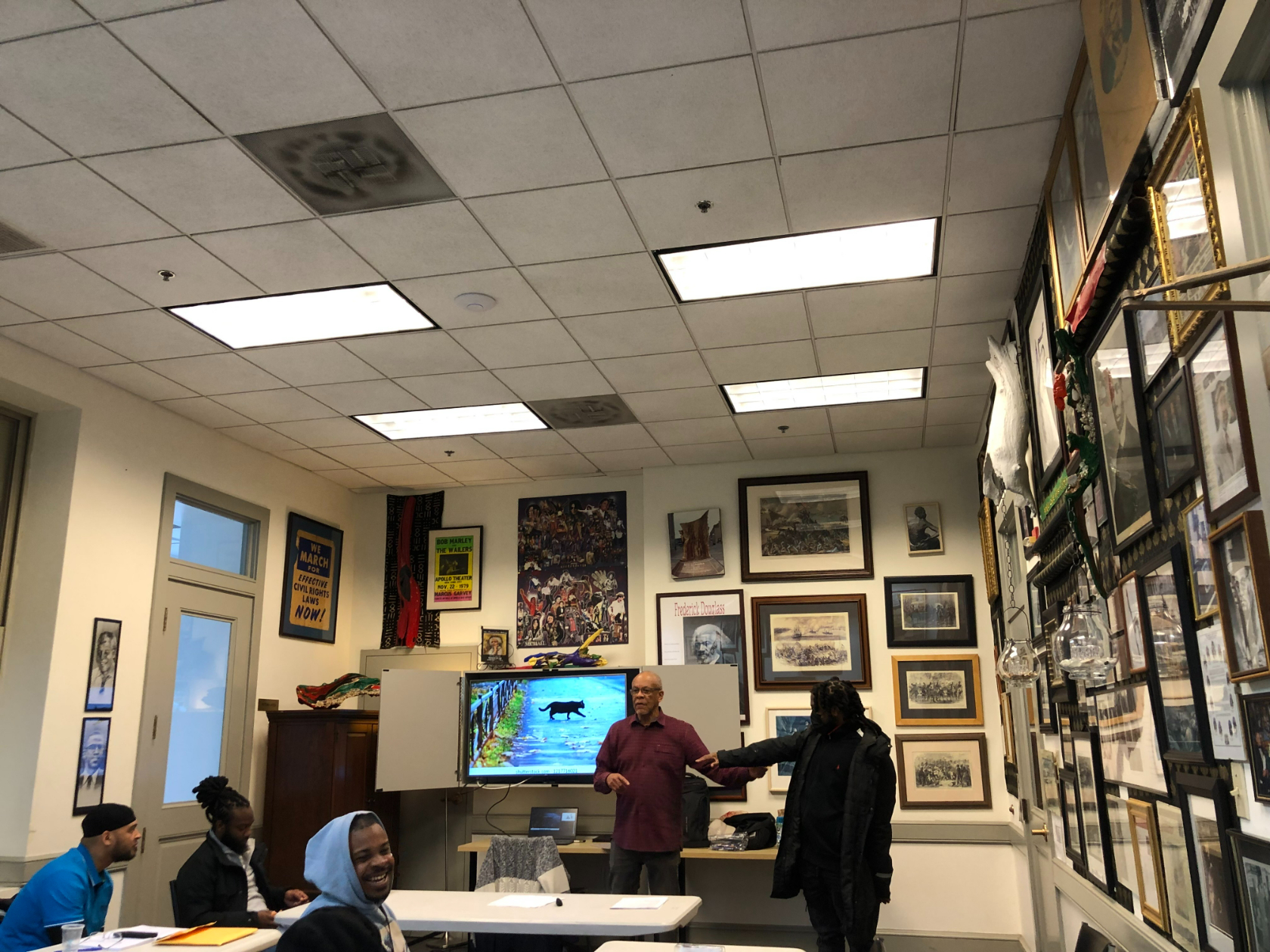
On a Thursday morning in January, Miller put his grant money to work with members of the Free Minds Book Club, an organization that offers book clubs, writing programs, and reentry support to currently and formerly incarcerated D.C. residents. Free Minds connected the students with Miller and provided space for the workshop at their offices in Shaw. Most people in the class were men who had been released from prison within the past several months, working through the often-frustrating processes of getting government IDs, finding jobs, looking for stable housing, and meeting the strict requirements of supervised release.
Amid a class of about ten students, in a room with walls full of Civil Rights era posters and portraits of Black icons like Frederick Douglass and Malcolm X, Miller asked the men in the class to write down five reasons why they’re worth never giving up on. La’Velle Nicholson stood up to read his answers to the class first.
“I’m a good loyal friend with potential. I am smart and a fast learner. If someone needs me and I am there …. I will help them. And I am an all-around good person,” he said.
“I have learned to accept self, something that I don’t believe I did in my past – meaning when we was young, we spent so much energy chasing perception,” Anthony Davis told the class next.
“I’m willing and able to contribute to something greater than myself,” Davis went on. “I’m willing to respect others … and I’m determined to be a better being, no longer afraid to announce that I am in need of help on this journey in life.”
After everyone shared, Miller turned back to the class.
“Let me tell you how to use this,” he said. “For the next 30 days, get up with it every morning, take that book in the bathroom, look in the mirror, and read those things.”
Miller has a long history working in and around the field of violence prevention. In the late ‘90s and early 2000s, he and his wife started working with young people in the warring Northeast D.C. communities of Mayfair and Paradise. In the mid-2000s, they moved the model over to Trinidad at a time when violence there was high and the police department had instituted a controversial vehicle checkpoint system for cars going into the neighborhood. He’s also trained school resource officers on how to work with young people, and he’s worked for the ACLU.
Moving money “more quickly and flexibly”
The Building Blocks grant program also has a long history. It was partially inspired by programs at D.C.’s Department of Youth Rehabilitation Services, which created a grants program of its own for community-based organizations in the 2000s.
Harllee Harper was at DYRS during that time, working in various capacities and rising to the role of Deputy Director before she started leading D.C.’s gun violence prevention efforts.
During her tenure at the agency, D.C.’s juvenile justice system underwent significant changes. After years of litigation over deplorable conditions at the city’s Oak Hill youth detention facility, a group of reformers took over leadership of D.C.’s youth rehabilitation agency. They focused on locking up fewer kids and offering more community-based programs. They replaced Oak Hill with a much smaller facility called New Beginnings, and started to treat it less like a youth jail and more like a site of rehabilitation. Miller says he actually helped train youth correctional officers at that time.
“Our training was a part of that shift in mindset,” Miller says.
During this period in the 2000s, DYRS also started partnering closely with Progressive Life Center — the nonprofit Building Blocks uses to distribute grants today — to contract with small, community-based providers to organize programs for young people. The specific intention was to connect with people who were already serving kids in their neighborhoods, like a trusted restaurant owner or hair braider, for example, and actually pay them to formalize and expand their offerings.
The idea behind this strategy is that if it works well, it empowers members of the community who may not be able to access more traditional government jobs — and lets the government step back and merely serve as a monitor to make sure the money is well-spent. And the nonprofit that administers the grant and distributes it can give out money faster (and be more adaptive to people’s needs) than the government, Harllee Harper says. Progressive Life has a $19 million operating budget and works across the mid-Atlantic; the nonprofit receives other grants through local governments, including to manage foster care and kinship care programs.
“Across the country, governments almost always have nonprofit partners to help them to move things more quickly and flexibly,” she says. One example of that flexibility is evening hours.
“A lot of our grantees have full time jobs. And so in order for them to come down and meet with Progressive Life and go over all the details of the grant, we had to set out weekend and evening hours,” Harllee Harper says. While not unheard of, she adds, “just that small thing is not as easy in the government.”
It’s also not easy — and in many cases, impossible — for the government to build trust with the residents who are closest to the violence.
Participants of one Building Blocks program — a Life Skills course run by longtime D.C. resident Asiyah Timimi — say it’s been successful at building that trust. For her class, Timimi recruits residents from the Anacostia neighborhood commonly known as Choppa City, and gets them together twice a week to identify their goals, get their resumes together, and practice interviewing for jobs.
“She’s been where we are,” says Imani Abdul-Rahman, who took the course last year. “Her own son was shot multiple times a few years ago…she’s lost countless friends and family members in the community through gun violence. Because of that understanding that she has, she can reach us in a way that somebody else couldn’t. And because she’s been in our shoes, we trust her.”
Building Blocks funding made it possible for Timimi to pay for transportation and food for participants, which Abdul-Rahman says also made a huge difference for them.
“Some people, when they live the street life or they’re going through things, they might not feel safe to travel through the city to get to class. And she totally made a way for those individuals,” she says. “You wouldn’t be hungry. You would be able to get there and get back home safely. And that’s half the battle…you don’t have to focus on safety. You’re there to learn.”
And Abdul-Rahman is convinced that programs like Timimi’s can prevent gun violence.
“Here’s how I see it: When you love yourself, you value life. And when you value life, you know the importance of somebody else’s life. And when you have a job and a career and you can pay your bills, the last thing you want to do is to take another life,” she says.
A lack of strategy
Lashonia Thompson-El, the director of strategic initiatives for the violence intervention-focused group Peace for DC, says she thinks these efforts could be even more effective if the city gave community-based organizations more sustainable funding and focused on the evidence-based practices that have been successful in reducing gun violence elsewhere.
“I’m just not a fan of throwing things at the problem,” Thompson-El says. “I’m a fan of building a movement, not just doing a bunch of stuff and having a bunch of people receive small amounts of funding to do programs. I want us to really deliver care in a more thoughtful and strategic way.”
Thompson-El says her viewpoint is not necessarily a critique of Building Blocks, but more a statement about what could happen if the city coalesced around a coherent gun violence reduction strategy, instead of “just doing things that are creative and sound good.”
For example, Thompson-El thinks city resources could be spent empowering residents to become what she calls “transformative leaders” who are trained to help the people at highest risk of becoming a victim of gun violence or a shooter. And she thinks the city needs to go beyond $5,000 grants for smaller projects, and focus more on equipping community-based organizations closest to the violence to be effective in the long-term. For example, she says, the city could invest in leadership training for the founders of small gun violence-focused nonprofits so that they can grow their organizations and serve more people.
The Building Blocks grant program was, after all, originally announced as part of a broader citywide strategy to focus resources and attention on the city blocks with the highest rates of shootings and violence. In 2021, the city launched what it called an “Emergency Operations Center” to serve, as the Washington Post reported –like “air traffic control” in the city’s gun violence prevention efforts.
But the center, which officials said was largely staffed by government workers who had been temporarily pulled from their jobs at other agencies, eventually wound down early last year. City leadership decided resources were better used investing in existing violence prevention programs. The move led to criticism from those who felt like they couldn’t understand D.C. Mayor Muriel Bowser’s overall violence reduction strategy — but officials say the Emergency Operations Center was always intended as a temporary tool for deciding how to organize the city’s violence prevention efforts.
Despite criticisms of what some have called a piecemeal approach, city officials say they have made strides towards a more coordinated strategy. Last year, the city published a gun violence reduction strategy they’d commissioned — and in February, City Administrator Kevin Donahue testified before the D.C. Council that the Bowser administration has begun to implement many of its recommendations. For example, city leaders say they’ve been conducting a weekly call with all of the community-based organizations across the city that work directly with people at high risk of becoming a shooter or a victim. This year, Bowser announced that Harllee Harper would take on leadership of the city’s Office of Neighborhood Safety and Engagement in addition to her existing job as Director of the Office of Gun Violence Prevention. The move was intended to consolidate some control of the city’s gun violence prevention efforts and improve coordination between the two agencies.
For her part, Harllee Harper argues that the Building Blocks grants actually are connected to a broader strategy, and have been awarded in tandem with other efforts. For example, she says that the last round of grants were given to people working in neighborhoods where MPD was adding extra homicide prevention resources, so “we have grantees working in those spaces at the same time that MPD was putting intensive efforts in the same community to reduce and eliminate homicides.”
“And we saw results,” Harllee Harper says. “It’s hard to pinpoint [whether] the increased police presence did it or the Building Blocks grantees did it. But we saw the answers, we saw the responses, and we saw the positive impact.”
While homicides citywide last year were down from 2021, they remained close to a 15-year-high. Homicides and assaults with a deadly weapon did decrease last year in two of the police service areas that MPD targeted through its Homicide Reduction Partnership, but it’s difficult to tell what exactly may have caused the decrease.
The program has also offered additional training for Building Blocks recipients – including media training and other workshops to help them grow their organizations. And they’re working to give larger amounts to grantees who use their money responsibly and effectively: this year, they made grantees who were in financial and programmatic compliance automatically eligible for larger grants of $15,000.
Dunn says he saw the potential citywide impact of a program like Building Blocks when he went to a meeting with other grant recipients. He was so inspired by all of their ideas, he says.
“We have to work together collectively to come up with different ideas because what may work with one may not work with others,” Dunn says. “Ultimately I believe that it’s a great idea … the ripple effect of it could be tremendous.”
Measuring success
For some Building Blocks recipients, the impacts of their work are measurable: Timimi’s former students say they’ve gotten jobs, for example. One of them told DCist/WAMU last year that he’d gotten a job with the violence intervention program Cure the Streets, a role that he felt was putting him on a solid career path.
Abdul-Rahman says the course led her back to a dream career. Timimi’s course was in part dedicated to Abdul-Rahman’s brother Yisa, who was fatally shot in 2020. Abdul-Rahman actually never intended to take the course herself, but after she visited the class one day, she decided to keep coming back. Since taking the course, she got a job at a salon and now has plans to complete her cosmetology license.
“Because I’ve gone through so much grief over the last 3 years, I kind of lost my own self confidence. I know I’m smart, but the most brilliant person with low self-esteem can never move mountains…and I feel like she gave me my self confidence back,” Abdul-Rahman says. “When I got pregnant with my son 14 years ago I was halfway through cosmetology school but I had to stop because my pregnancy was so hard … I used the tools that she gave me to get back into the salon.”
On the other hand, the impact of a class like Miller’s — which is about internal transformation — is difficult to quantify.
But Anthony Davis, who sat quietly taking detailed notes for most of the hours-long session with Free Minds, says it made a difference for him. His main takeaway was that it’s important to always look inward — instead of blaming your circumstances or other people for the position you’re in. Davis, 48, was released from a 28-year prison sentence in December. He’s still getting used to his smartphone, and he says navigating the employment process has been full of “confusion.” But he wants to work in landscaping, or maybe get a forklift certification so he can get a well-paying warehouse job.
“I understand there are some obstacles we may have to go through,” Davis says, “but you still take ownership of self and be responsible [for yourself] with regards to trying to get your employment and housing and things of that nature. It all goes back to self – I truly believe it.”
This article was reported through a fellowship supported by the Lilly Endowment and administered by the Chronicle of Philanthropy to expand coverage of philanthropy and nonprofits. WAMU/DCist is solely responsible for all content.