Morgan Baskin
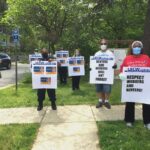
When the dozens of families who live at 741 Longfellow St. NW received notices in late March that their rents would increase by 8.9% after May 1, they were shocked, then increasingly concerned.
At the rent stabilized building, which 27-year-old resident Cristian Santos says is home to many Spanish-speaking families who rely on service jobs to make ends meet, tenants have struggled to bounce back from the widespread layoffs and reductions in hours that plagued their industries during the pandemic. Many don’t work full 40-hour weeks, while others haven’t been able to find new work at all.
And now they’re staring down housing insecurity. At least five households believe they might have to move to avoid paying the increased rate, which adds up to about $150 per month at the building’s more expensive units.
“[It’s] the difference between putting another meal on the table, buying groceries, or paying rent,” says Santos, who also founded the building’s tenant association. “It comes down to that, because everything around them is expensive. We’re in an expensive city, in an area that’s seen a lot of change.”
The tenants at Longfellow are flashing a warning sign to others across the District: With the city’s allowable rent increase rate set to jump from about 6% to nearly 9%, tenants who continue to struggle from lost work during the pandemic might not be able to shell out for the hike.
When the rate increase goes into effect May 1 – the highest it has been in more than 40 years thanks to surging inflation – it will apply to between 70,000 and 90,000 rent stabilized households across D.C. It comes as many renters are feeling the pinch of higher living costs, and recalibrating their careers after the pandemic left many industries in freefall.
And it does not appear likely that agencies under the direction of Mayor Muriel Bowser will work with lawmakers seeking to reduce the rent hike. Both Ward 5 Councilmember Zachary Parker and At-Large Councilmember Robert White, who chairs the housing committee, planned to introduce emergency bills on Tuesday that would have capped new rent increases below the 8.9% rate scheduled to go into effect next month. White’s bill would have limited new rent increases to the rate of inflation – 6.9% – while Parker’s aimed for a 5% cap. (Under D.C.’s current rent stabilization law, most new increases are limited to inflation plus 2% at buildings built before 1976, capped at 10% total.)
But in the days leading up to Tuesday’s legislative session, conversations between the councilmembers’ offices and the Bowser administration soured, lawmakers said, and it became unclear whether White and Parker would even be able to introduce their measures. Employees of the Department of Housing and Community Development, which oversees the commission responsible for approving rent increases, told members that the fiscal impact of their proposals was too large for the city to absorb – a death knell for emergency laws, which cannot cost the city money.
That cost? At most, one full time employee, DHCD Director Colleen Green told the housing committee during a hearing on Monday. Other cost estimates have run as low as $30,000 in pay for the part-time employee who would have to take on the caseload, City Paper reported – at an agency with more than 170 employees. (A spokesperson for DHCD did not respond to DCist/WAMU’s questions about the agency’s position on the measures, or their fiscal impact.)
“That seems like a hard pill to swallow, that we couldn’t repurpose funds to ensure tens of thousands wouldn’t be displaced [or] face financial hardship,” Parker told DCist/WAMU. “We still have a chance to act. [But] the urgency I’ve seen from the council has not been met by the executive.”
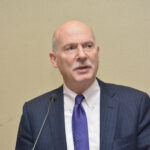
At this point, Parker says, the council could only work to enact emergency legislation before the May 1 hike if DHCD agrees to swallow the cost of the bill; the council would then have to organize an emergency session to pass a cap. (If D.C. Council Chairman Phil Mendelson declined to call the session, a majority of councilmembers would have to do so.)
Absent that kind of intervention, Parker says his office is drafting a permanent rent stabilization bill that’s more aggressive than what D.C. has on the books, and that is informed by the policy conversations happening in surrounding jurisdictions. The Prince George’s County Council passed a yearlong rent stabilization bill that will cap new hikes at 3%; in Montgomery County, legislators are weighing two rent stabilization measures that would see hikes limited to either 3% or inflation plus 8%.
Asked by DCist/WAMU when he might introduce that bill, Parker said “stay tuned.”
But even passing a more aggressive rent stabilization law than the one currently on the books, which would require overcoming significant political hurdles on and off the council, would leave tenants to shoulder the 8.9% hike for months, if not longer.
The historic rent hike comes as emergency rental assistance for those behind on payments – one of the city’s most effective tools to prevent eviction – has already run out for the year. Bowser’s proposed budget for the next year would cut funds to that program even more dramatically. The combination of those factors, White said in an emailed statement to DCist/WAMU, will be “devastating.”
For Santos, that could mean losing the vibrancy of a community that has become a central part of life. Some families occupy between two and five units each in the building, which hosts a deeply connected web of relationships that have seen some tenants through 15 years in the same apartments.
“We come from a background where we have nothing, and we come to this country to work. We want to preserve what we have,” Santos says of the immigrant community living at 741 Longfellow. “We want to avoid going our separate ways.”