Margaret Barthel
Puedes leer este artículo en español aquí.
Gaping holes in oversight of private affordable housing providers in Arlington County came to light during a four-year struggle to improve living conditions at a single building. The county is still wrestling with implementing the lessons learned.
It took nearly two years of tireless advocacy on the part of tenants and tenant advocates to elicit a systemic response to address poor housing conditions like mold and ever-present mice at the Serrano Apartments, a two-building, 280-unit complex originally built in the 1960s.
The complex is owned by AHC, Inc., a nonprofit affordable housing provider with a significant portfolio in Arlington. The organization owns more than 3,300 units, about a third of the county’s total, and has been working there since the mid-1970s. The nonprofit has since become active elsewhere in the region, with properties in D.C., Fairfax County, Montgomery County, and Baltimore.
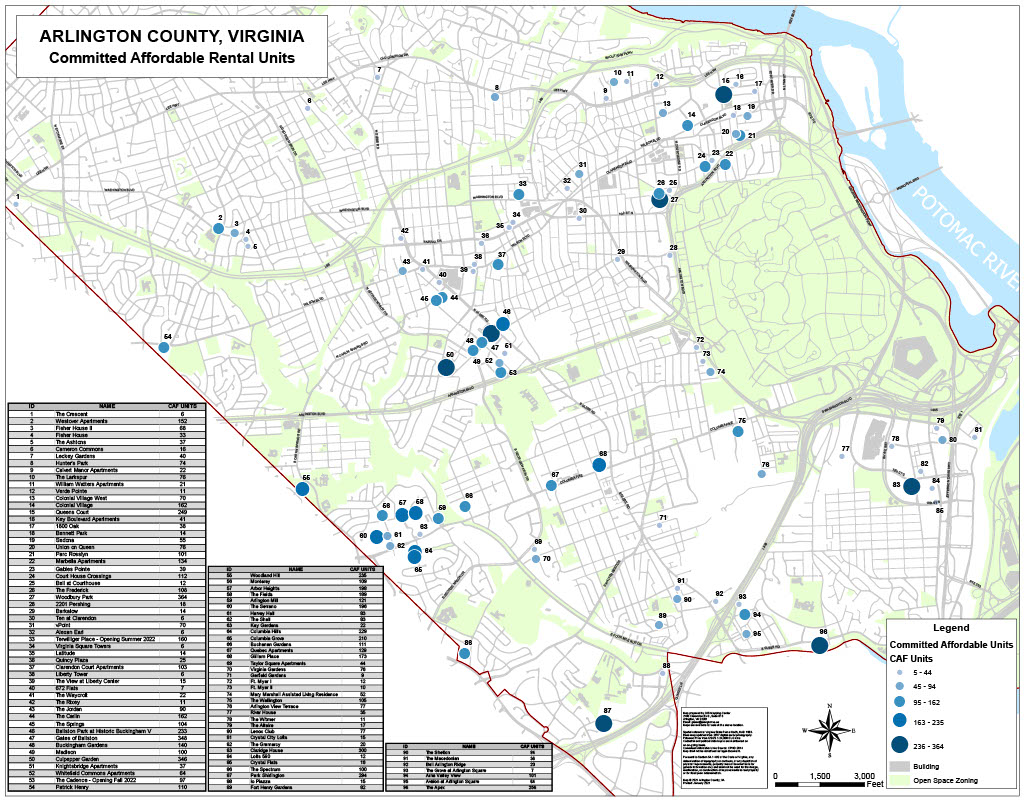
Arlington does not have a public housing authority. It depends on — and financially supports — a handful of nonprofit organizations like AHC and for-profit companies that preserve, develop and maintain affordable housing units. Of Arlington’s roughly 11,000 “committed affordable” apartment units, two thirds are owned by nonprofits.
The maintenance issues and broken trust unearthed at the Serrano Apartments in 2021 were particularly stark and made headlines (ARLnow first reported the story). Some advocates say the maintenance needs of the aging property were compounded by what they describe as a dismissive attitude toward tenant concerns on the part of the then leadership of AHC.
“It seemed like they were treating it like, ‘Well, there’s always going to be maintenance issues. There’s always going to be people who are unhappy, like, what’s the big deal?’” says Kellen MacBeth, the chair of the county’s Housing Commission. “That’s not how a nonprofit should be acting.”
AHC has since made significant changes in its leadership, and says it is working to become more “resident-centric.”
But for some tenants and advocates, the experience highlighted how few avenues the county has to compel private partners to maintain livable conditions in affordable housing. And they believe that the same issues are present across Arlington’s affordable housing portfolio, particularly in other buildings run by AHC.
“You’re also saying that things have improved. And I would like to say that you need to come and see for yourself, knock on their doors and check the conditions that we’re living in and our children, too,” one Serrano resident said through a translator at a public meeting last month.
They point out that the county’s rush to create more desperately-needed affordable units — an expensive proposition in the red-hot local housing market — often focuses on aging properties, which are more prone to maintenance problems and management challenges.
And they say that figuring out how to prevent future oversight lapses is essential, not only for current tenants but also for future ones, as the county seeks to hit ambitious goals for the preservation and creation of affordable units.
“[The county] wants to help, to have affordable homes,” says Janeth Valenzuela, who has been working with tenants at the Serrano since 2019 and is also the founder of Arlington Schools Hispanic Parents Association. “But the question here is, who’s overseeing this? What is the accountability for the money that they [are] giving to these organizations? That is my question.”
Trying to keep up with the housing market
Affordable housing is urgently needed throughout the D.C. region. To prevent high housing costs and scarcity from damaging the area’s overall economic competitiveness, at least 374,000 more affordable units must be added by 2030, a 2019 Urban Institute report found.
Arlington is one of the local jurisdictions that has had at least some success rising to that challenge. The county has rapidly increased its supply of affordable units, growing its total nearly 30% between fiscal years 2020 and 2022. That pace will continue or speed up if the county abides by its ambitious goal of ensuring 17.7% of its housing stock is affordable to people making at or below 60% of area median by 2040 — an estimated 15,800 affordable units.
But this recent success follows a decades-long severe loss of affordable homes. The county lost more than 20% of its market-rate affordable apartments between 2000 and 2009, according to a report from the Northern Virginia Affordable Housing Alliance. The County Board was feeling that pressure in 2014 when they approved a $16.5 million loan to help AHC buy the Serrano complex.
“We need to…make as many committed, affordable housing units as we can, as fast as we can for as least money as we can,” said County Board Member Libby Garvey during the debate on whether to approve the loan. She noted the Columbia Pike area’s targets and her concerns that the county would fall short of them.
At the time of the loan approval, the board debated one of the trade-offs localities face in creating affordable housing: whether to spend the limited funds to create more affordable units at higher price points, or to use the money to create fewer units that could serve people with much lower incomes. In the Serrano project, the former won out: ultimately, the proposition of preserving nearly 200 affordable homes, even at higher price points (affordable to households making 60-80% of the area median income), was too attractive for the board to pass up, particularly considering the development pressures along Columbia Pike.

Low-cost loans from the Affordable Housing Investment Fund (AHIF), like the one that helped finance the Serrano purchase, are one of Arlington’s main tools for incentivizing the creation and preservation of affordable housing. The county has approved more than 120 such loans, with about $457 million lent out (and about $150 million repaid), according to a recent budget presentation.
Lately, Arlington has had an unexpected boost from corporate giant Amazon, which has pledged $992 million in loans and grants to increase affordable housing in the D.C. region, as its high-paid employees arrive (slowly) at the company’s new campus in the county and seek housing nearby. Some of that money has already helped finance the purchase and preservation of several large agingproperties in Arlington.
There are structural reasons why money often goes to converting aging buildings into affordable housing. It’s cheaper than building new, at least in the short term. New construction of a high-rise development can cost as much as $400,000 per unit, according to one expert estimate. That’s significantly more than what AHC and county staff estimated as the development cost for the entire 280-unit Serrano complex at the time of purchase: $222,000.
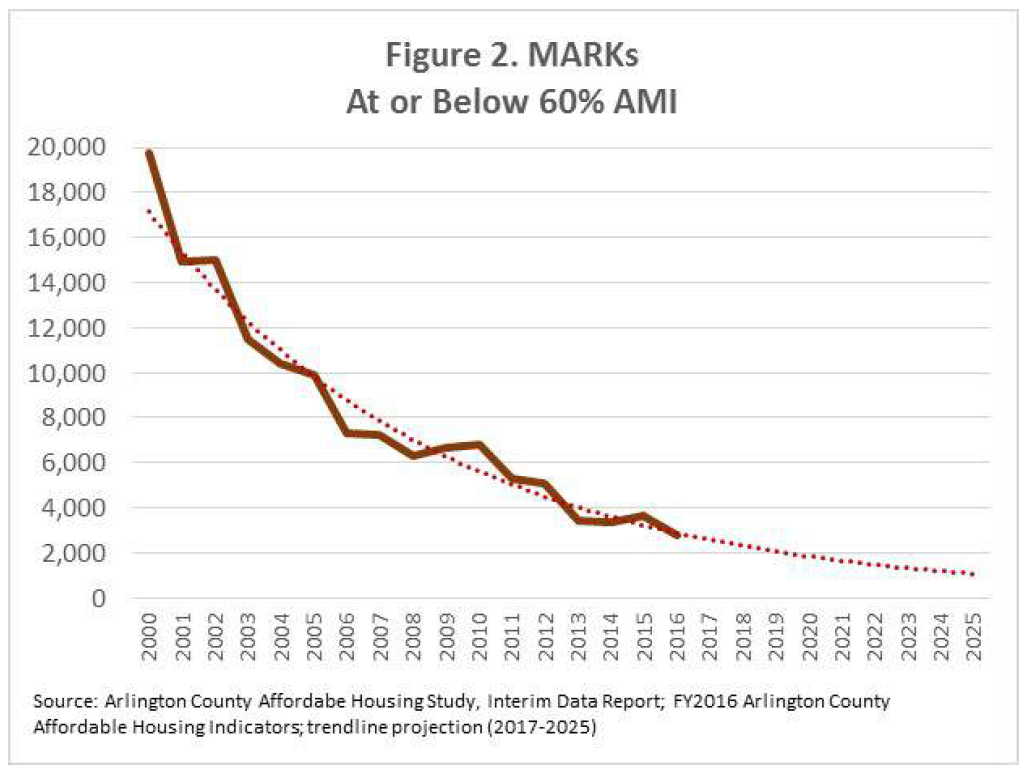
As land prices rise, older complexes like the Serrano either see big jumps in rents or are bought, torn down, and replaced by luxury high-rises. And, because most areas of the D.C. region are already heavily built out, losing market-rate affordable homes to the skyrocketing market often means those homes are just gone, says Peter Tatian, a senior fellow at the Urban Institute’s Metropolitan Housing and Community Center.
“It’s often impossible to replace [an affordable property] directly,” he explains. “So the preservation piece is so important.” Preservation of older buildings as affordable housing can also help prevent the displacement of people who already live there.
But once a development deal is over and the apartments in an aging building are preserved as affordable homes, governments and property owners face a new challenge with new costs: keeping those older buildings maintained.
Maintenance of aging properties — particularly, finding the money to do it — is “a constant topic of conversation,” Tatian says, in the local and national affordable housing community.
“The rent is very low, obviously, because the people who are living there … can’t afford to pay more,” he says. “It’s the problem of who is going to pay for all those renovations and quality improvements.”
Inspections find problems at other properties
The Serrano complex is unique in the level of scrutiny and public outcry it sparked in recent years — but it is not the only AHC-owned property that tenants and advocates have expressed concerns over.
“Other properties are in the same or worse condition,” Valenzuela says. “The only problem is people are afraid to say it.”
Saul Reyes, who runs BU-GATA, the county’s only tenant advocacy organization, agrees.
“We have been around since 1992. We’ve communicated issues,” he says. “This isn’t the only apartment community that they have had problems [with] pest issues, maintenance and disrespectful management staff that would be rude to residents.”
Elder Julio Basurto, a former Serrano resident and the founder of Juntos en Justicia, an advocacy group that organizes with vulnerable communities, worked with Valenzuela to organize residents at the complex. He’s since started advocating for residents at other affordable housing properties in Arlington, including Gates of Ballston, a 465-unit aging complex from the 1940s. It’s also owned by AHC.
“[Gates of Ballston tenants] were reporting mold all over the walls, mold taking over the beds, mice and rats,” Basurto says. He gave a tenants-rights presentation at a local Latino church in December 2021 and organized several follow-up meetings with Gates of Ballston residents that month and in early 2022. “They were reporting all of these things going on and they were saying that management was unresponsive.”

While conditions at the Serrano complex have improved, tenants and advocates still report problems. At a recent county Housing Commission meeting, several people shared concerns about mishandled water and heat shut-offs — disruptions which are the result of fixes to building systems — and problems with elevator outages, pest control, and rudeness or threats from property management staff.
Concerns about housing conditions at AHC properties aren’t new to Macbeth, the Housing Commission chair, who has been involved in the county’s Housing and Tenant-Landlord commissions for several years. (Both are volunteer advisory commissions made up of citizens appointed by the County Board.)
MacBeth says that most of the tenant complaints about subsidized housing units he has heard during his more than five years of service have been about AHC properties. In some ways this is not surprising, considering that the nonprofit manages a larger number of units and has more aging properties than other landlords. But before the problems at the Serrano received heavy community and media scrutiny in 2021, MacBeth says he saw a level of disinterest from AHC’s old leadership in responding to the problems.
“There were some cultural challenges that AHC has faced, and I think they’re reckoning with those,” he says. “They have been trying to reorient themselves towards like, ‘We need to make sure that every one of our residents is happy and safe in their home as we possibly can.’”
There’s some evidence that those “cultural challenges” may have affected other buildings. In the wake of the Serrano saga, Valenzuela, Basurto and Reyes pushed for Arlington County to conduct building-wide housing quality standards inspections for six additional aging affordable properties. Three are owned by AHC: Harvey Hall, Arbor Heights (both neighboring properties to the Serrano), and Gates of Ballston. Those inspections took place in 2022, approximately one year after AHC’s CEO retired amid the scandal at the Serrano.
While all 65 units inspected at Harvey Hall passed on the first attempt, only 46% passed at Arbor Heights, and only 29% passed at Gates of Ballston, according to numbers provided by Arlington County. (One other property, Buckingham Villages, also struggled with inspections, with a 34% pass rate. Buckingham is a historic garden-style apartment complex owned by Telesis, a for-profit B corporation. The final two properties inspected by the county belong to Arlington Partnership for Affordable Housing and, according to a statement on the nonprofit’s website, had a 91% pass rate.)
A county spokesperson said all units passed reinspection within 30 days, and noted that units can fail if any item on the lengthy inspection checklist is a problem. That includes things like general wear-and-tear on tub caulking or damaged cabinets, smoke detectors without charged batteries, or additional locks or satellite wiring added by a resident.
The inspections were held up by a COVID-19 wave in early 2022, which Valenzuela and Basurto said gave property owners a window to make last-minute repairs. Some residents, they said, told them property managers suddenly made fixes that they had been requesting for years.

Some things did get fixed, Basurto says, including a mold problem so bad it had taken over the beds one family — including two children — slept on, which came to light in late 2021. He remembers a call from the family, thanking him for his help with a problem they’d been trying for years to fix.
“I was like, oof, it had to take all of this for this family, this hardworking family, immigrant family, to get a decent place to live,” he says.
But Basurto is skeptical that one-off inspections catch everything. After hearing concerns from multiple tenants at Gates of Ballston, he visited an apartment in September 2022 that he says should have been on the county’s list of inspections and repairs.
“Resident’s called me reporting multiple dead rats and mold in a large hole underneath the kitchen cabinets that a private repairman couldn’t fix. He referred them to me. I found two large rotting, moldy holes underneath the kitchen,” he says.
Arlington has increased the volume of committed affordable units it inspects each year, following the Serrano crisis, from just 5% of the portfolio — meaning that some units might only be inspected once every 10 years — to more than 20% between 2021 and 2023.
AHC CEO Paul Bernard, who came to lead the organization about a year ago, said he was committed to fixing any problems that arise at the nonprofit’s affordable housing properties in a timely manner. He said he was not aware of any current major problems, and pointed to breakdowns in communication between tenants, advocates, and AHC as a possible reason for the disconnect.
“I haven’t received the information [complaints about other properties aside from Serrano] that you are putting in front of me now, that there are these widespread concerns with residents or tenants around poor conditions in properties outside of the Serrano,” he said in an interview with WAMU/DCist. “I have not received that information either from the advocates or from the residents or from or from my property management.”
Bernard said that he last met with tenant advocates in November, and that he believed the organization had resolved all previous problems across its portfolio that they had brought to his attention, including regarding parking and pest control.
He said the nonprofit is making some changes to its asset-management approach, implementing regular apartment-by-apartment inspections for all of its properties.
“When I came [to AHC], I knew I had to tackle issues around asset management,” Bernard said at a March public meeting with the Housing Commission. “We’re rebuilding all that and putting structures and systems in place.”
Those inspections, Bernard says, allow AHC staff to see the physical state of apartments and also ask tenants about their experience living there.
“We’re going to make that standard in terms of what we do, so that we have two sets of eyes looking at the properties and looking at the conditions,” AHC staff and its contracted property manager, he told WAMU/DCist in an interview.
AHC recently completed that round of inspections at the Serrano. Bernard told the Housing Commission in March that staff found most apartments to be in good condition, but acknowledged that 20-30 units on the bottom floors “need some attention” to improve ventilation and fix issues related to moisture, stains, and tile repair. Bernard said pest control was “improved” but “still a focus,” particularly in certain “hot spots that we really need to take care of.”
Financial pressures
Some advocates believe what they describe as AHC’s history of neglect at the Serrano and other properties is traceable to the enormous financial pressures to develop new properties, which they believe has pulled the nonprofit’s — and to a certain extent, the county’s — focus.
“You just have to keep generating new and new and new. I mean, ultimately, you renovate the Serrano — that’s not a moneymaker, right?” says Rev. Ashley Goff, a clergy leader with Virginians Organized for Interfaith Community Engagement (VOICE), which helped with the initial response to conditions at the Serrano. “So how do you increase the bottom line? You make more units.”
According to documents filed with the IRS, AHC’s main source of revenue — accounting for more than 90% in most recent years — comes from “program services”: a combination of rents, fees from development, and other sources.
Bernard disputed the idea that AHC’s business model relies on increasing the number of units in the nonprofit’s portfolio. He said increasing the number of units AHC owns is more about the organization’s mission than its bottom line.
“The scaling part is secondary. Running the business well is primary,” he said. “So if I have real estate that is performing, then we could stay at whatever unit count [and not continue to scale].”
The nonprofit was not struggling financially in the years leading up to the Serrano crisis. For the most recent year available, 2019 — the year tenant concerns began — AHC reported net earnings of more than $4.5 million across all of its properties, up from $2.4 million and $3.3 million the previous two years. More recent forms have not yet been published by the IRS.
As for the past earnings numbers, Bernard called those profits “solid numbers” but said the organization would not see similar ones this year. “Those would represent successful years,” he said. “It’s certainly not going to represent what’s budgeted for 2023, because the development activity has tailed off.”
In “successful years,” Bernard said, AHC reinvests its profits back into its properties, particularly older ones like the Serrano, whose expenses are usually higher.
Former AHC executives enjoyed the benefits of the nonprofit’s financial success until the Serrano crisis led to a leadership shake-up. Tax forms filed by AHC for 2019 indicate that former CEO Walter Webdale made a salary of $382,213 that year, plus $89,461 in other compensation. Four other members of the leadership team also drew salaries of more than $200,000, plus tens of thousands each in additional compensation. That included the head of AHC’s for-profit property management arm, which the nonprofit replaced at the Serrano and other properties after problems at the Serrano came to light. In all, AHC executives’ salaries accounted for just over 10% of the organization’s expenses in 2019.
Management concerns
During the Serrano crisis, MacBeth saw broader organizational problems, too. As the living conditions at the Serrano came to light, he said AHC encouraged advocates to go to the nonprofit’s leadership with individual tenant problems. It was a useful stopgap, but one that underscored larger organizational issues, according to MacBeth.
“That means your processes are broken. That means that your chain of command isn’t working properly, if in order to get something resolved, you have to take it to the head of the organization,” he said. “Residents should be able to go to your frontline staff, bring up an issue and feel reasonably confident that it’s going to get resolved in a timely manner.”
“We have to babysit them,” Basurto says of his and other advocates’ work. “You don’t have systems, you don’t have management that does this? You don’t have procedures? Protocols? Come on.”
Bernard, who says he’s also shared his personal cell phone with advocates, says the decision is borne of a desire to have “open lines of communication” to address problems. He also says AHC has two resident services staff on-site at the Serrano, and believes they provide an additional channel for residents to raise concerns, “but you have to avail yourself [of] those pieces,” he notes.
Prior to the Serrano crisis, most AHC properties were managed by AHC Management, the company’s now-defunct for-profit property management arm. As of February 2021, the Serrano complex is managed by Drucker + Falk, and the nonprofit has contracted a total of three different management companies to run its properties in Arlington.
Basurto isn’t convinced that there was actually much of a change.
“I saw the same employees that were working for AHC Management were now working for Drucker + Falk,” he says. “So, you know, you got the same issues, just a new uniform.”
Bernard sees third-party property management as an additional layer of “oversight” and “objectivity.” But in response to a question about crossover between old AHC Management employees and new property management firms, he said he is vigilant about pieces of the organization’s old culture reasserting itself.
“As I’ve come in, I’ve been very deliberate in terms of articulating what my expectations are. And it’s up to me to hold people accountable,” he says. “When issues like that arise out of the old trying to sort of infiltrate and tread on what we’re trying to do that’s new, it’s taken care of, it’s managed.”
MacBeth sees the departure of Webdale and the arrival of Bernard and other new members of senior leadership in March 2022 as “really important,” a signal that the nonprofit could change course. He remembers being shocked by former AHC leadership in meetings at the height of the Serrano crisis “basically saying publicly the only thing that they will commit to do is what’s legally required of them.”
“It was like, ‘I think you’ve lost sight of who you are as an organization,’” he says. “This isn’t about business. This isn’t about the law. This is about helping people. That should be your overwhelming thought of why you exist as an organization. And if your leadership is not putting that first, then you need new leadership.”
There are signs that AHC is attempting to improve, instituting trauma-informed trainings for AHC staff and property management staff, and launching a strategic planning process aimed at making the organization more “resident-centric.”
“The view is you start with the residents, you start with what the residents’ needs are and you start at the people level and then you build around it, as opposed to starting with ‘how can I fund the building and then put people in it,’” Bernard says.
His philosophy, he says, is all about seeing affordable housing as a springboard for broader economic opportunity and social mobility for residents.
But organizational change doesn’t happen overnight.
“That message … has to work its way down to every person,” MacBeth says. “And that’s not just within AHC, that’s also in their management companies that they do business with.”
Bernard recognizes that there’s always more work to be done.
“I always feel pressure because I don’t think we are quite there,” he says. “I’m not sure if we’ll ever be able to do enough. And I carry that.”
Few ways to hold organizations accountable
Reyes, with BU-GATA, says the Arlington affordable housing landscape is beginning to change, with more private companies jumping in on high-profile affordable housing preservation deals. Added competition, he believes, could be a good thing. But how private companies handle the unique pressures of affordable housing mostly remains to be seen, he says.
Basurto and Valenzuela note that they’ve also heard concerns from tenants in affordable housing owned by entities other than AHC, though none so far have risen to the level of the Serrano issues. For example, Residents at Parc Rosslyn (which is owned by the nonprofit Arlington Partnership for Affordable Housing), spoke up at a recent County Board meeting about a practice of requiring residents in affordable units to park on the lowest floor of the parking garage, away from the parking spots of residents paying market rates.
The situation at the Serrano underscored gaps in county oversight of committed affordable housing properties and called into question just how many tools the county government has to prevent similar situations from developing.
Goff and Marjorie Green, both advocates with VOICE, say they felt county staff and County Board members had always generally assumed the good intentions of AHC as a partner. The need to draw a hard line with AHC, they said, seemed to come as a shock.
“All of a sudden they were being confronted with the reality that they were not holding these partners accountable, and they didn’t know exactly how to do it,” Green says.
Before the Serrano crisis, MacBeth says the county didn’t see much of a broader oversight role for itself in affordable housing properties.
“They were much more focused on, ‘Okay, how do we set aside the next building or how do we get the next affordable housing development project approved?’” he says.
Now, the county government sees its role as being a convener and a resource for property owners and residents alike. County staff and the citizen commissions essentially served as mediators between AHC and tenants during the height of the Serrano problems, and at times they continue to play that role.
“Ideally, residents and owners would be working together to resolve issues that arise,” says Anne Venezia, Arlington’s housing director. “If additional intervention is needed, the county is happy and willing to play that role to step in and try to facilitate conversation and resolution.”
Venezia gives credit to affordable housing owners for being willing to work on issues, including, she says, in the case of the Serrano. She worries that communication channels between residents and property owners are sometimes broken.
“What we find more often is, talking to an owner [about a problem] and an owner saying, ‘I wasn’t aware, I did not know that fill-in-the-blank was a concern or was an issue. Let me get someone out there today so we can follow up,’” she says. “And then we talk to the person who raised the concern with us and they say, ‘oh, yeah, I never actually called the owner. I just called you guys directly.’ So we’re finding that communication, strong communication, goes a really long way to reaching quick or quicker resolution.”
Green, the VOICE advocate, says some tenants haven’t always gotten results from calling the county’s Housing Information Center in the past, which is where the county has generally sent residents with landlord disputes.
“What the tenants were getting a couple of years ago was, ‘Well, now, have you talked to the management office? Okay. You didn’t get any satisfaction there? Have you gone to the next level? Do you know what the next level is?’”
But aside from facilitating conversations and communication, the county has few concrete enforcement mechanisms to demand change from owners — in the case of the Serrano, from its longtime nonprofit partner. (AHC had about $88 million in outstanding loan principal with Arlington County in 2021, according to audit documents.)
It’s a problem that even the federal government hasn’t cracked. While the Department of Housing and Urban Development requires and conducts housing quality inspections on affordable homes that receive public subsidies, its enforcement tools for when buildings are found consistently lacking are sometimes limited, says Tatian, the Urban Institute researcher.
“The recourse for HUD is basically to take the subsidy away, which is not necessarily helpful in terms of preserving affordable housing and may actually be what the owner wants, because they’d rather get out from the subsidy regime and have something that’s more market rate,” he says.
Implementing oversight of private housing providers
A September 2022 report from a joint subcommittee of the Housing Commission and Tenant-Landlord Commission on what happened at the Serrano points to “generally weak accountability provisions” in AHIF loan agreements. Like what Tatian describes at the federal level, the AHIF terms “forced county officials to choose between forcing affordable housing providers into default — and potentially turning the CAFs into market-rate units with no affordability protections — or letting providers get away with poor tenant treatment and property conditions.”
Venezia, the county housing director, says the goal is to never have to make that choice.
“At the end of the day, again, we’d like to assume residents wish to stay in their homes. We, of course, wish to see an operating healthy property, as does the owner — that’s our assumption,” she says. “So we really are aiming to get to resolution of whatever issue may come up as opposed to trying to shut down a property, for instance. That’s really not in anybody’s interest.”
Furthermore, the joint subcommittee report said Arlington had only a “limited infrastructure in place to deal with one-off tenant complaints and concerns” and “lacked a process to effectively address multiple, recurring complaints arising at the same property.”
The joint subcommittee recommended a host of fixes that could help prevent another Serrano-like situation in the future. They include changing the terms of AHIF loans to encourage landlords to support tenant councils and include tenants on their boards of directors, offer regular third-party fair housing training on tenant rights, and require them to report eviction data.
The report also suggests that the county provide free mold testing to residents, centralize the tenant complaint process, streamline the application for affordable housing, and take steps to increase the frequency of inspections — if necessary by offering compensation or incentives for tenants who are hesitant to allow inspectors into their units.
The county has implemented or committed to some of those ideas, as outlined in its own report published five months earlier, in April 2022: “Long-Term Strategies For Improved Oversight And Tenant Support At Aging CAF Properties.”
Venezia says Arlington is making progress towards those goals. The county is working with the Tenant-Landlord Commission to research possible alternative dispute resolution models, which could offer another avenue for conflicts. Staff are also attempting to make web and print information about what the county can do for affordable housing residents clearer, so that “if [tenants are] not feeling like issues are being resolved in a timely way, they understand how to reach out to and access county resources as well,” she says.
An upcoming county-led training, Venezia said, would also review tenant rights and responsibilities and offer information about how the county can help resolve problems.
With the help of third-party inspectors, the county is currently ramping up the frequency of inspections of committed affordable units that fall outside of its Housing Choice Voucher program (which includes inspection of every unit, managed by HUD). Prior to the Serrano crisis, the county had been inspecting just 10% of its committed affordable units each year, according to the report, meaning that “many units may receive a county inspection only once a decade.” Now, according to a budget presentation that Venezia delivered to the county board, the rate is closer to 20%.
The county is shoring up AHIF agreements’ focus on compliance and inspections. Venezia said the county has also added requirements for housing owners to do more frequent capital needs assessments and show the county an adequate budget to take care of the needs they find. The county is also working to implement several of the joint subcommittee’s ideas about tenant support, tenant services, and encouraging owners to create and support independent resident councils at their properties.
Venezia and the housing division expect to have a more formal update on the county’s implementation in May.
It all comes back to the budget
MacBeth, the Housing Commission chair, is encouraged by the county’s progress and commitments, but says there’s a long way to go. And he’s concerned that the county doesn’t have the staff capacity to get there.
He says it was a major victory when the county added funding last year for one additional staff position devoted to inspections — even with the recent nearly 30% increase in the number of units in the county’s portfolio.
“That was with a ton of advocacy and a ton of effort to be like, ‘You guys have to do this,’” MacBeth says. “Like how can you, with a straight face, say that we’re doing everything we can to make sure another Serrano saga doesn’t happen and you’re so under-resourced to actually do anything to prevent it.”
In lieu of a much larger staff, Reyes wants to see the county figure out how to centralize, collect, and analyze tenant complaints — “looking at data so that they can see, ‘Okay, well, there’s a lot of calls coming from such a landlord or such property,’ and it’s a red flag,” as he puts it.
Venezia acknowledges that the work of implementing the recommendations, even as the county’s affordable housing portfolio continues to grow, “will require ongoing resources.”
“So I think it’s just going to be really important for staff to continue to communicate with the [county] manager and then by extension to the [county] board on what the resource needs are and you know, and if there are any gaps going forward,” she says.
This year’s proposed budget, which is being forced to react to an uncertain economic climate and heightened inflation, does little to change housing staffing capacity.
While still under review by the County Board, the draft budget keeps staffing in the housing division of the county’s Department of Community Planning, Housing and Development the same. The proposal does not currently include replacement dollars for the one-time $50,000 American Rescue Plan allocation that funded the additional inspection position that was added last year. (County Manager Mark Schwarz said in a budget work session that replacing that funding is top on his list of priorities for the as-yet unallocated funds at the county’s disposal.)
MacBeth, who provided perspectives from the Housing Commission at the work session, also said he was concerned that the proposed $9.7 contribution to the AHIF loan fund — down from $18.7 million last year — would not be adequate to meet future capital needs beyond known expenditures needed this year.
“We know, for instance, that the Serrano is going to be coming up soon for either rehabilitation or redevelopment,” MacBeth told the Board. “That’s probably going to result in an AHIF request that at current funding levels of 9.7 million, we will not be able to pay for.”
The AHIF website says it will not be soliciting loan applications for fiscal year 2024.
Venezia said $9.7 million is the county’s standard year-over-year contribution to the fund; the large sum in last year’s budget, she said, was one-time funding.
In the meantime, the advocates say they’ll keep pushing for better living conditions — but in the absence of more support, they can feel themselves getting tired and losing hope.
“Sometimes I can’t take any more calls, and sometimes I can’t take any more meetings. And sometimes I just see Arlington County — I begin to see them as the problem instead of a partner,” says Basurto, the former Serrano resident. “I start to get almost cynical, and I never want to get like that.”
Green, the VOICE advocate, doesn’t see the funding problem changing unless public will to better fund affordable housing services and inspections grows unavoidable.
“At what point do we as a community say, ‘We do not in Arlington want tenants at the properties we support as taxpayers, let alone other properties, but the ones we have some leverage over — we do not want these people to be treated this way because we believe they’re human beings just like us,’” she says.
“We are part of this so-called great county that embraces everybody,” says Janeth Valenzuela. “I don’t feel embraced until my people [are] also embraced.”
This article was reported through a fellowship supported by the Lilly Endowment and administered by the Chronicle of Philanthropy to expand coverage of philanthropy and nonprofits. WAMU/DCist is solely responsible for all content.