 Jenny Gathright
Lashonia Thompson-El’s old job used to keep her up at night.
Thompson-El, a D.C. native, once co-led the violence interruption program at D.C.’s Office of the Attorney General — a job she was suited to in part because of her deep connections to communities in Ward 8 profoundly harmed by gun violence.
“It’s really difficult when you literally know the people on both sides of the shooting,” Thompson-El says.
Even more difficult was a sense of helplessness that sometimes pervaded the work – a feeling that they weren’t quite getting it right.
“I was a little naive in thinking that we would be more strategic and more thoughtful and more supportive of the workforce than we actually were,” Thompson-El says.
That last piece — support of the violence intervention workforce — was particularly upsetting. The violence interrupters who staffed the city’s Cure the Streets sites were “begging for”more training, but the city was slow to provide it, Thompson-El says. They were venturing into potentially dangerous situations without the necessary tools.
“It feels wrong to expect people who have lived in a traumatized environment [and] transformed their lives …. to go back to those same communities and help other folks do the same without providing them with the necessary tools and support to do that,” she says. “It just feels wrong.”
(In response to concerns about inadequate training, Ameen Beale with the Office of the Attorney General’s violence reduction unit writes in an emailed statement that they are “exploring additional opportunities to provide our violence interrupters with supplementary training.”)
Meanwhile, homicides in the city were rising. And Thompson-El was questioning whether governments, in general, are really equipped to solve big social problems alone.
So she left to join a team she believes in more. Thompson-El still works to reduce violence in the District — but now she does so with Peace For DC, a non-profit organization that launched last year. Thompson-El is the group’s director of Strategic Initiatives. Peace for DC’s new executive director, Marcus Ellis, is also a former city staffer: He just left a two-decade career in the D.C. government, where he most recently served as Chief of Staff in the city’s Office of Neighborhood Safety and Engagement, to join the team.
Peace for DC has a staff of just seven people, but a big goal: They want to reduce shootings in D.C. significantly, and in the short-term. They have ideas about how the city can do violence intervention better, using methods that have shown promise in other cities. They’re using money from private foundations to train D.C.’s violence interruption workers and add staff and resources to violence interruption sites in Ward 8. And they’re doing all of this because they say the government is simply taking too long to arrive at the right strategies – and they’re done waiting.
“We can’t wait for the system to change. We can’t wait for the slow process of government to get there,” says Roger Marmet, one of Peace for DC’s founders. “That’s where philanthropy is amazing and nimble and flexible.”
Where D.C.’s programs fall short
The Peace for DC approach centers around “community violence intervention,” which essentially means ways of reducing violence that don’t rely on police, prosecutors, and other elements of the traditional criminal justice system. Marmet put it this way:
“When we see that 67% of cases are not being prosecuted [by the U.S. Attorney for D.C.], well what are we going to do with the rest of them?” he says. “When we know we can’t reach [people] and there are no witnesses and there’s no evidence, that’s where people-based transformation and outreach has a huge role … there’s an incredible role for building this complementary and alternative system.”
The idea goes something like this: Each day in the District, shootings and murders go unsolved, in part because people are reluctant to cooperate with police. But there are trusted members of the community who know the people responsible for driving violence, often because they were often once involved in violence themselves. Those people, who have reformed their lives but maintain credibility in the neighborhood, may be able to interfere before conflicts escalate. This “violence interruption” approach has been in use for decades in cities across the country, including in D.C.
Peace for DC’s goal is to partner with the community-based organizations that are already reaching people at risk of committing violence. And they believe that if this work is successful in reaching that relatively small group of people (as few as 500, researchers say), they can dramatically reduce murders and save lives.
The city has two violence intervention programs — one, called “Cure the Streets,” which is run through the city’s Office of the Attorney General, and another violence intervention program run through the Office of Neighborhood Safety and Engagement. Both programs contract out to community-based organizations that try to form relationships with people at the center of gun violence in neighborhoods across the District.
A separate D.C. government program, called the People of Promise initiative, has been trying to target 200 of the highest-risk individuals in the city with government services.
Marmet says it’s “huge” that D.C. already has a significant violence intervention workforce: As many as 300 workers in these various city programs.
“A lot of cities don’t have that, and there are a lot of cities right now who are scrambling to try and put that in place,” he says.
But this medley of programs has faced criticism from advocates and researchers for multiple reasons, chiefly their lack of cohesion. The two largest violence interruption programs were housed under two D.C. leaders — D.C. Mayor Muriel Bowser and former Attorney General Karl Racine — who couldn’t seem to work through their own disagreements. And a researcher who studied D.C.’s violence prevention landscape noted in a 2021 analysis that communication between their two programs, ONSE and Cure the Streets, “ha[d] improved but consistent coordination appear[ed] to remain minimal.”
The Peace for DC team posits that these programs aren’t working to their full potential for a few additional reasons: They say D.C.’s programs rely too much on government-based services, which the highest-risk individuals do not trust. They say the services don’t have the staffing or resources to offer people the therapy and educational assistance they desperately need, right in their neighborhoods. And they say the services aren’t steeped in the evidence-based practices that have shown promise in other cities — namely, cognitive behavioral therapy, which researchers have found to be the most effective kind of therapy for reducing criminal activity.
The city says it has made progress on delivering services more efficiently; for example, D.C.’s director of gun violence prevention told DCist/WAMU in December that the city’s Office of Neighborhood Safety and Engagement is now working with two mental health providers – So Others Might Eat and One Common Unity– who can now help high-risk individuals get a therapy appointment on the same day they ask for it, instead of having to wait weeks for one.
Beale, with Cure the Streets, says that the program wasn’t designed to offer wraparound services, but it does successfully refer people to services “whenever feasible.”
“In the current year, each of our [Cure the Streets] sites has referred approximately 35 community members to resources, including those related to housing, job placement, legal issues, and health,” Beale wrote in an email.
But in general, Peace for DC argues, the city hasn’t set up a system where people can receive the care they need — like a tutor to help them complete their GED, a team that can help them address their housing and substance abuse needs, and a mental health team that can get them out of crisis mode. And they say this system of care and support needs to be led by trusted community-based organizations — not the government — and available where the highest-risk people live. Because in many cases, people who are involved in crews don’t trust the government, and don’t feel safe stepping foot outside the group of blocks where they operate.
“We’re not talking about sending nobody to no government buildings,” Thompson-El says. “Because these people don’t leave their neighborhood.”

What Peace for DC is doing about it
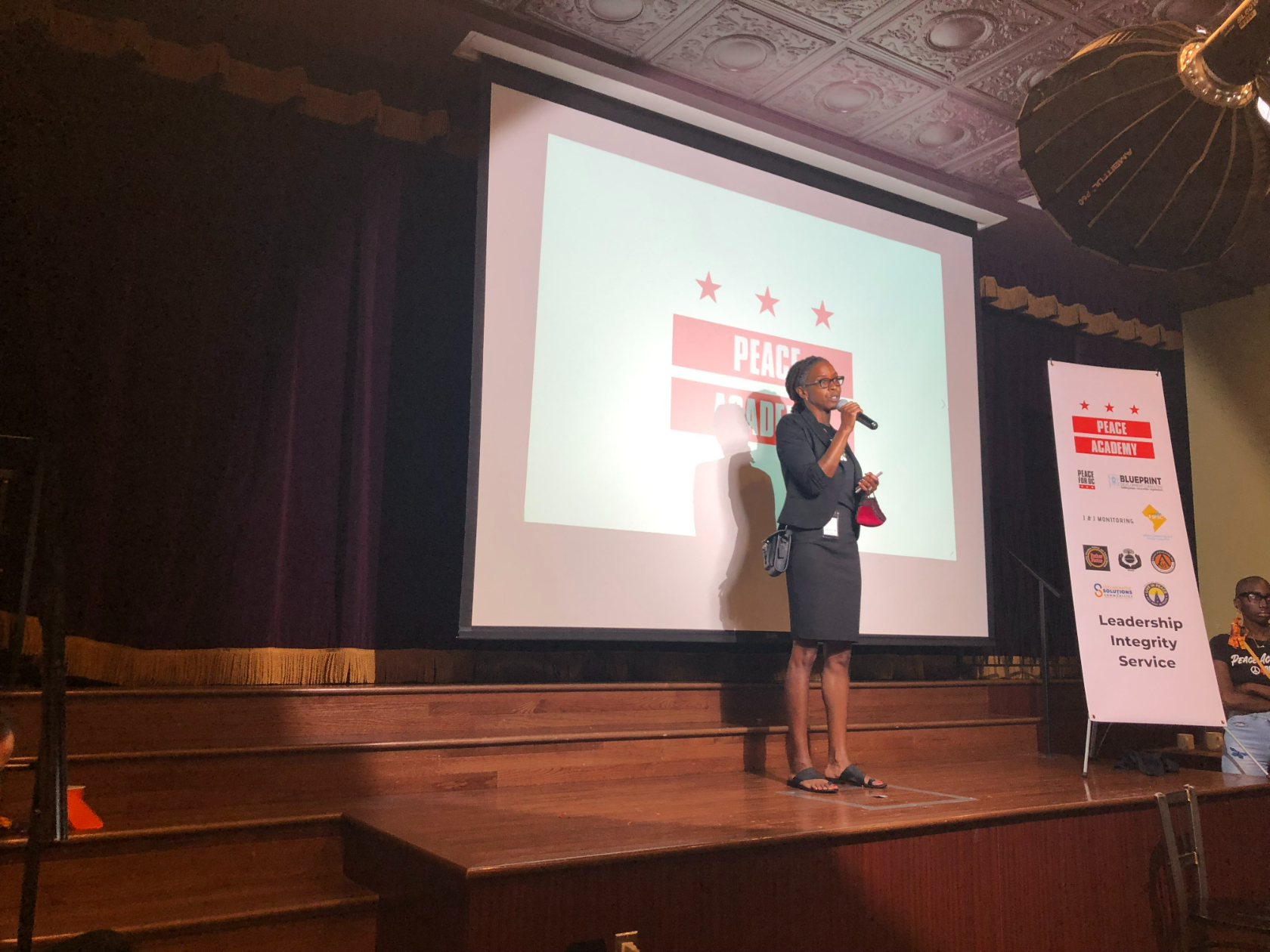
To address the gap in direct services they’ve identified, Peace for DC has hired life coaches and a social worker to help supplement the work that city-funded workers are doing in two neighborhoods: Washington Highlands and Congress Heights, the Ward 8 neighborhoods with the highest rates of gun violence. They’ve been working directly with community-based organizations in those neighborhoods to come up with an 18-month program for participants, based on models that have shown promise in other cities. This new effort builds upon the work Peace for DC did last year, when they partnered with these organizations and other local experts to launch a Peace Academy to train the city’s violence intervention workers on best practices, including cognitive behavioral therapy.
“Everything that we do, we do in partnership with community. We haven’t come up with anything on our own and just took it to them to say, ‘Oh, this is what we’re going to do,’”Thompson-El says. “We are studying evidence-based practices that have worked in other places. But we’re talking to our local experts about how it could work here in D.C. and we’re talking to them about what their needs are. We’re talking to them about what they think this new system should look like.”
Peace for DC estimates that the incentives they’ll provide participants, along with staffing and programming costs, will amount to $35,000 per participant. They’re aiming for 50 participants, so they estimate they’ll be kicking in about $1.75 million to supplement the city’s existing investments.
And Peace for DC says they want to be sure their intervention actually works — so they’re bringing in outside researchers to evaluate its efficacy after they launch later this spring.
“You prove that it works, and then the hope is that the government will come on board,” Thompson-El says. “We all want this work to be effective. Because when this work is effective, that means we have less shootings and homicides.”
Including independent evaluation from the outset is something the D.C. government did not do: Despite pouring millions into Cure the Streets and ONSE’s violence prevention programs since they launched in 2018, the city has not had outside researchers come in to formally and thoroughly evaluate them until this year: two prominent gun violence researchers— Johns Hopkins professor Daniel Webster and University of Maryland professor Joseph Richardson — recently received a grant from Arnold Ventures to evaluate violence intervention in the District.

What philanthropy can (and can’t) do
The idea of local philanthropic organizations funding solutions to problems isn’t a new one. The Washington AIDS Partnership — which started with funding from the Ford Foundation — was part of a collaboration between government, philanthropy, and community-based organizations that led to a 75% decrease in D.C.’s HIV infection rate over the course of a decade. Large foundations in D.C. have partnered with the local government to tackle other social problems too, like homelessness and hunger.
But Peace for DC says the same approach has not been applied to D.C.’s gun violence problem at the same scale. So they started seeking out foundation funding to work specifically on community violence intervention. Peace for DC is a fund under the Greater Washington Community Foundation.
Webster, the Johns Hopkins professor, says there’s always potential for concern when private foundations play a role in dictating a city’s response to social problems.
“Certainly you have to worry or concern yourself with, frankly, a democratic process,” says Webster. “If constituents elect a city council and mayor that say they want to go in one direction and then a private entity comes in with a lot of funds and takes it in another direction, I think you have to question where those communities are really getting what they want and need.”
But, Webster says he’s seen examples of cities – namely, Chicago – where philanthropy has played a responsible and effective role in funding violence prevention work. And, Webster adds, he thinks Peace for DC has “done their homework about what is needed, how to get there, and how to be frankly pretty methodical” about expanding capacity for community-based organizations working on violence intervention in the District.
Community violence intervention can be organized in a myriad of ways. Some models, like Cure Violence – which violence interrupters with D.C.’s “Cure the Streets” program are trained in — focus on mediating conflicts between warring crews and preventing retaliatory shootings. Other models, like the Roca model founded in Massachusetts, focus on using cognitive behavioral therapy techniques to work with the people at highest risk of being on either side of a gun. Some violence intervention organizations provide services to individuals in their neighborhoods, while others bring high-risk people from across a city together for programming.
But in many cases, the success of these programs has been difficult to measure, or hasn’t been measured at all — and they’re not without their skeptics and detractors.
“We have funded violence interrupters and social workers for 30 years. This is not a new idea. Unfortunately, it has never worked. Let’s figure out why before spending more money,” wrote former Ward 2 Councilmember Jack Evans in a Washington Post op-ed earlier this year.
But supporters of the work point to cities where community violence intervention initiatives have shown measurable success — like New York and Chicago. In the latter city, researchers found that participants in a program called READI — which provides 18 months of therapy and subsidized employment — were 64% less likely to be arrested for a shooting or homicide than similarly high-risk people who did not participate, and 18% less likely to be shot.
Peace for DC’s leaders say the programs in Chicago have been a specific source of inspiration for them, because it was philanthropy that actually enabled the sustained investments that led them to success.
When Chico Tillmon started doing street outreach work in Chicago using the Cure Violence model back in 2011, he says the organizations doing the work would typically run out of their government funding by the end of June each year.
That meant that in July, August, and September — typically the most violent months of the year — most of the violence interrupters would get laid off.
Jorge Matos, who was also doing street outreach at the time, says the instability “hurt our momentum here.” Some violence prevention workers “backslid into the life and got rearrested,” and “a lot of elements that we were facing set us up to fail,” Matos added.
“That’s what really made individuals understand, like, we need to get involved with philanthropy,” Tillmon says.
By 2016, philanthropy had answered their call. A new coalition of funders, called the Partnership for Safe and Peaceful Communities, decided to funnel significant amounts of money to a few larger organizations doing violence intervention work – among them, READI Chicago, which Matos now leads. In turn, those larger organizations gave funding to smaller community-based organizations that they partnered with. Philanthropic support for violence intervention in Chicago flooded in from other directions, too. Laurene Powell Jobs’ fund, The Emerson Collective, provides most of the $25 million budget for CRED, one of the city’s other most prominent community violence intervention groups. CRED itself takes no public funding.
Arne Duncan, the founder of CRED and former U.S. Secretary of Education, recently estimated that when you combine public and private dollars, Chicago invested about $188 million in these violence intervention programs. “Six years ago,” he wrote last summer in the Stanford Social Innovation Review, “that number was much closer to zero.”
The result, Tillmon says, is that violence prevention in Chicago got more resources, and more focused on the solutions that were showing results.
“You could be getting funding and not doing nothing,” Tillmon says. But “PSPC — they funded individuals who were doing evidence-informed work that’s showing results.”
Now, Tillmon is the Executive Director of READI. They’ve created an 18-month, intensive program designed for people who are considered at high risk of committing acts of violence or becoming victims. It includes a therapeutic element — based on cognitive behavioral therapy principles — and a workforce element, with on-the-job training.
Tillmon says their goal was to use private funding “to test it, evaluate it and then scale it. But before we got to the point where we can scale it, we wanted to really give it some rigorous evaluation.”
And so far, the programs appear to be yielding results. Participation in CRED — the other prominent violence intervention initiative in Chicago, which provides life coaching, trauma counseling, education, and biweekly cash stipends to its participants — was associated with a nearly 50% decrease in fatal and non-fatal gunshot injuries, according to researchers at Northwestern University who interviewed participants and studied the program.
There are some caveats to the promising results researchers found: The Northwestern paper on CRED cautioned that given the fact that the program is young and the number of participants remains relatively small, they haven’t yet found the program’s positive effects to be statistically significant. And the University of Chicago researchers who studied READI said, similarly, that despite reduced arrests and victimizations, they could not definitively say the program was successful. (Webster, the Johns Hopkins researcher, says the reduction in arrests has him convinced that “READI has had a clear, positive impact in reducing gun violence,” while the smaller reduction in shooting victimizations was less convincing.)
Still, the University of Chicago study found the program appeared to be a worthwhile investment. “Relative to their peers, we estimate that READI reduces harms to society from involvement in crime and violence by between $174,000 to $858,000 per participant,” the researchers wrote in a summary of their preliminary findings published in January.
For his part, Marmet with Peace for DC says the numbers he has seen have him convinced enough to transfer Chicago’s strategies to the District.
“In North Lawndale, where CRED is operating this in collaboration with READI … everything’s down — both victimization and violent crime perpetration — by 50%,” Marmet says. “So if we could do that in Congress Heights and Washington Highlands and keep it that way, that’s our goal. And then we’ll raise more money to invest and keep going, not where politics or the council says, ‘you need to come over here,’ but to the neighborhoods with the next highest rate of shootings and homicide rates.”
‘We’ve got a problem with funding the work’
Government funding for violence intervention work has increased dramatically in recent years, in part thanks to dollars from President Joe Biden’s American Rescue Plan. Across the country, the Biden administration has freed up more federal money for violence intervention. That made possible the approximately $55 million dollars D.C. budgeted for non-police forms of violence prevention this fiscal year.
Marmet says his team is worried about what might happen if that extra federal money has dried up and the District still hasn’t delivered on violence intervention’s promises. D.C. Mayor Muriel Bowser’s proposed budget for next fiscal year includes potential cuts to violence interruption programs — a move that Marmet called “confounding and frustrating” at a time when public safety is a top concern for the city.
“When the American Rescue Plan dollars go away and the tax base is lower in D.C., we’ve got a problem with funding the work,” Marmet says. “And you’ll read the column[s] [where] they’re like, ‘None of these programs are working and we don’t know what they’re doing.’ Well, they’re half right, because we haven’t rigorously evaluated them. But on the other hand, we know that these programs can work.”
The leaders of Peace for DC say they want to help the D.C. government help itself, by proving that their programs can work if they’re better resourced and better executed. But instead of waiting for the government to change its approach, they’re stepping in themselves. For Marmet, that urgency also comes from personal tragedy: He lost his 22-year-old son, Tom Marmet, to gun violence in D.C. in 2018.
“I really want to keep this tragedy from visiting people as much as possible in the city where I was born, where my son was born, and [where] I never imagined he would be killed,” Marmet says.
And Marmet says they want their relationships with city officials to stay positive. They have current and former D.C. officials on their advisory board for the Peace Academy, for example. Bowser spoke at the graduation ceremony for the Peace Academy’s first cohort. Beale, with the Office of the Attorney General, told DCist/WAMU via email that OAG prides its partnership with Peace for DC, which it says plays a “vital role” in the city.
“Peace for DC works alongside the Cure The Streets team to establish an effective local hub that provides violence interrupters with access to critical resources necessary for conflict resolution. For example, as a part of this collaboration, Peace for DC offers Cognitive Behavioral Theory (CBT) training and helps establish a professional code of conduct for community violence intervention workers,” wrote Beale. “We take pride in partnering with organizations like Peace for DC and others who contribute to the overall success of Cure The Streets.”
The Peace for DC team seems to take pride in the collaboration, too.
“It’s an open book for us with the D.C. government,” Marmet said. “Because we all want the same thing. We just think there are other ways to get there.”
This article was reported through a fellowship supported by the Lilly Endowment and administered by the Chronicle of Philanthropy to expand coverage of philanthropy and nonprofits. WAMU/DCist is solely responsible for all content.
This story was updated to clarify information about Peace for DC’s fiscal sponsor.