Margaret Barthel
That soft mechanical hum you hear? It’s your eagerly-awaited noodles, not your brain overheating. Probably.
Starting today, some Uber Eats food deliveries from a handful of restaurants in Fairfax’s bustling Mosaic District will be conducted by robots.
“The Mosaic District has a wonderful mix of both local and national restaurants represented, and is also a really walkable community,” said Uber spokesperson Abby Wheeler in an interview with WAMU/DCist. “So it was ideal for us to deploy sidewalk robots there.”
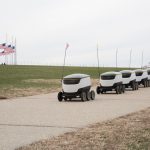
The robots, which were developed and are operated by AI robotics company Cartken, look like a big cooler with six wheels, headlights, and an orange flag poking up for added visibility. They’re sized to fit roughly two grocery bags.
The robots use a mix of autonomous artificial intelligence and occasional remote human directions to navigate the streetscape and arrive at their destination.
The bots will be mainly tasked with shorter delivery trips around the Mosaic District and immediate surrounding areas.
“Generally, sidewalk robots are always really well suited for trips that are easy to access on pedestrian walkways, and so that makes the surrounding few miles that are around the Mosaic District a really good fit for robotic delivery,” Wheeler said.
Wheeler did not respond to a question about how many robots are part of the initial pilot.
Uber Eats customers will be able to track the robot’s progress in the app, as they would with a regular human delivery person. When the robot arrives, the customer will be prompted to unlock the robot with their phone and take out their order. Customers will be able to opt-out if they’d rather not have a robot bring them their food.
Five area vendors — including Pupatella, Our Mom Eugenia, and RASA, an Indian fast-casual spot — are currently participating in the pilot program. There are about forty restaurants in the Mosaic District, “providing Uber and Cartken the opportunity to serve a diverse group of merchants and delight more eaters as the program grows,” the company’s press release notes.
RASA co-founder Rahul Vinod said he sees the program as a way to further the restaurant’s mission of making “the Indian food and culture we grew up with … more accessible to people.”
“This is just kind of an extension of that,” he said in an interview with WAMU/DCist. “If you happen to be in the Mosaic District, but on the other side or you live there, and maybe it’s raining outside and you don’t want to walk … this robot can deliver our food to you fresh.”
As for restaurant staff interacting with the delivery robots, Vinod said that restaurant staff would use a special tablet set aside for receiving and handling food orders bound for robot couriers.
The RASA location in the Mosaic District opened last summer. Vinod said he was excited to open there because the area is “a little landmark” throughout Northern Virginia, attracting people from across the region to its dining and entertainment offerings. He credited Mosaic District property owner EDEN with creating innovative “new experiences” for visitors.
Wheeler said Uber and Cartken don’t have immediate plans to expand the program beyond the Mosaic District into other places in the D.C. area, but said the companies are “really eager” to do so in future. She said Uber will be looking closely at data — particularly customer satisfaction metrics and trip times — to evaluate how well the robots are performing in the area and determine possible expansion plans.
As for passersby sharing the area’s busy sidewalks with these new automated citizens? Wheeler says the robots are programmed to keep away from pedestrians and avoid traffic.
“The robots are able to come to a safe stop,” Wheeler said. “They’re going to avoid the pedestrian at all costs to remain safe and on trip.”
Robots bearing food to eager delivery diners have been a long time coming to the commonwealth. The General Assembly passed a law allowing autonomous delivery robots in 2017.
The new food delivery bots aren’t the first robots to test-drive themselves around Fairfax County. The county has a driverless car shuttle service pilot ongoing between the Mosaic District and the Dunn-Loring Metro station — though the shuttle only takes to the street if it’s not raining or snowing. (Robots! They’re just like us!)
Postmates rolled out a fleet of delivery robots in D.C. in 2017. Other local dabbling in our robotic future has included a driverless car tooling around National Landing — and, alas, a watery grave for a security robot in Georgetown.
Uber has already piloted robotic food delivery in Miami with Cartken, and with other partnerships in Los Angeles, Houston, and Mountain View, California.