Amanda Michelle Gomez
Employees of the Wharf InterContinental Hotel in D.C., including staff of acclaimed Vietnamese restaurant Moon Rabbit, want to form a union, citing worries about their wages and working conditions.
Several dozen employees signed a petition delivered to the hotel’s human resource department last week signaling their interest in unionizing; the petition requests that the hotel’s operator, InterContinental Hotels Group (IHG), respect their right to organize. For the Moon Rabbit employees, a successful union drive would be a rarity in the restaurant industry, particularly in fine dining. There are not many unionized restaurants in the District, and the food and beverage industry has one of the lowest unionization rates of any sector nationwide. But workers don’t seem discouraged.
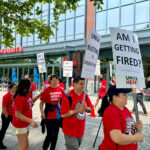
“This is the best I’ve felt walking to work in six months,” said Wes Waterhouse, who’s worked at Moon Rabbit since September 2022, as he and seven of his coworkers set out to deliver the petition April 19. “Basically, the poster is saying that we are demanding a union,” he added.
Moon Rabbit workers hope a union contract could help to address job insecurity and high health insurance costs — long-standing problems within their industry. But they also believe collective bargaining could lead to some accountability with specific problems they have experienced at the Wharf hotel — such as not being paid correctly or not having a transparent tip-sharing policy.
An IHG spokesperson acknowledges that there were some pay discrepancies due to system transitions within the last six months, but says that they were corrected, and also says all tipped employees are informed about the tip-sharing system. More broadly, the spokesperson says in an emailed statement that IHG leadership has not yet reviewed the contents of the workers’ petition but that the hotel company will follow federal labor law.
“IHG agrees that employees are entitled to decide whether to elect or not elect a representative without threats and intimidation and will abide by the federal laws that govern such a process,” reads the statement.
One of the motivating forces behind unionizing is wages, according to five employees, most of whom work at Moon Rabbit. Workers believe a union would result not only in increased hourly wages, which currently range from $17 for a server assistant to $24 for an experienced cook, but hold management accountable to problems with payroll and tips.

For example: Waterhouse, who started at Moon Rabbit as a server and started bartending there this year, says he’s been issued only one paycheck correctly this year. He told management about his issue, and they acknowledged repeated problems and assured him they’d resolve it, according to emails shared with DCist/WAMU.
“For the entirety of the time that I’ve been working as a bartender at that restaurant, they have been paying me the server rate, which is significantly lower,” says Waterhouse. “They’re treating it like it’s just a small clerical error as opposed to like gross negligence.”
The IHG spokesperson says the company is “committed to timely and accurate payments” to all employees. Recent pay discrepancies were “corrected as soon as the manager became aware,” they added.
Waterhouse disputes that characterization, saying he has “yet to be made whole.” In his most recent paycheck, which he shared with DCist/WAMU, he was marked as having worked roughly 60 hours as a server, which pays $9.67 an hour plus tips, and eight hours as a bartender, which pays $21.69 an hour plus tips. He says he should have been marked for 16 hours of bartending.
Moon Rabbit staff members have also raised concerns about the lack of transparency in the way tips are pooled and divided up, according to three employees.
Waterhouse says the restaurant hasn’t shared a written tip-sharing policy with employees, which is required by D.C. law, so staff only knows by word of mouth. And Michael Cruz, who’s been a Moon Rabbit server for a year and a half, says tips vary for special events, like the ones they have done for Chefs Stopping AAPI Hate, a charity that Moon Rabbit’s chef, Kevin Tien, organizes for.
Josue Coreas, who’s bussed tables and been a food runner for roughly six months, also says he’d like to see a breakdown of how much the restaurant collected in tips on any given day and how the money was divided among staff. Coreas says management offered some information after “everyone was complaining,” but the chart only tells staff their individual tips on a daily basis.
The IHG spokesperson says there is a “tip-sharing program” available to tipped workers. Employees “are advised about the program by the [food and beverage] manager who regularly explains the program in detail,” according to the spokesperson, and managers will provide individual tip reports if someone needs clarification.
Coreas also cited concerns about workload and staffing, as did JC Escobar, who cooks breakfast and lunch at Moon Rabbit. Escobar says he never has time to take even a short break during his 5:30 a.m. to 3:30 p.m. shift, because there’s only two cooks prepping loads of meals. One time, his colleague got dizzy because she didn’t have time to eat, Escobar says.
“If I take a break, somebody has to cover my station,” he says. “So we need maybe one more person and then we can rotate.”
The IHG spokesperson says that workers are “scheduled and directed” to take a 30-minute meal break during every shift that’s more than 7 hours, and that Moon Rabbit closes for an hour mid-morning so that the morning crew can break. However, Escobar says they often use that time to prepare for their lunch rush given how many meals they anticipate.

Dennis Chambers, a banquet cook who works in another kitchen, cited safety concerns as one of his reasons for signing the petition. He says there isn’t consistent kitchen stewarding, or people assigned to clean the cooking station, so there’s often water from the stoves spilled on the floor. He says he was once electrocuted after plugging in the electric stove, and the executive chef just raised his eyebrows after learning about the incident. Chambers says he’s worked in kitchens for three decades, including nearly a year at the Wharf InterContinental Hotel, and earns $22.70 an hour.
The IHG spokesperson says the hotel employs a team of stewards who clean throughout the day and outsources a cleaning company to clean all kitchens overnight. The spokesperson also says there have been no reported employee injuries recorded in the upstairs kitchen.
In all, the petition submitted to the hotel’s management included the signatures of 60 hotel employees, which would likely be a majority of workers that are union-eligible, according to UNITE HERE Local 25, the labor organization that’d be their bargaining agent if they’re successful. Local 25 suspects that a bargaining unit at the Wharf InterContinental Hotel would mostly be made up of food service workers because many others are temporary or contracted workers.
Local 25 is largely known for organizing hotel workers, and represents employees at several dozen other hotels around D.C region. But it’s also the union for a few dozen hotel restaurants or food and beverage establishments, including a handful that are fine dining like The Lafayette at The Hay-Adams Hotel and Estuary at the Conrad hotel, the union says.
“It’s just something that unions haven’t focused on. I believe they should,” Local 25 head Paul Schwalb says of restaurants, adding that a lack of union contracts is in part to blame for the industry’s “abysmal conditions.” He pointed to the health care costs as one example: “You’d be hard put in Washington, D.C. to find a single restaurant worker who has free family health care. Our members have free family health care,” notes Schwalb.
The Wharf InterContinental Hotel workers’ petition is an attempt to implement an organizing agreement, which is a pledge for neutrality that some labor organizations ask employers to agree to because management opposition can lead to a union loss. Schwalb says IHG has not provided a written response to the petition, which says: “IHG should agree to a quick and fair process to enable us to exercise our right to organize and decide whether to form a union without threats and intimidation.” The petition could lead to a union card check and voluntary recognition, but if it does not, then the union will have to proceed with an election through the National Labor Relations Board.
InterContinental Hotels — a U.K.-based multinational, multi-billion dollar company — currently has only one local hotel in its portfolio that is unionized: the Kimpton Hotel Monaco in Penn Quarter. IHG manages several other hotels in the District, however, including The Willard InterContinental.
IHG also manages Moon Rabbit, a restaurant that’s become a local sensation because of its chef, Kevin Tien. The young chef made a name for himself with the much-lauded Himitsu in Petworth, for which he earned a finalist nod in the James Beard Foundation Awards’ Rising Culinary Star category in 2018. He went on to compete on Food Network’s Iron Chef, was also named a James Beard semifinalist this year, and co-founded the local chapter of Chefs Stopping AAPI Hate. (He’s also hosting a huge market featuring AAPI chefs on the waterfront next month, the first of its kind on the Wharf.)
Many of the workers interviewed expressed respect for Tien, who is also an IHG employee but would likely not be eligible to join the union. Tien was unaware that people in his kitchen sought to unionize, he told DCist/WAMU in a brief phone call the day after the petition drop-off. In a follow-up conversation, Tien says he is taking the time and opportunity to learn about the organizing effort, as he’s never worked in a unionized establishment before.
“At the end of the day, I’ve always wanted Moon Rabbit to be a place for a community that focuses on really good food. And for us to do a lot of charity events,” Tien tells DCist/WAMU. “For Moon Rabbit to be a place where everybody wants to work.”
The Moon Rabbit employees tell DCist/WAMU that they see a career for themselves at the restaurant or hotel —- which is why they are organizing their workplace, even if that means confronting a large hotel company that’s part of one of the city’s biggest real estate development projects.
Local 25 believes the city has a vested interest in improving the jobs of the hotel workers, given the D.C. government heavily subsidized the Wharf project — to the tune of $300 million, according to the DC Fiscal Policy Institute.
“We think with that level of investment goes some responsibility to make sure that the city and its taxpayers get what they want out of it. And I think what they wanted was good jobs. And I think by our definition, many of these are not good jobs,” Schwalb tells DCist/WAMU.