Elliot C. Williams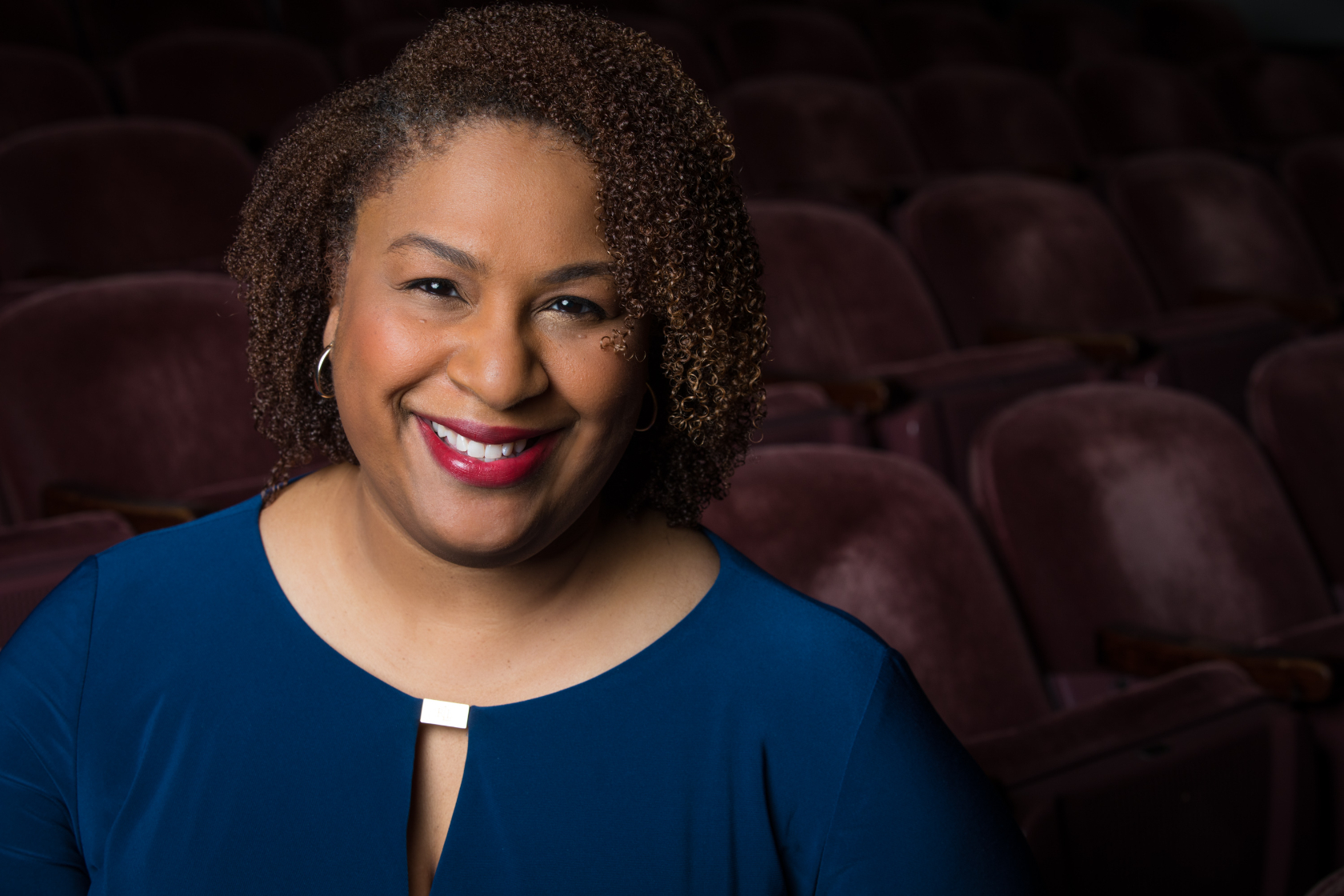
Hana Sharif will take over as the new artistic director for Arena Stage, succeeding Molly Smith, who led the storied nonprofit theater for the past 25 years and announced her retirement last June. Sharif will be arriving from St. Louis, where she led The Repertory Theatre for five years, in a career that has included stints in Hartford, Boston, and Baltimore.
Sharif will become just the fourth artistic director and first person of color to lead Arena, which opened as Washington’s first integrated theater in 1950. “It is profoundly humbling,” Sharif tells DCist/WAMU of her new role.
“Throughout my career, I have sometimes had the bittersweet fortune of being the first.”
When she joined The Rep in St. Louis, she became the first Black woman to lead a major regional theater in the entire country, she says. For her role at Arena, the board of trustees selected Sharif from a pool of more than 50 candidates, The Washington Post reported.
“I think that my first year is really going to be about listening and learning,” Shariff says. “We’re in this incredible moment of evolution for our field and for our industry, and one of the reasons why Arena is so appealing to me is because of the strength of its history, its legacy, and its practices. You know, I’m not coming to an organization that needs to be rebuilt from the ground up. However, we are in a moment of evolution and of change.”
It is indeed a pivotal moment for the 72-year-old institution, which is headquartered at the Mead Center for American Theater in Southwest D.C., and for arts organizations more broadly. Local theaters are reporting financial deficits as pandemic recovery funding has mostly dried up, and audiences have not returned to live performances as enthusiastically as production companies had hoped.
The evolution Sharif speaks of is about more than money, though. In 2020, following George Floyd’s death, BIPOC theater workers demanded radical change with their release of “We See You, White American Theater.” Many theaters laid out action plans for how they would engage in antiracist work on a deeper level. Some have tried the unprecedented, such as Woolly Mammoth Theatre Company’s production of Ain’t No Mo’, which hosted an all-Black audience for one night. (At Arena, more than a third of its shows over the past quarter century have highlighted works by artists of color, according to a recent DCist/WAMU interview with Smith.)
When it comes to Arena Stage’s track record, Sharif says, “At the center of everything is this exceptional quality of art.” Pushing the boundaries of equity is ingrained in the theater’s founding, she adds.
Smith will formally depart in July, and Sharif will begin on Aug. 21. She brings with her a history of transformational theater. In St. Louis, she directed The Rep’s highest grossing production, a 2019 adaptation of Pride and Prejudice, and oversaw the production of multiple world premieres and new plays. She recently staged Ken Ludwig’s adaptation of Murder on the Orient Express to rave reviews.
She has experience with leading change and “shepherded [The Rep] through a cultural transformation” after the retirement of her predecessor, Steven Woolf, according to a press release.
Sharif, 44, grew up in Houston and later co-founded a theater company, Nasir Productions, as an undergraduate at Spelman, the historically Black women’s college in Atlanta. She received her MFA from the University of Houston and, in 2003, joined the Hartford Stage in Connecticut as an entry-level artistic assistant. In her decade at Hartford, she climbed the ranks to become associate artistic director and director of new play development. She then went on to Boston, where she launched a resident artist program for ArtsEmerson. After that, Sharif became associate artistic director at Baltimore Center Stage.
That’s all to say this role is a long time coming. Sharif told The Post that at 19, she was already a fan of Arena Stage and had aspirations of becoming its artistic director one day.

Explaining her creative outlook, Sharif tells DCist/WAMU: “I think that I am an artist who cares deeply about the fundamental truth of our lived experience … Every time I approach a work of art, I’m looking for an entry point that is fundamentally about the thing that is core to our humanity — this desire to be seen, to be known, to be loved, to be valued, to exist, for your voice to be heard.”
Outgoing director Molly Smith is hosting a concluding round of “Molly’s Salons,” sit-down conversations with innovative leaders in the theater world, which she began hosting at the start of her tenure. She’s already laid out most of the 2023-2024 season, per the Post, setting up Sharif for a smooth transition. Under Smith, Arena premiered hits like the Broadway-bound Dear Evan Hansen in 2015; staged a daring production about conservative Supreme Court Justice Antonin Scalia; and provided a D.C. home for dance company Step Afrika!
Smith’s final directorial effort was with My Body No Choice, a series of monologues about women’s bodies and issues involving choice.
Sharif says she will continue the work of the Arena directors who came before her — including Smith, co-founder Zelda Fichandler, and Douglas Wager — and pose their same central question to audiences: “What does it mean to be American?” She says she owes her successes, not only to these directors, but to artistic giants who never got their due:
“There were hundreds of women who were talented, qualified, and helped form this field — that didn’t make it through the glass ceiling,” Sharif adds. “When the days are hard, the thing I remember is that this is actually bigger than me, that I am holding space for the women coming behind me.”