Martin Austermuhle
D.C. Mayor Muriel Bowser on Monday pushed back against a pair of budget proposals from the D.C. Council which she decried as “downtown killers” that would hamper the city’s plans to help revitalize the ailing area.
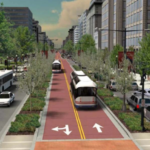
Speaking at a hastily organized press conference and rally in Franklin Square Park, Bowser criticized a proposed $2 congestion charge that would be applied to rideshares in and out of downtown D.C. during rush hour, as well as a separate council move that would gut the $115 million in funding for a planned remake of K Street known as the Transitway that would see dedicated bus lanes built along the downtown corridor.
“We have to take our comebacks seriously, so you can count on me to oppose — and oppose vigorously — any downtown killers in this budget process,” she said. “Killing the K Street Transitway is a downtown killer. Adding $2 to your Uber or Lyft ride is a downtown killer, and we’re going to oppose those downtown killers.”
Bowser said the pair of council proposals would imperil her administration’s efforts to remake downtown D.C., which has struggled to return to its pre-pandemic vigor because of the persistent trend of remote work. That in return has dragged down commercial property values and prompted a decrease in property tax revenue for the city, leading to the leanest budget season for the city in almost a decade.
Without a revitalized downtown, according to Bowser and her supporters at the rally, other city initiatives and programs from education to social spending would suffer. “Compromising our downtown is compromising the long-term economic future of our city,” said Councilmember Brooke Pinto (D-Ward 2), who is also opposing her colleagues’ proposals.
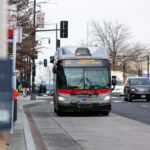
Bowser has unveiled plans to attract 15,000 new residents to downtown over the next five years, in part by enticing owners of office buildings to convert them to housing. She has also continued to push the federal government to force more workers to return to the office, and has sold the proposed K Street Transitway as a groundbreaking new concept for the city that would dramatically increase transit options by creating dedicated lanes for buses.
“Even people who love buses don’t love buses when they are stuck in traffic and are not reliable,” said Bowser. “Even if they’re free.”
That was a direct dig at one of the sources of the brewing conflict between the two branches of government: a council bill passed late last year that would make Metrobus free of charge. Bowser opted not to fund the program in her proposed budget for 2024, forcing the council to do so. And Councilmember Charles Allen (D-Ward 6) did just that by redirecting the $115 million set aside to construct the K Street Transitway to make Metrobus free, while Councilmember Brianne Nadeau (D-Ward 1) proposed the $2 congestion charge — from which revenue would be used to cover the costs of offering 24-hour service on designated high-use Metrobus routes.
In his budget report outlining the proposed change, Allen said that the K Street Transitway was initially planned during pre-pandemic times, and the concept had not meaningfully changed to account for what a new downtown D.C. could look like.
“Bus service is the most resilient form of public transit; during the pandemic, bus ridership fell much less, and recovered much faster, than Metrorail service. Shifting K Street Transitway funding to fare-free bus service for District residents will provide some measure of relief to low-income residents, and expanded late-night service will be a boon for restaurants and hospitality industry workers,” he said.
Speaking on Monday before Bowser’s press conference, Chairman Phil Mendelson agreed with Allen’s assessment of the Transitway, saying that it would take too long to complete and that downtown D.C. needs more immediate help. “The plan needs some refreshing,” he said. “It misses the mark. The mark is now, not five years from now.”
Nadeau made a similar point regarding her proposed congestion charge, arguing that it would help create a new and different type of downtown.
“We have an opportunity, as we are rebuilding downtown, to make it what we want it to be. Not to fall back on old patterns. We want it to be inviting. We want it to be fun to visit, safe for people to get to, to walk around, to bike around and to drive to. At the same time that we’ve seen vehicular traffic go up, and rideshare in particular in that corridor, we’ve also seen transit ridership down. That’s not what we want for the District of Columbia,” she said last Friday on WAMU’s “The Politics Hour.”
The dispute between Bowser and the council has divided urbanists, some of whom see the prospect of dedicated bus lanes in one of the city’s most congested corridors as a game-changer. Others, though, soured on the project when the D.C. Department of Transportation recently announced it was removing planned bike lanes from the Transitway; those now-critics worry that the redesigned K Street will serve as little more than a freeway in and out of the city. Bowser did little to change that impression when her office tweeted on Monday that the new K Street would result in “better motorist experiences.” (One protester at the press conference held a sign calling Bowser a “bike lane butcher.”)
Urbanists have also been divided on the value of free Metrobus, and questioned whether it would be better for D.C. to consider a congestion charge that applies to all cars entering downtown during rush hour, instead of only rideshares as Nadeau has proposed.
The conflict between Bowser and the council has to be resolved ahead of a first vote on the 2024 budget set for May 16, but it’s still unclear whether the mayor will save her Transitway and defeat the proposed congestion charge. While Mendelson said he supports Allen’s move on redirecting the funding for K Street to fare-free Metrobuses, he said he hadn’t yet settled on whether he will support Nadeau’s congestion charge. And even if both do pass council muster, lawmakers are still short on the funding needed to pay for fare-free Metrobuses.
Pinto said she would push her colleagues to scrap both proposals, in part because she believes the proposal for fare-free Metrobuses isn’t yet ready to be rolled out — while the K Street Transitway is in the final planning stages.
“In terms of the free buses, I think it’s a great idea,” she said. “But I think there’s a lot more work that needs to be done to see if we’re in a place as a city to move forward in that way and that it would be premature to take funding for a project that we don’t have assurance is going to be able to be implemented.”