 Jenny Gathright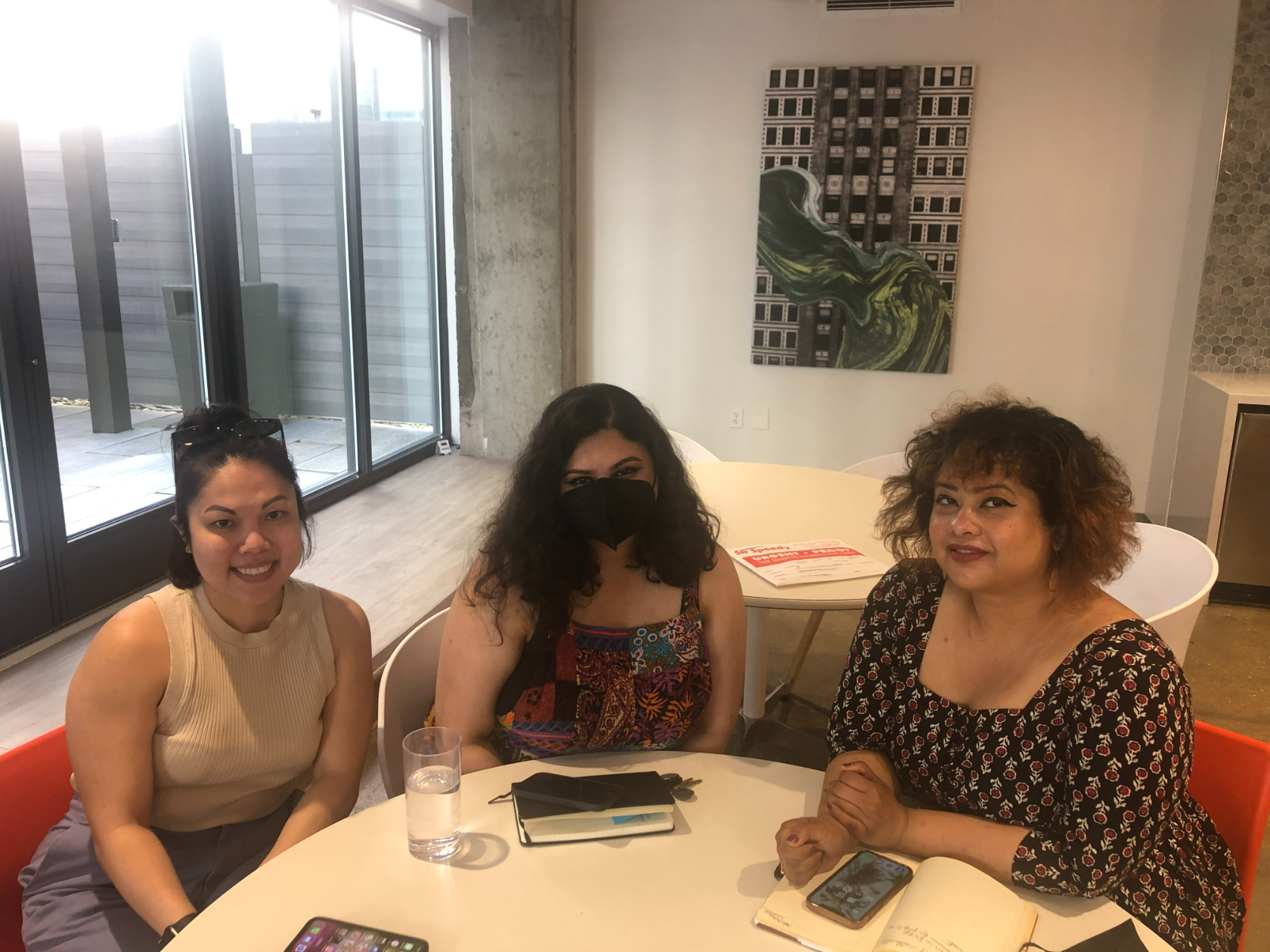
Organizations that serve domestic violence survivors say they have an annual ritual.
They examine D.C. Mayor Muriel Bowser’s proposed budget, and inevitably determine it falls short of their needs. Then they plead before the D.C. Council to add money back to the Office of Victims Services and Justice Grants (OVSJG), the agency that provides the vast majority of their D.C. government funding.
“It’s like a yearly little dance that we do,” said Krittika Ghosh, the executive director of the Asian/Pacific Islander Domestic Violence Resource Project.
The local coalition of domestic violence service providers did this last year, when the Mayor’s budget mostly flat-funded crime victims’ services – despite what organizations said was a growing and dire need after the increase of reported domestic violence during the pandemic.
Members of the D.C. Council heeded their calls and added additional funding for fiscal year 2023. It was easier to do then, because the city was flush with federal COVID relief funds. That federal assistance contributed to significant growth in the agency’s budget for the past two fiscal years: In fiscal year 2021, the OVSJG budget was $58.6 million, and in the next two fiscal years, it grew to $89 million and then $110 million.
But D.C. Mayor Muriel Bowser’s proposed budget for next fiscal year gives the agency about $75 million — a 30% cut from the previous year, placing the organization back at pre-pandemic funding levels.
And this budget cycle feels different. The proposed reduction to OVSJG’s budget is part of a host of cuts to social services and the city’s economic safety net for the poor – which Bowser says is a recognition of tough economic realities that require bringing the city “back to basics.” New collective bargaining agreements mean higher pay for teachers and first responders, inflation is making construction more expensive, remote work continues to challenge the city’s economy, and federal COVID relief funds have dried up.
As Bowser put it in her budget presentation to the D.C. Council, “our resources are shrinking while at the same time our fixed costs are increasing.”
Bowser’s proposed cuts translate to an estimated 16% — or $6.7 million — cut to victims’ services, the portion of the OVSJG budget that funds organizations that provide housing, legal representation, therapy, cash assistance, and myriad other supports for crime victims and survivors of domestic violence. Advocates say that in reality, the cut to grant money available for victims’ services is closer to 20%, because the budget adds staff positions to OVSJG.
The cuts come at a time when the need for victims’ services is increasing: certain categories of crime, including homicides and carjackings, are up. One legal services provider testified that domestic violence related filings were up about 65% in D.C. Superior Court during the first part of this year. And reports of sexual assault in the District are up 111%, according to recent council testimony from Elisabeth Olds, an independent expert who evaluates D.C.’s adherence to best practices in sexual assault response.
So the coalition of domestic violence providers in the city returned to the D.C. Council this year with an even more dire message than they brought last year. They told councilmembers that even with the current funding levels, they’re unable to meet the needs of their clients. Some organizations say budget cuts on top of that could force them to shut down entire programs, and scale back their services even more than they already have.
For smaller organizations that serve specific cultural communities, the proposed cuts may present an even more existential threat.
“Immediately our existence is what comes to my mind,” says Lul Mohamud, who runs The Person Center, a small organization focused on supporting African immigrant survivors of domestic violence and sexual violence. “Not just a part of what we do, not just, you know — one program may have to be let go or paused. I’m thinking the entire organization here.”
Mohamud, 25, runs a small staff of one case manager and one finance director at The Person Center. Today, Mohamud says, TPC receives 70 to 80% of its funding from the D.C. government.
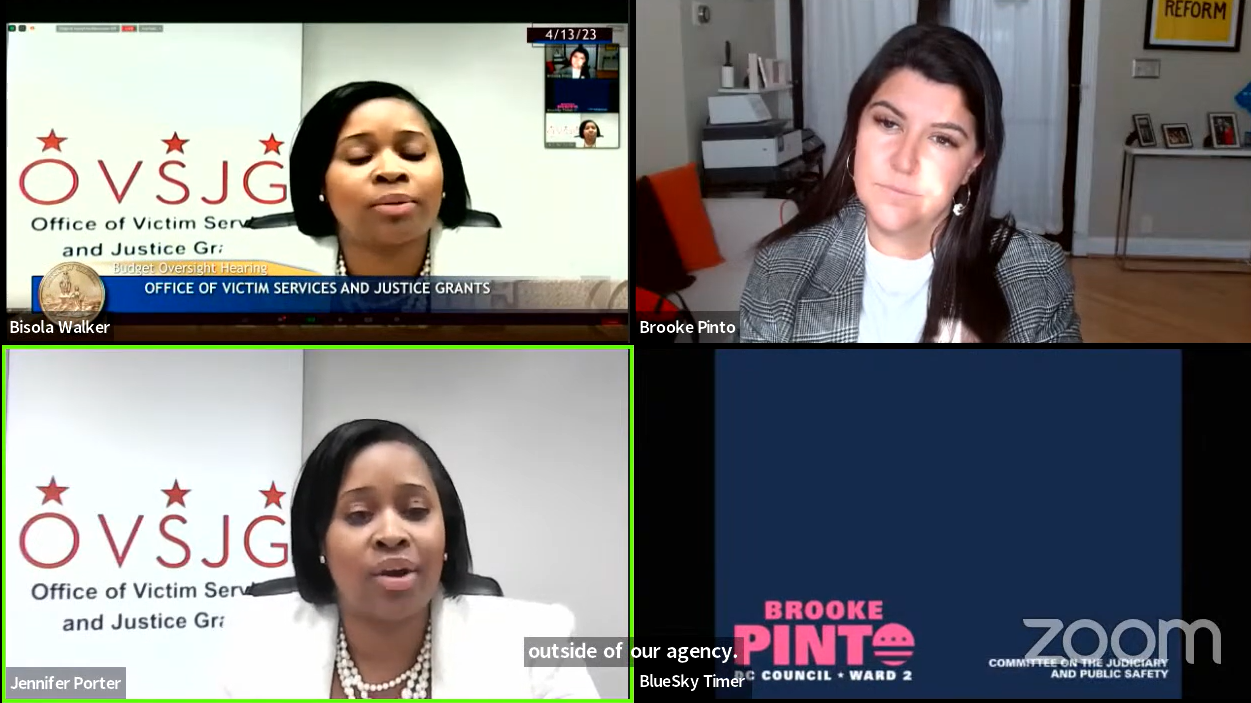
It’s still unclear exactly how OVSJG would handle the cut to its funding for victims services. During testimony before the D.C. Council last month, OVSJG Director Jennifer Porter gave no indication of how the budget cuts would affect the size of individual grants – OVSJG could choose to cut funding to specific programs, or the agency could reduce all grants they give to service providers by a certain percentage.
“It could be a 20% cut across the board, and some of our longer-term, larger-budget programs might be able to weather a 20% cut,” says Micaela Deming, a policy director at the DC Coalition Against Domestic Violence. “Smaller programs, which tend to be our culturally specific service providing programs … a 20% cut there is catastrophic.”
At any given time, The Person Center serves about 12 clients — many of whom have complex needs as they try to escape abusers amidst the complexity of the U.S. immigration system. TPC helps clients navigate physical and financial abuse, including providing culturally competent support – for example, helping clients who feel they can’t leave an abusive situation because their partner threatens to withhold remittances to family in their home country.
“The reality is that when you feel like someone is looking down on you or someone doesn’t respect your beliefs or where you come from, you’re not likely to feel safe with them either. And so for a lot of our survivors, they’re making a decision between a known abuser, or the system as an abuser,” Mohamud says.
Ghosh’s organization, the Asian/Pacific Islander Domestic Violence Resource Project, works with about 40 clients in D.C., mostly recently arrived immigrants. It has a small staff of case managers that Ghosh says are constantly at capacity.
Ghosh told DCist/WAMU that DVRP provides a service other mainstream organizations can’t — like support for survivors in the languages they speak, help with immigration, and culturally competent therapy.
Kaylie Nguyen, who manages DVRP’s case managers, says what they offer clients goes beyond a temporary protection order or civil protection order in court — and includes services unique to the immigrant experience, like helping them with English classes, or helping them get clothes. Many of their clients, she says, arrived to the U.S. recently. Others have lived here longer, but spent most of that time under the control of an abusive partner.
“A lot of clients will leave their abusive situation having nothing,” she says.
But if the proposed budget cuts remain, Ghosh and her staff say they’ll likely have to cut back – like potentially cutting therapy offerings to their clients.
“I think there’s a continual expectation of smaller organizations, culturally specific organizations, to do more with less,” Ghosh said. “And historically, we have done it, but we are tired.”
Providers like Mohamud and Ghosh say the cuts couldn’t come at a worse time. After an explosion of domestic violence that began during lockdowns in 2020, they say, their clients are still struggling.
“It’s like the Pandora’s box has opened, and you’re closing it and expecting things to stay shut when it’s not going to,” Ghosh says. “So yeah, there’s a crisis brewing in D.C. if they’re going to make these radical cuts.”
Moreover, as inflation tightens the D.C. government’s budget, it’s also making it more difficult for clients to afford food and other basic necessities. And on top of that, other programs that serve survivors of domestic violence are facing budget cuts, too: a program that funds free legal services for low-income residents fighting eviction, trying to obtain public benefits, or seeking civil protection orders could be cut in half if the current budget proposal passes the D.C. Council.
Last week, Ward 2 Councilmember Brooke Pinto, who chairs the D.C. Council’s judiciary committee, announced that with an addition of $300,000 from the council’s labor committee, and another $950,000 she transferred from other areas of the judiciary budget, she was adding $1.25 million additional dollars for domestic violence services. It does not close the $6.7 million budget gap in victims’ services — and Pinto’s committee wrote in its report that it urged the whole council to “identify even more funding to account for the gap in the Mayor’s budget proposal.”
Pinto left the largest pot of money under the purview of her committee – the $500 million budget for the Metropolitan Police Department — untouched, touting her commitment to providing the department with the resources it has asked for amid a higher murder rate than the city has seen in two decades.
Providers of services to domestic violence survivors argue that they are a key part of public safety too, including homicide prevention. About 9% of homicides in the District each year are domestic violence-related, according to the city’s Domestic Violence Fatality Review Board.
“I think that this work is not understood and appreciated,” Ghosh says. “I think that there is more funding going towards things like policing when it should be going towards community based organizations that are doing this much critical work — because most of our community members do not feel safe going to structures like the police, but they’ll come to us for support.”
The first of two council votes on the budget takes place in mid-May.