Jacob Fenston
The clock is ticking for the few healthy ash tree groves still in existence around D.C.
Twenty years ago an invasive pest arrived in the area, hidden away inside a shipment of ash trees headed for a nursery in Maryland. Since then, most of the ash forests in the area have been decimated by the pest, known as the emerald ash borer.
The loss of these trees is having a devastating impact on wetland ecosystems in the region.
“They’re really important ecologically,” says Gabe Popkin, a science writer based in Mount Rainier, Md. “As they die, there’s only a tiny handful of trees that can potentially take their place.”
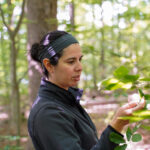
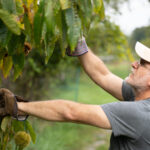
For more than three years, Popkin and photographer Leslie Brice have been visiting local ash forests in the D.C. region to document the decline of the trees.
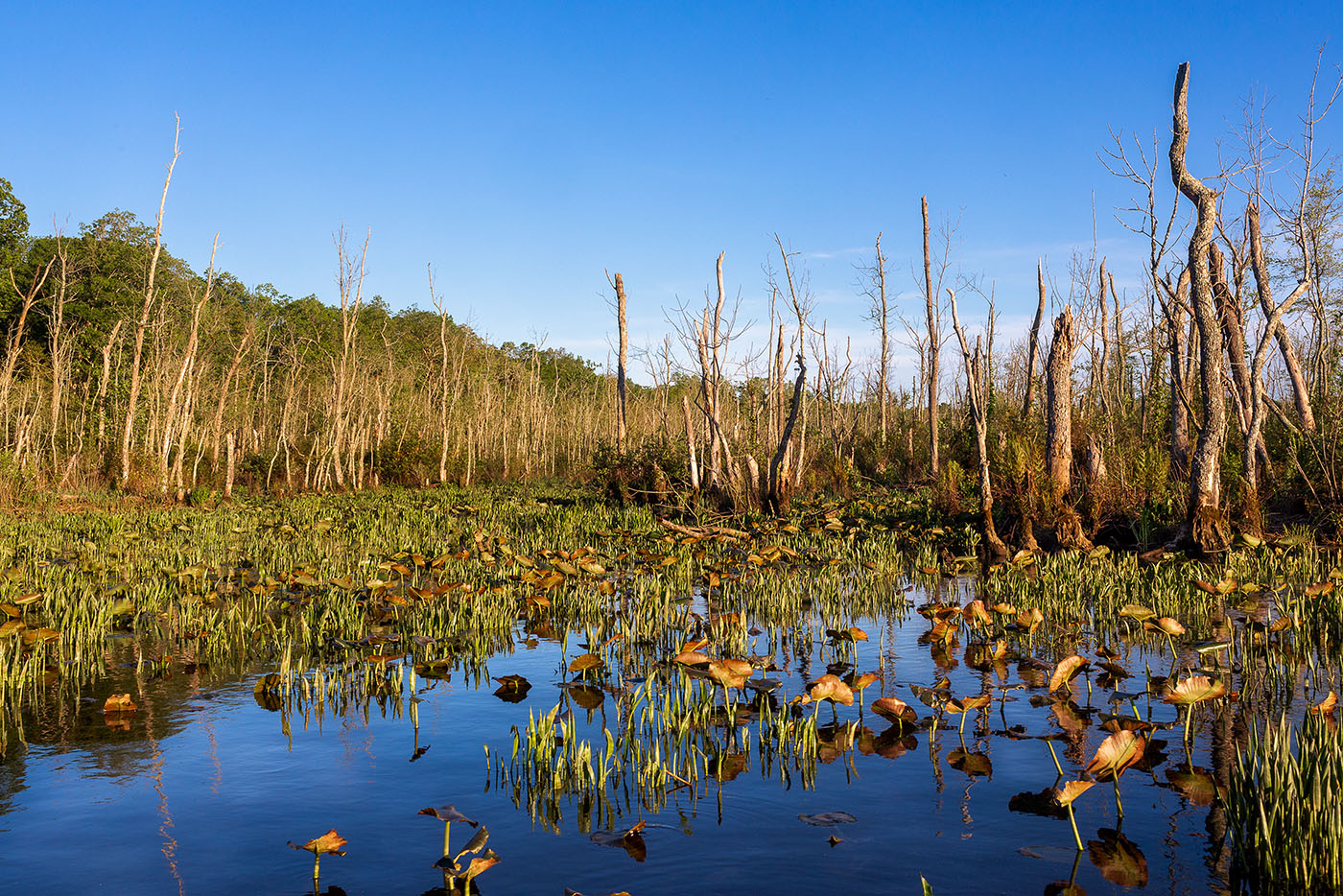
It started with a canoe trip in the summer of 2019. Popkin and Brice were paddling Mattawoman Creek, a tributary of the Potomac River, when they came around a bend and were confronted by a forested wetland filled with dead trees.
“I didn’t know what it was,” recalls Brice. At first she wondered if it could be saltwater intrusion — rising sea level killing trees unaccustomed to salty ocean water. But they were too far inland.
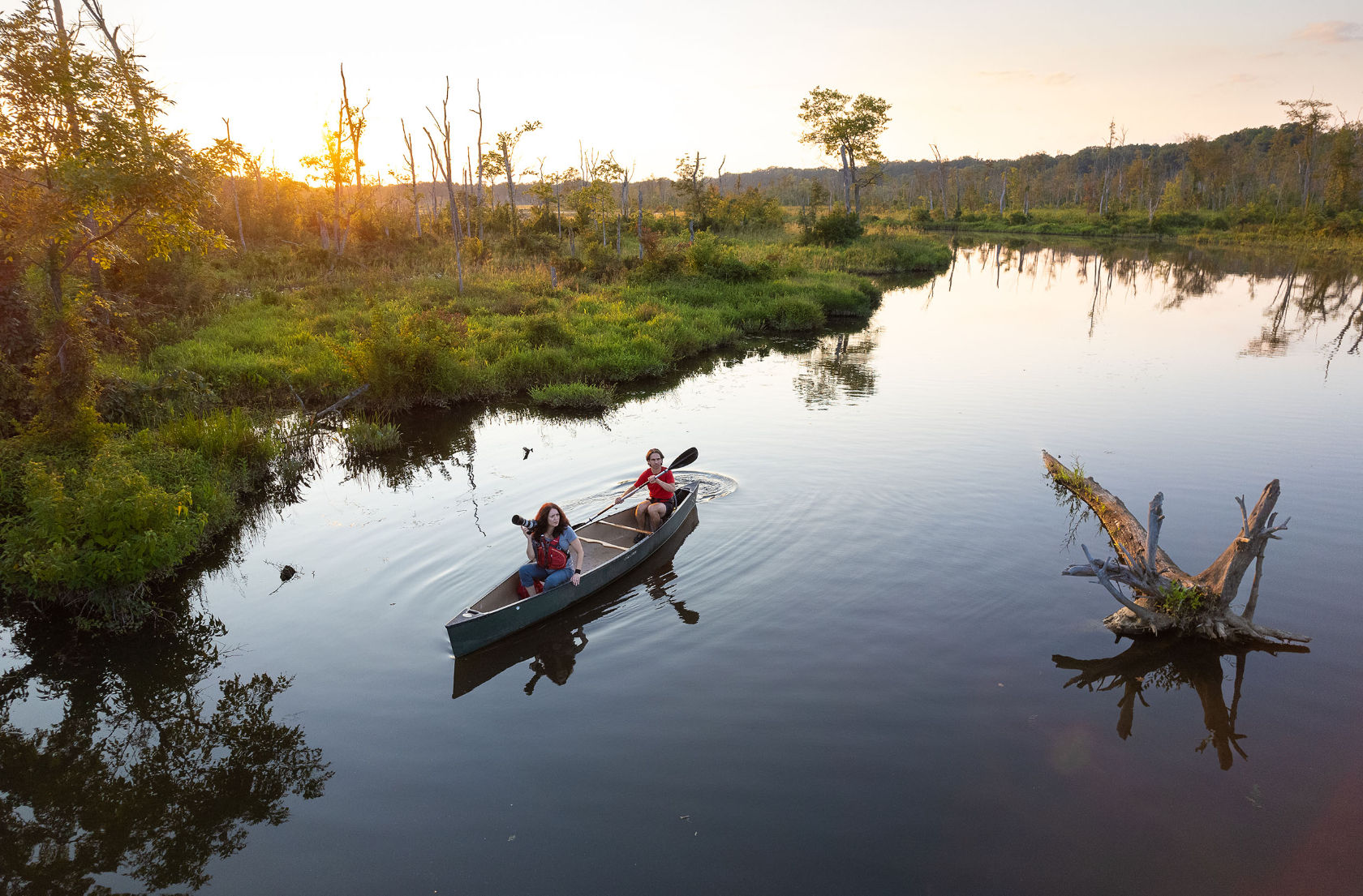
Popkin, who writes a lot about trees and forests, recognized what they were looking at: grove upon grove of dead ash trees.
“It definitely shocked both of us and we felt like we needed to do something. We weren’t sure what that something was going to look like. But we just started going out to these forests documenting them,” Popkin says.
It evolved into an online exhibit called the Ash Forest Project. The work is also currently on display at Joe’s Movement Emporium in Mount Rainier.
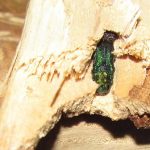
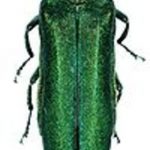
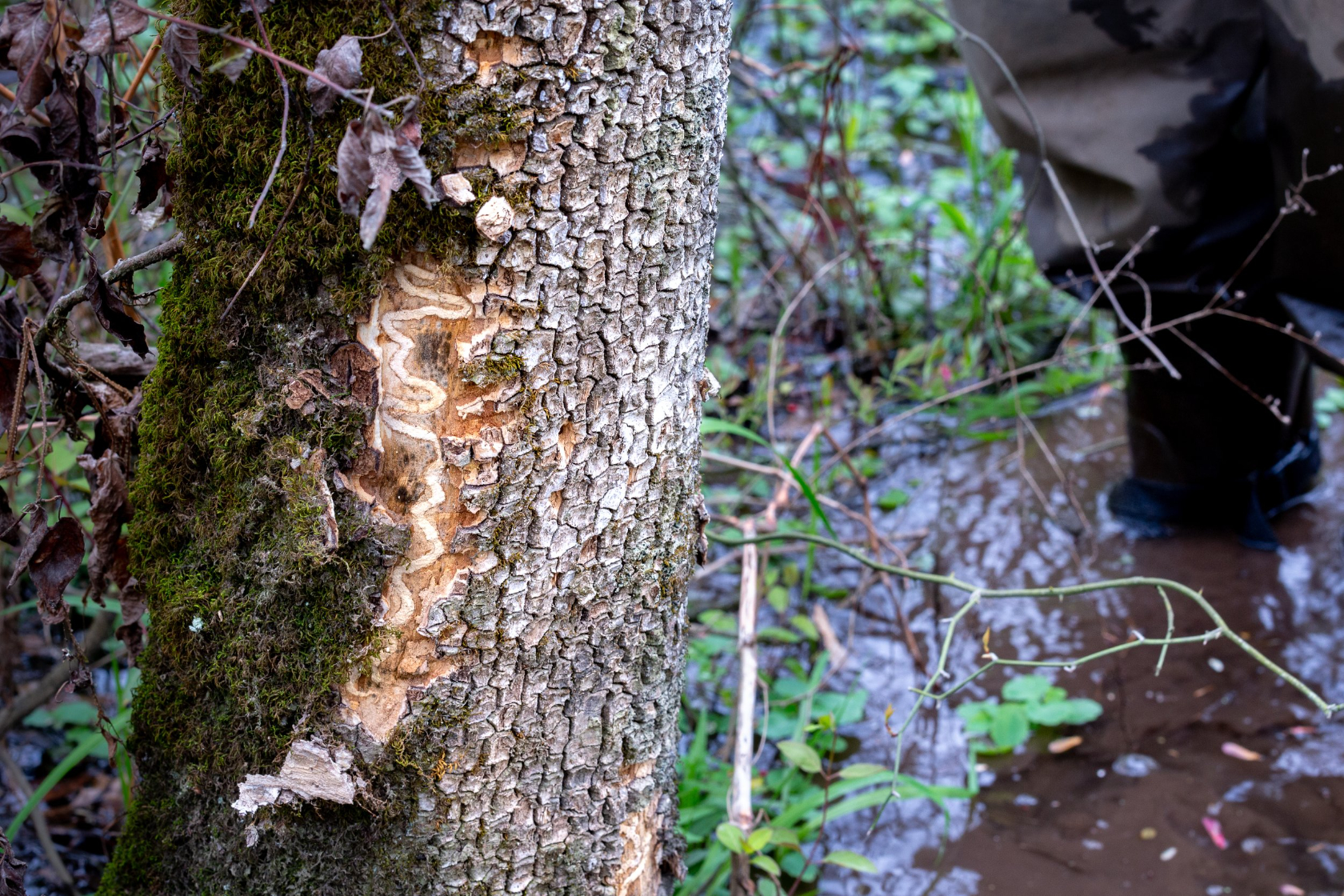
The emerald ash borer is an invasive beetle from Asia with a shiny emerald-colored body that lays its eggs in the bark of ash trees. When the eggs hatch, the larvae bore into the tree’s vascular tissue. In Asia, ash trees co-evolved with the bug, developing a natural resistance over thousands of years. In North-American ash species, however, emerald ash borer infestations result in a 99% mortality rate.
It’s a small insect, only about half an inch long, but it’s killed tens of millions of ash trees across 36 states.
The emerald ash borer was first detected in North America in Michigan in 2002. It’s thought to have arrived in wooden packing material used to ship consumer goods from Asia. After Michigan, the D.C. area was one of the next places to be hit, when an infected shipment of trees arrived from the Midwest.
Nearly all of the ash forests west of the Chesapeake Bay in Maryland, Virginia, and D.C. have already been decimated. You can find dead green ashes in wetlands along the Anacostia River, Rock Creek, and the Potomac River. In the mountains, you’ll find groves of dead white ash — the trees make up roughly 5% of the forests in Shenandoah National Park, for example.
But there are still intact ash wetlands on the Eastern Shore. Over the past few years, Popkin and Brice have witnessed the progression of the emerald ash borer, as it inevitably, inexorably, conquers the Delmarva peninsula.
“When you walk into a healthy forest, it’s lush,” Brice says. “It’s hard to know where to focus your eye.”
In a dead ash forest, on the other hand, there’s much more light, she says. There may be greenery low down, as invasive vines climb the dead trunks, but higher up, the canopy is bare, Brice says.
“I thought of when I was in Puerto Rico after Hurricane Maria: it looked like just sticks of wood, just bare trunks,” she says.
The loss of ash trees isn’t so noticeable in urban areas. Many of the ash groves along the Anacostia River, for example, are difficult to get to without off-trail bushwhacking or arriving by boat.
There are 16 different species of ash tree in North America, adapted to a wide variety of ecosystems.. “There’s kind of an ash tree for every environment,” Popkin says. He was surprised to learn that large, mostly intact ash forests existed in the region.
“To see these places start to get wiped out, it really felt like we were losing something important, and something that most people aren’t even aware of,” Popkin says.
In the Mid-Atlantic, many green ashes grow along rivers and creeks, forming freshwater forested swamps. The swamps are muddy and teeming with life — at high tide, the trees’ trunks are under water. These ash swamps are unique ecosystems, and when the ashes die, the swamps are dramatically transformed.

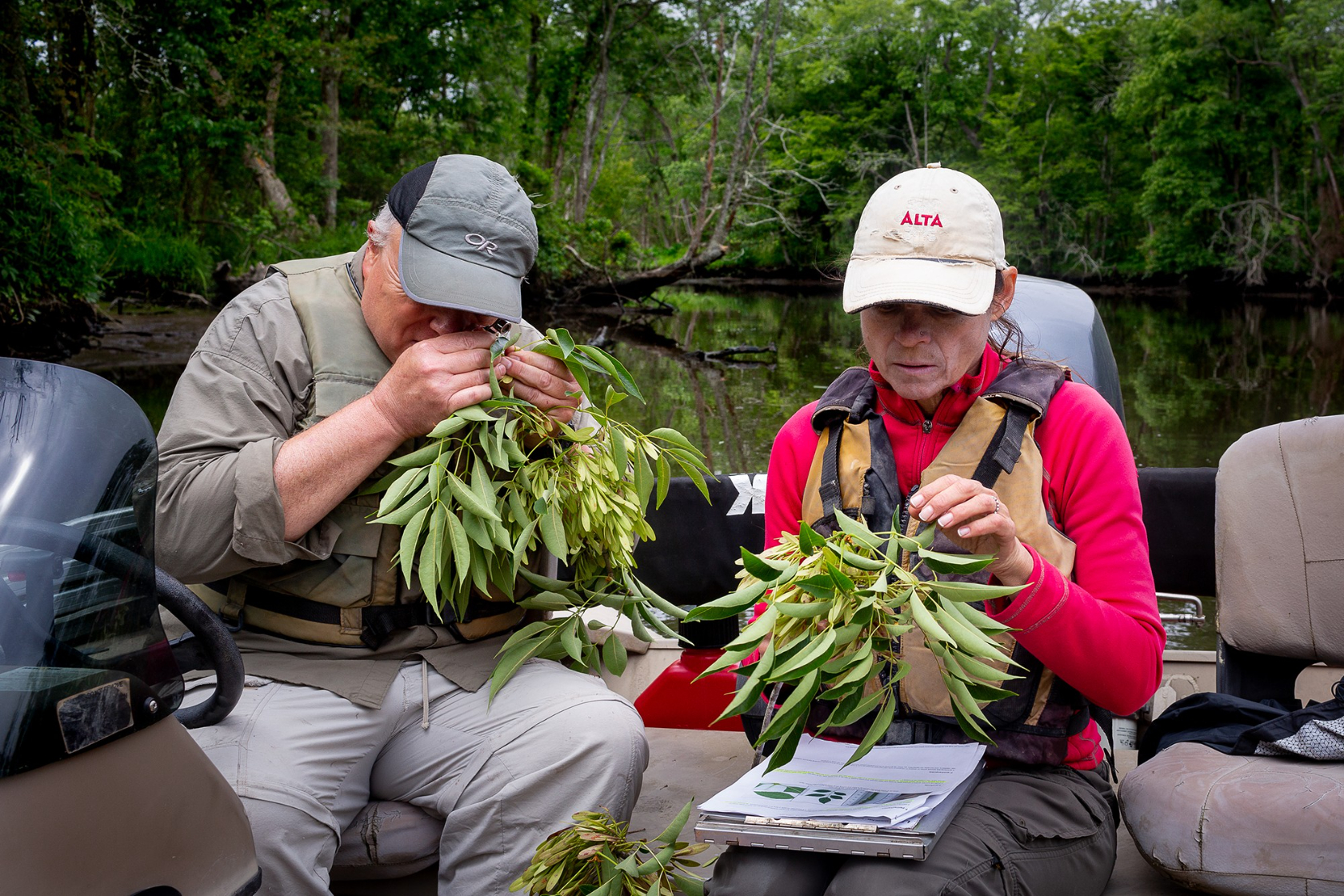
“There are other trees, but it’s the ash that is the dominant species,” explains Diane Leason, a researcher at the University of Maryland who is studying the impact of the emerald ash borer.
Trees like red maples and swamp tupelos also grow in the same wet habitat, but they’re rare, Leason says.
“Maybe they will eventually take over, but we don’t know,” Leason says.
Leason is one of the scientists Popkin and Brice spent a lot of time with for the Ash Forest Project, along with Andrew Baldwin, a UMD professor.
Baldwin says whatever replaces ash swaps, it will be a different community of plants and animals. Many formerly forested swamps will likely transform into open marshes.
“It’s not that all the woody plants are gone. The trees die back, but there are a lot of shrubs under there. So it’s still a woody plant community, but it’s got marsh plants in it,” Baldwin says.
It is possible to treat trees with insecticides to protect them from the ash borer, but that’s not a large-scale solution — it’s expensive and has to be repeated on every tree every year.
So in many cases, saving forested wetlands means planting new trees of different species.
That’s what Jorge Bogantes and his team at the Anacostia Watershed Society are trying to do. On a recent morning in April, Bogantes showed off his work trying to restore what used to be an ash swamp at Colmar Manor Community Park, just north of the District line in Prince George’s County. Volunteers have planted 600 trees on about 15 acres on both sides of the Anacostia River, and there are plans to plant 300 more trees.
They’ve planted more than a dozen different species in an attempt to recreate a forest canopy beneath the stands of dead ash snags.
“You don’t know how much ash trees make up a riparian forest until they’re dead,” says Bogantes.
Restoring former ash wetlands like this is a ton of work, and a bit of a never ending battle. But without intensive restoration, areas like this could transform into thickets of invasive plants.
Even with all the tree planting work, it will still take decades to recreate the forest canopy that was lost when the ash trees here died. And the unique ecosystem they created will be gone for good.
Popkin says he’s struggled with what message to send about the death of ash forests.
“With something like climate change, you can be like, ‘I’m going to go out and buy solar panels,’” Popkin says.
There’s not much you can do about ash trees, though. Popkin says he hopes the Ash Forest Project gets more people to appreciate our local ecosystems, and maybe pay a visit to one of the ash groves that’s still standing on the eastern shore.
“If you want to see one of these forests, like now’s the time because they’re not going to be around too much longer.”