Morgan Baskin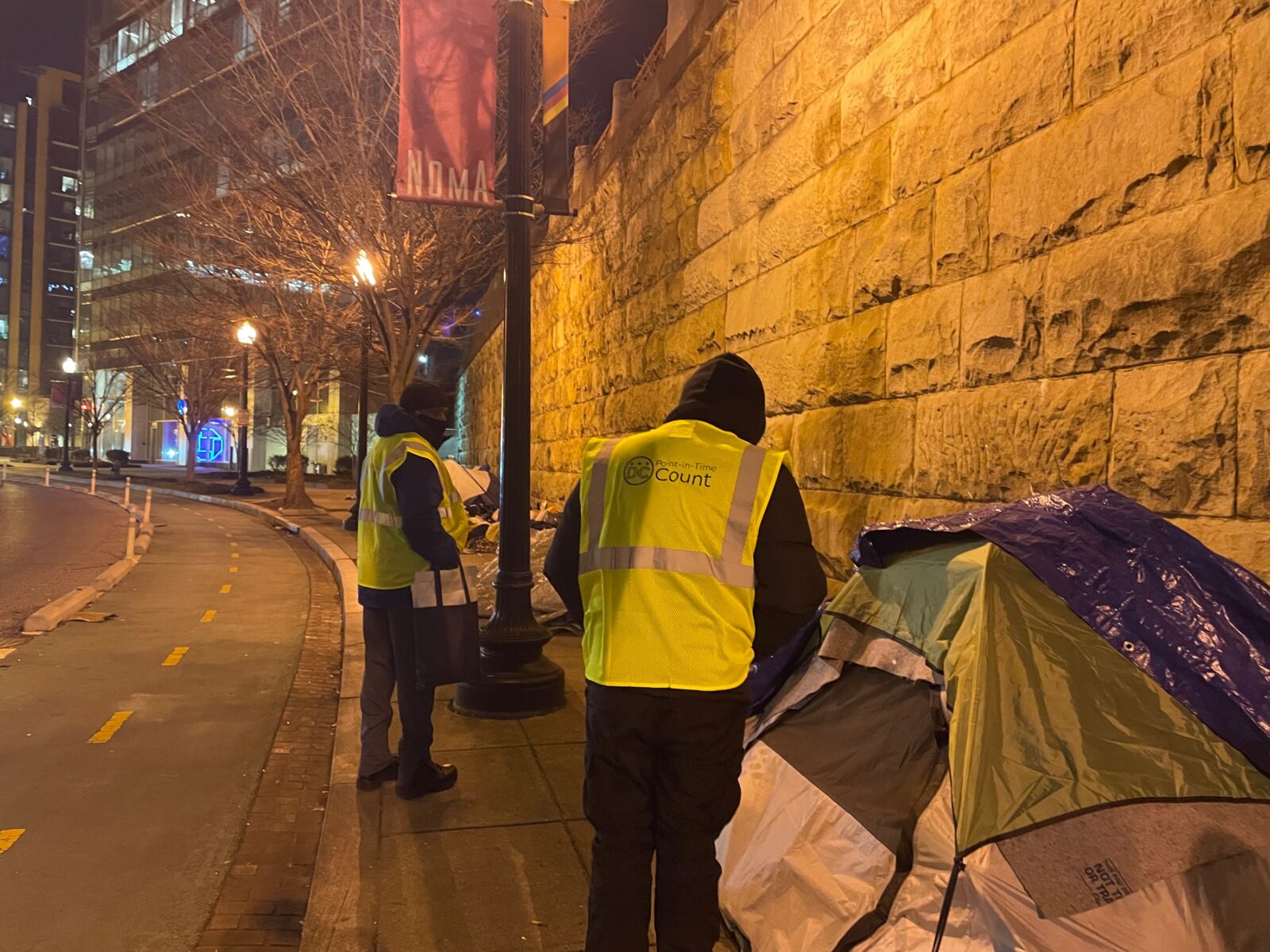
The metropolitan Washington region experienced an 18% increase in homelessness between January 2022 and January 2023, the region’s Council of Governments announced Wednesday.
That data comes from the point-in-time count, an annual survey of people who are “literally homeless” – those living on the street or in abandoned buildings – or staying in temporary and emergency shelter. The count is imperfect, with outcomes hinging in part on the weather at the time of the count and the number of shelter beds available in any given jurisdiction; it also doesn’t account for a variety of populations experiencing housing instability, including those couch-surfing with friends or experiencing a time-limited rental subsidy.
Much of the increase came from D.C., which alone saw a 12% uptick in homelessness and has the largest proportion of the region’s unhoused residents, and from Montgomery County, which counted 894 people, a 54% jump over last year. But all of the nine jurisdictions that comprise metropolitan Washington – Alexandria and D.C.; as well as Arlington, Fairfax, Frederick, Loudon, Montgomery, Prince William, and Prince George’s counties – saw a rise in their unhoused populations this year, indicating that the trend isn’t isolated to any one area.
“This never happens,” says Hilary Chapman, COG’s housing program manager. “It’s pretty unprecedented to see an increase across the board, 100%. Every community is experiencing this increase across a wide variety of [places] – urban, rural suburban. It’s indicative that there’s a larger trend at play here.”
In total, those jurisdictions collectively counted 8,944 people experiencing homelessness this year, a jump above the 7,605 counted in 2022. Loudon County saw a startling 122% increase in homelessness, jumping from 99 people counted in 2022 to 220 counted this year. Prince William County saw a 35% increase, and Prince George’s a 15% increase. Every jurisdiction saw at least a 10% increase in homelessness.
Chapman points to the rise in homelessness among seniors as one of the region’s most troubling trends. Metro Washington counted 383 unsheltered seniors, up from 118 in 2022. More than two-thirds of the seniors counted as unhoused this year are 70 or older; at least three are more than 90.
“Most of the region’s shelter systems are not well equipped to deal with people who have the kinds of conditions that come with elderliness, like dementia or cognitive decline,” Chapman says, noting that people experiencing homelessness tend to age more quickly than peers who have stable housing, often presenting with physical ailments more common in housed people 20 years older.
Medium-term data from PIT shows homelessness trending down in four of these jurisdictions over time, decreasing 9% overall since 2019, when the region counted roughly 9,800 unhoused people. (Though because of the PIT count’s inherent shortcomings, the report notes, “It is not unusual for a jurisdiction to serve as many as four or five times the number of people during a year as are counted during one night of the PIT enumeration.”)
Over the last five years, the region has also consistently counted fewer than 10,000 people experiencing homelessness. And while the number of people experiencing chronic homelessness decreased slightly this year – down by 41 people since last year – the number of people experiencing homelessness for the first time increased in some jurisdictions, including D.C. Half of the city’s unhoused population captured by the count this year is experiencing homelessness for the first time, and there are now about 7 unhoused people for every 1,000 residents in the District. (The next-closest jurisdiction is Fairfax County, which has about one unhoused person per every thousand residents.)
The report’s authors point to a number of factors that have contributed to this year’s rise in homelessness, including the end of local eviction moratoriums and exhausted emergency rental and utility assistance. But ultimately, they argue, there is an underlying culprit: a lack of affordable and available permanent housing for lower-income households.
“Due to high housing costs and limited housing options for households with lower incomes, the collaborating jurisdictions and service providers represented in this report are concerned that many of the region’s residents are at risk of experiencing homelessness,” the report concludes.
Although people who use housing vouchers are not included in the region’s tally of unhoused people, COG’s report does enumerate the number of people participating in various housing programs, including rapid re-housing and permanent supportive housing. (The former is a temporary program.) More than 29,000 people participated in those programs across the region this year, COG reported. It counted 3,446 more rapid-rehousing placements this year than there were in 2019.
While that figure signifies deeper regional investments in housing vulnerable populations, it also reflects the breathtaking need for more affordable housing. D.C. Mayor Muriel Bowser has relied on both programs to offset stress on the family shelter system, though has proposed a fiscal year 2024 budget that does not make any additional investments in the permanent supportive housing program.
“I think if we don’t see some real closing of the social safety net gap in the budgets, we’re gonna see continued increases in these numbers of people experiencing homelessness,” says Kris Thompson, CEO of Calvary Women’s Services, a transitional housing provider in D.C. “I think it’s a critical moment in the life of this community for the council and the mayor to fully fund the kinds of services that are necessary for all of the district residents, including those experiencing homelessness.”