Jacob Fenston
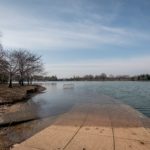
When D.C.’s Tidal Basin was built more than 100 years ago, the walkways around it were 6 feet above the Potomac River at low tide. Since then, a combination of rising sea level and sinking land has brought the water much closer — in fact portions of the walkway now flood twice a day at high tide.
The National Park Service has just approved a plan to rebuild several sections of the seawall around the Tidal Basin and nearby West Potomac Park, raising the walkway by roughly 5 feet. Even this height may not be enough to keep walkways dry in the coming decades, however. To deal with future sea level rise, and the potential for more frequent and more intense coastal storms, NPS plans to build the seawalls in a way that they can be built up higher later on.
The regular flooding around the Tidal Basin is an inconvenience to the millions of tourists that visit the District each year. In some places the walkway never dries, with mud and debris building up. Plus, the water is causing erosion and hurting the famous flowering cherry trees around the basin.

Mike Litterst, a spokesperson for NPS, says the land around the Tidal Basin has sunk as much as 3 feet in some places, since the park was built in the late 1800s and early 1900s. At the same time, sea level has risen by more than a foot, creating an overall loss of elevation of 4 feet.
The new seawalls will be anchored in bedrock 45 to 100 feet underground, unlike the original walls, which were build directly on soft infilled land dredged up from the river bottom. This should prevent further sinking.
As part of the project, NPS also plans to widen walkways from 8 ft. to 12 ft.
“Anybody who’s tried to walk around the Tidal Basin during cherry blossom season knows that we could certainly use some additional width there on those paths,” Litterst says. “More room for people to walk, and less likely that they’ll walk off the paths and on the roots of the cherry trees.”

NPS will now move ahead with selecting a contractor for the project, which is getting funding through the Great American Outdoors Act. Construction could begin as early as next summer. There will be some closures to visitors, but only around the southwestern corner of the Tidal Basin.
The project will also require the removal of about 300 trees, mostly cherries. These will be replaced with the same tree species when the work is complete.
The current phase of the project only addresses 6,800 linear feet of seawall — the part most in need of repair. Litterst says NPS hopes to rehabilitate other portions of seawall in future phases.
In 2019 the Tidal Basin was listed as one of the nation’s “most endangered historic places” by the National Trust For Historic Preservation. Numerous ideas have been floated for trying to save it — including through the Tidal Basin Ideas Lab, a competition that challenged designers to imagine a more resilient Tidal Basin. The proposals generated through the lab will still be considered in future planning, according to NPS.