 Aja Drain
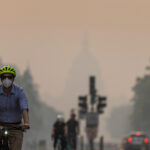
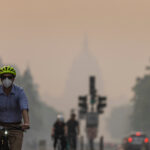
The only thing clear about today is the heat and haziness hanging over the city. The National Weather Service has now issued a Code Red for air quality across the D.C.-region. The worsened air quality comes after multiple Code Orange alerts last week. But why is the air quality so bad today?
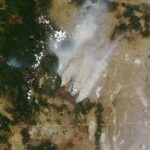
Bad air pollution often comes from car exhaust, but wildfires in Quebec are the biggest source of haze and smoke in our air today, according to Capital Weather Gang. Smoke can travel a long way: we’ve recently been impacted by wildfires in New Jersey, Nova Scotia, and Alberta.
https://twitter.com/islivingston/status/1666418367589146624?s=20
The air quality has been worsening since then. A cold front coming from the northeast last Saturday was expected to add more smoke and worsen air quality, Ian Livingston, forecaster/information lead for the Washington Post’s Capital Weather Gang, told WAMU/DCist June 2.
That’s similar to what’s happening now. Livingston says that wildfire smoke gets trapped in the jet stream — like an “air river” 30,000 to 40,000 feet in the air, around the same height that commercial jets fly– and that’s how the smoke travel cross-country. But for smaller fires, smoke plumes only go up to 15,000-20,000 feet; not high enough to enter the jet stream and waft a few thousand miles away.
“I think one reason we’re seeing more of it these days is that we have seen much bigger, more intense fires,” Livingston says. “It’s just like a massive crazy wildfire you see sometimes like fire tornadoes spin-off of it because it’s so hot; so those basically sort of act like a thunderstorm, those big updraft in a thunderstorm that flies up to 30,000 – 40,000 feet.”
Those massive wildfires — which often happen in the western US — have only gotten worse due to multiyear droughts, beetle infestations killing large parts of the forests, lightning, and other factors, Livingston adds.
“Most of the fires in the past month or so have been fueled by a mixture of unusually hot weather and drought conditions in Canada,” Livingston told WAMU/DCist. “There is also drought locally [in the D.C.-area], although New Jersey is not necessarily in super-dry conditions. I think the forests in the southern half of the state ignite every now and then.”
And the wind direction was right for the smoke to be drawn into this area, where it would usually be blown out to sea, Livingston adds. And all of that has a domino effect impacting our air quality.
What is air quality?
Air quality is determined using the Air Quality Index (AQI), which is broken up into six categories/different colors: green, yellow, orange, red, purple, and maroon – with green representing good air quality and maroon indicating the worst level of air quality, according to AirNow.gov.
A Code Red sits in the 151-200 range in Air Quality Index (AQI) range and is unhealthy for some members of the general public, with serious health effects for sensitive groups like children, the elderly, or people with chronic conditions such as asthma, heart disease, or other lung conditions.
To reduce the effects of air pollution, the National Weather Service recommends minimizing strenuous activity or exercise outdoors. D.C. experienced its first Code Red since 2012 in 2018, and multiple Code Reds have been cited since then.
“The primary ingredients for any of these codes are the PM 2.5, which is particulate matter, things like smoke, dust, other sorts of emissions from burned fossil fuels, that sort of thing,” Livingston says. “And then again, the other is ozone.”
Ozone is a colorless gas that hangs high up in the upper atmosphere, shielding the Earth from the sun’s UV rays, according to AirNow.gov. But ozone can form at ground level when two types of pollutants (VOCs and NOx) react to sunlight. These pollutants come from lots of different sources like cars, shipping, heavy industry, power plants, and products like solvents and paint. And although helpful high up in the atmosphere, ozone exposure at ground level can cause respiratory problems.
“Basically, our pollution season overlaps summer more or less,” Livingston says. “I think generally something like May to September is the most common time to see a Code Orange or higher these days.”
Livingston adds that usually those peaks occur later in the day, after emissions and heat have built up.
“These days we might see about, you know, on average five or so Code Orange days a year,” Livingston says. “Again, those are mostly in the middle of summer, and the biggest, biggest day nationally for Code Orange or worse is the Fourth of July.”
Starting in May 2021, there were nine Code Orange days and one Code Red on the Fourth of July, according to Clean Air Partners. Last year there were only four Code Orange days all through the summer, according to the same group. There have been at least five Code Orange days so far this year, with the earliest Orange day coming in April, according to Clean Air Partners. Livingston says it’s possible but pretty uncommon to see air pollution that high early in the spring.
Over the past few decades, air pollution has improved within the region. In the 1980s and 90s, Livingston says D.C. could average 30 Code Orange days or higher a year because there were a lot of factories contributing to air pollution around the Mid-Atlantic. But over the years, Livingston says public transportation systems, fuel efficiency, and clean energy have helped to improve air quality. The pandemic shutdown restrictions also had a temporary effect on improving air quality in the area, with only two Code Orange days in 2020 – and another code red on, you guessed it, the Fourth of July.
But air pollution doesn’t impact D.C., residents, equally. Black residents in D.C. are disproportionately impacted by poor air quality, despite overall improvements in the region. Air quality can vary from neighborhood to neighborhood.
How does air pollution impact my body?
All air pollutants are not built the same, and so their size is what dictates their impact on your body.
“[Fine particulate matter] particles enter the respiratory tract and can cause inflammation and irritation in the lungs,” Dr. Neelu Tummala, Assistant Professor of Surgery at George Washington University School of Medicine and Health Sciences and co-director of the Climate Health Institute at George Washington University told WAMU/DCist.
Fine particulate matter – particles that are 2.5 microns or less (that’s like 30 times smaller than a single hair on your head!) – is one of the most concerning types of air pollutants, according to Tummala. The sources of this particulate matter include the burning of gas, oil, diesel fuel, and wood.
“These pollutants can cause breathing complications, including worsening the severity and frequency of asthma attacks,” Tummala told WAMU/DCist. “With chronic exposure, these particles can also decrease lung function and capacity.”
Ultra-fine particulate matter can be worse since they’re small enough to enter the bloodstream, and with chronic exposure, these particles can increase the risk of heart attacks and strokes, Tummala told WAMU/DCist. Sources of ultra-fine particles that impact us the most include vehicle exhaust, factory emissions, and controlled burns. Generally, children, elderly individuals, pregnant women, and individuals with underlying heart and lung conditions are most at risk.
Okay, but are pollen and pollution affecting my body the same way?
In addition to the air pollution, we’re still having a bit of overlap with allergy season – with plenty of allergy sufferers who can attest to how bad symptoms have been this year.
“Pollen season lasts through much of the spring, summer, and fall,” Tummala told WAMU/DCist. What changes is the source of the pollen each season: spring is typically tree pollen, summer is dominated by grass pollen, and ragweed is typical for late summer and early fall. “Right now in DC, we are having an overlap of pollen seasons, with increased levels of both tree and grass pollen,” Tummala told WAMU/DCist.
Pollen and air pollution affect the body in two different ways but can have compounding effects. Pollen particles are bigger than many air pollutants, so most of their impact is on the upper airway, like congestion, drainage, and sneezing with your nose, according to Tummala.
“Fine particulate matter, a main air pollutant, is small enough that it can travel farther in the airway and tends to cause respiratory symptoms in the lower airway – such as shortness of breath from inflammation in the lungs,” Tummala told WAMU/DCist. “That being said, there is oftentimes a lot of crossover on their impact on the respiratory symptoms, especially in those with underlying respiratory conditions such as asthma.”
But there are prevention tips to help keep you safe from allergens and pollution. Tummala recommends checking air quality levels, limiting time outdoors and wearing an N95 mask for high air pollution levels, setting up a portable air cleaner or air filter at home, and limiting pets from going outdoors when air pollution levels are high.
This story has been updated to reflect the Code Red air quality index on June 7.