Martin Austermuhle
Republicans and Democrats in the U.S. House of Representatives vehemently disagreed on Wednesday over whether D.C.’s current elections are a model for the rest of the country — or if Congress should use the city as an example by imposing new practices and restrictions some say would increase voter security and confidence.
The venue for the debate was a four-hour-long hearing held by a pair of House committees on how to increase election integrity in the U.S., and a likely outcome is a Republican bill-in-the-making that would propose sweeping changes to how the city conducts its elections. It would include requiring photo ID to vote, banning same-day voter registration, largely doing away with mail voting, and repealing a new city law that allows non-citizens to vote in local elections.
“For years, D.C. elections have been mismanaged,” said Rep. Bryan Steil (R-Wisconsin), chair of the House Administration Committee, which has held a series of hearings over the last two months on a draft bill known as the American Confidence in Elections Act. The bill would establish largely voluntary guidelines and standards for the states, but would directly make changes to how D.C. residents vote.
“I’m focused on using Congress’s constitutional authority to bring common sense election integrity reforms to the District and protect its voters. The ACE Act takes D.C. from being the poster child on how not to run an election to being the model for states to follow,” said Steil during the hearing.
But Democrats questioned the underlying presumption that elections across the country are unsafe, accused Republicans of amplifying the few claims of voter fraud, and pushed back on the effort to focus on D.C.’s elections.
“Our elections are secure. The majority has taken us deeper down a rabbit hole, desperately seeking some justification for their unpopular policies that would restrict access to the ballot. Today, they have really gone off the deep end,” said Rep. Joe Morelle (D-New York). “Today’s hearing is even more cynical than past because it has the voters of Washington, D.C., who already lack full voting representation in Congress, in its crosshairs. I want to be absolutely clear: Elections in Washington, D.C. are among the most accessible and democratic in our country. They are also among the most secure.”
Just about every element of D.C.’s current election and voter registration practices was hotly debated during the hearing, with Republicans claiming they opened the city up to fraud and foreign interference and Democrats arguing they enfranchised voters and increased turnout.
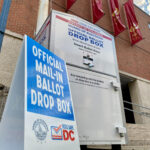
Former Virginia Attorney General Ken Cuccinelli, now chairman of the conservative Election Transparency Initiative, called D.C.’s election practices an “unmitigated disaster” and said the city’s same-day voter registration and more recent practice of automatically mailing ballots to voters increased the chances that ineligible voters could participate.
“Current D.C. election laws are fraught with a host of anti-election integrity procedures and practices which unfortunately do more to sow doubt, confusion, and mistrust than they do to inspire confidence and trust in elections that are fair, secure, and transparent,” he said.
He and Republican representatives pointed to a recent report from DCist/WAMU about the relatively high percentage of mail ballots returned as undeliverable and ballots that go to addresses where voters no longer reside, suggesting it shows the city’s voter registry is out of date. Rep. Morgan Griffith (R-Virginia) said a friend of his who votes in D.C. had received multiple ballots for other voters at this house. Cuccinelli said that voting should mainly happen in person, and only after a voter shows photo ID.
But Democrats said that the city’s move to increase voter registration and voting options actually increased access and turnout, and without any notable instances of fraud. They pointed to an election fraud database hosted by the conservative Heritage Foundation which shows no proven cases in the city over the last four decades.
“What possible reason could there be to eliminate same-day registration when it’s been successful and devoid of fraud?” asked Rep. Alexandria Ocasio-Cortez (D-New York). “I can’t think of any,” responded Wendy Weiser, who directs the Democracy Program at the Brennan Center for Justice at NYU School of Law, noting that same-day voter registration is currently in use in 22 states.
“What reason could there be for eliminating sending mail ballots to voters?” Ocasio-Cortez followed. “There’s isn’t,” said Weiser. “It has led to greater voter turnout and more secure elections.”
“What is striking is how afraid the other side of the aisle is of free and fair elections. This has nothing to do with election integrity. It has to do with racial control,” concluded Ocasio-Cortez, arguing that Democratic-supported measures to increase voter registration and voting largely benefit Black, Latino, and low-income voters.
Republicans focused a large part of their ire on D.C.’s new law that will allow non-citizens — including undocumented immigrants — to vote in local elections as early as next year. While other jurisdictions like Takoma Park, Maryland and more recently Burlington, Vermont have adopted similar laws, Republicans said that D.C. moving forward with it would be an insult to U.S. citizens and pose a distinct security risk because, hypothetically, Russian and Chinese diplomats would be allowed to vote.
“The D.C. mayor and city council play a crucial role in emergency preparedness, and now foreign nationals will have a say in who holds those seats,” said Rep. James Comer (R-Kentucky), who earlier this year unsuccessfully tried to have Congress block the city’s law from taking effect.
Raskin (D-Maryland) said non-citizen voting dated back to the country’s early years, and largely dismissed Republican security claims as concerns over “the possibility that a handful of Russian diplomats could sway in an advisory neighborhood commission election in Dupont Circle.”
All the while, Monica Evans, the director of the D.C. Board of Elections, largely avoided being dragged into the partisan fights over election law, opting instead to tell the representatives that her office “ensures the integrity of each and every election… we have many measures and safeguards in place that warrant confidence in our elections processes.” Towards the end of the hearing, she did contest Cuccinelli’s claims the elections office doesn’t know how much voter fraud is occurring because it isn’t capable of spotting it. “I’ve heard allegations that we have no desire to find fraud. That’s not true,” she said.
Ultimately, the hearing was as much about election procedures as it was about D.C.’s ability to govern itself. Republicans repeated that they merely sought to use their constitutional powers to make the city a model of voting practices for the rest of the country, while Democrats decried the debate and the Republican bill as unfair attempts to usurp local control — only months after Congress had successfully blocked a criminal justice bill passed by D.C. lawmakers.
“They seek to directly impose this anti-voter legislation as a political straightjacket on the people of Washington, D.C. The bill’s obvious aim is to disenfranchise people and make it harder to vote,” said Raskin. “D.C.’s very strong pro-voter, pro-registration policies are conducive to election integrity. The only reason for this legislation is for people to use D.C. as a whipping post, a guinea pig, a sacrificial lamb in efforts to suppress the vote.”