Martin Austermuhle
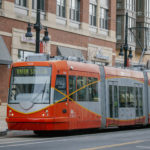
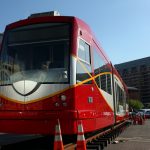
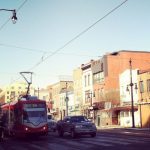
It was just about seven years ago that D.C.’s first streetcar in decades started running again, shuttling passengers along a 2.4-mile stretch of H Street and Benning Road NE. But a long-promised 2.2-mile eastward extension to the Benning Road Metro Station may now have to wait another seven years, if it happens at all.
The planned project was dealt a setback last week, when the D.C. Council gave final approval to a budget that pushes back the funding to start construction by at least two years, if not longer. At best, that could delay the streetcar’s eastward extension until later this decade; at worst, streetcar aficionados worry, it could deflate any remaining enthusiasm for the project and kill it altogether.
“We’ve been promised it over and over and over again,” says Michael Havlin, a Ward 7 resident and leader of Friends of the D.C. Streetcar, a community group pushing for the streetcar’s eastward extension. “And the can just keeps getting kicked down the road.”
The fight over expanding the existing H Street line isn’t new; lawmakers have debated the wisdom of spending upwards of $100 million on the project over the last three years. But it again highlights the streetcar’s shrinking place in the city’s transit network, a stark contrast from big plans for trolleys in years past.
For more than a decade, D.C. officials ambitiously envisioned a 37-mile network of streetcars crisscrossing the city, starting with a line on H Street that would help fuel the corridor’s redevelopment and create a new connection to Union Station. But the broader plan was eventually scaled back to 22 miles because of logistical and funding challenges, before being pared back even further to just eight miles, crossing from Georgetown and spanning the Anacostia River. The stretch to Georgetown was also eventually abandoned, leaving just the original line along H Street and Benning Road and the planned eastward expansion into Ward 7 — which would be a total of five miles of streetcar tracks.
Much of the scaling back came amidst softening political support for streetcars — especially as the construction of the H Street line faced numerous delays and a final price tag of $200 million, not to mention criticism of the decision to run the trolley in a lane shared with cars (meaning it could only travel as fast as traffic, and could be stopped by a double-parked car). And as more parts of the original network were shelved, the remaining segments were less urgent to the lawmakers who control the city’s purse strings.
This year, Councilmember Charles Allen (D-Ward 6), who chairs the council’s transportation committee, opted to delay funding for the streetcar’s extension to the Benning Road Metro station. In a report explaining the decision, his committee criticized the streetcar’s “low ridership [and] limited flexibility,” as well as the system’s shrinking footprint and connection to other modes of transit. At its peak a few years ago, the streetcar — which is free of charge — carried some 1.8 million passengers a year, comparable to some D.C. Circulator bus routes.
In an interview with DCist/WAMU, Allen said he wants to use the extra time from the delay to have the city rethink the role the streetcar plays in the city’s broader transit network.
“I think we need to have a clear-eyed approach to what our goals are overall with a streetcar system,” he said. “I do support streetcar and I want to see it extended east. But we did have to make tough decisions in this budget on a myriad of projects, one of which was to just slide back and delay that that eastward expansion.”
The council’s decision prompted pushback from Mayor Muriel Bowser, who called them “inequitable and avoidable,” and from Councilmember Vincent Gray (D-Ward 7), who had championed streetcars when he served as mayor and had defended the eastward extension in recent years when some of his colleagues tried to defund it. “If funds for this project are eliminated, the future of the streetcar will be in limbo,” he wrote last month.
For Havlin, the delay and possibly murky future of the eastward extension is additionally troubling because of what he says the line could represent.
“The streetcar extension to [Benning Road] Metro is the largest transportation equity project in the District in the last 20 years. It’s restorative investment that would heal the racist infrastructure blunders of the 20th century by reconnecting communities across the river with the streetcar extension,” he says. “About 40% of Ward 7 households do not own a vehicle. And there are 37,000 Ward 7 residents within walking distance of that prospective streetcar extension.”
That’s what matters to Delia Houseal, an Advisory Neighborhood Commissioner in Marshall Heights, which would be within walking distance of the last stop on the new route.
“I think the streetcar for us could be a gamechanger in terms of how we utilize transportation to get to places that we need to be, to be able to access the most basic amenities for ourselves and also just basic services,” she says. “That value can be seen not only in making sure that people have access to amenities across the city that we unfortunately don’t have here. But I also think that it could spur economic development.”
Houseal concedes that streetcars are “polarizing” for some people in her community, both because of the years of construction that would have to happen along Benning Road, but also because of fears of possible gentrification. Still, she believes most of her neighbors support the eastward extension, and would like to see it built.
Council Chairman Phil Mendelson says he’d also like to see that happen, though he says the streetcar’s once-vaunted potential hasn’t panned out and he doesn’t think there’s widespread political momentum for the streetcar.
“I know there are folks who want to see it happen. When I am east of the river rarely does anybody bring it up, so I don’t think it’s a top issue,” he says. “But I don’t think it’s dead. My sense is that nobody wants to kill the extension going across the river. My own view is that it makes no sense that streetcar ends at Oklahoma Avenue, that it has to have a more reasonable, practical, and useful terminus.”
Havlin, Houseal, and other advocates say they will keep pushing for that, even as Havlin says he recognizes that it’s an uphill fight — largely because of how little of the initial plans for streetcars remains in place.
“The full vision was to have an eight-mile line from the Benning Road Metro Station to Georgetown. And if the District had any level of follow-through, it would have done that and it would have been a world-class light rail system,” he says. “Instead, we’re haggling over a mile here or a mile there. And what we’re ending up with is like death by a million compromises.”