 Jenny Gathright
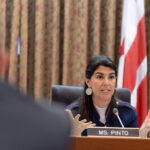
Ward 2 Councilmember Brooke Pinto unveiled a new emergency crime bill Thursday, incorporating many elements of the public safety bill introduced earlier this year by D.C. Mayor Muriel Bowser.
Because it’s emergency legislation, Pinto’s bill can become law much faster than Bowser’s, which has to go through committee, receive two votes from the full council, and undergo congressional review. Emergency bills require only one round of voting with nine councilmembers in favor, and are in effect for 90 days.
The legislation comes during a year when many categories of crime are up in the District: Homicides are up 19% compared to this time last year, and overall violent crime is up 30%, according to police. At a press conference Thursday, Pinto said she introduced the emergency bill because she believed it could make an immediate impact on crime in the city.
“We have to act now,” Pinto said. “This is an emergency.”
Among other provisions, the emergency bill would tilt the law in favor of pretrial detention for both adults and juveniles, create a new offense for firing a gun in public, and make it easier for prosecutors to extradite people for misdemeanors and use GPS data from ankle monitors to prove people’s guilt in court.
Pinto introduced her bill about a week after the councilmember held a public hearing on Bowser’s legislation, which drew both intense support and opposition. More than 170 people signed up to testify, and the hearing lasted nearly 12 hours.
Pinto’s version of the bill excluded or amended several provisions of Bowser’s bill that received the most opposition in the hearing, but it maintained several of Bowser’s changes too. The mayor said she supported the bill because it incorporated the “heart” of the legislation she introduced in May.
“I think that it will make us safer,” Bowser said at the press conference. “I think the vote should be unanimous.”
Both Pinto and Bowser pushed the rest of the council to pass the legislation during the council’s final legislative meeting Tuesday, before the body’s summer recess starts.
What elements of Bowser’s bill does the emergency legislation preserve?
Pinto’s emergency legislation would keep a Bowser proposal to increase the amount of reimbursement residents can get for installing private security cameras outside their homes.
It would also keep a measure that many advocates for children support – a provision that would expand protections for children who have experienced child abuse and allow contractors and consultants who have access to schools to be prosecuted for sexual abuse.
Pinto’s bill adds strangulation to the definition of a crime of violence in the D.C. code – a move that domestic violence-focused advocates have pushed for in various forms, since strangulation can often be an early warning sign for domestic violence-related homicides. It would also designate firing a gun in public as a felony and require the city’s Criminal Justice Coordinating Council to publicly share more data on the outcomes of diversion programs that offer services instead of traditional prosecution.
Similar to Bowser’s bill, it would tilt the law more in favor of pretrial detention for adults accused of violent crimes. In the first three months of 2023, D.C. saw more than 100 cases where people were out on pretrial release for alleged violent crimes and were rearrested for another alleged violent crime, Pinto said Thursday. “That’s just an unacceptable number,” she said.
And like Bowser’s bill, Pinto’s emergency bill would also make it easier for prosecutors to argue in favor of pretrial detention for juveniles.
What does Pinto’s bill change?
But notably, Pinto’s version of the bill doesn’t go as far as Bowser’s proposal did on juvenile detention and makes some changes, perhaps in response to the significant opposition the juvenile statutes received at last week’s hearing on the bill.
Both youth defense attorneys and D.C.’s top youth prosecutor – Attorney General Brian Schwalb — came out strongly against this piece of Bowser’s proposal, arguing that it would lead to the unnecessary detention of young people who present no danger to the community and would be further traumatized by incarceration.
Current law says that young people accused of crimes involving a real or imitation weapon should be held in detention ahead of their trials unless there’s compelling evidence that they can be released. Bowser’s proposal significantly expanded the range of crimes for which judges would be assumed to rule in favor of detention, broadening it to include other offenses like burglary, robbery, and attempted robbery. Another element of Bowser’s proposal would allow judges to detain children for their own protection.
Pinto’s emergency bill would still tilt the law in favor of more pre-trial detention for youth accused of dangerous or violent crimes whether or not they were armed — but it keeps some exceptions for drug-related crimes and burglaries that don’t involve real or imitation guns. It also strikes the particularly controversial Bowser proposal that would allow judges to detain kids for their own protection regardless of whether they presented a danger to the public.
In a statement Friday, Schwalb said that while his office was still reviewing Pinto’s proposed bill, “we appreciate that Chairwoman Pinto took the concerns of our office seriously and did not include several counterproductive elements of the Safer Stronger Amendment Act [Bowser’s bill] in this proposed emergency legislation.”
Pinto’s bill also leaves out another Bowser proposal that drew strong opposition at last week’s hearing — changes to a D.C. law (also known as the Incarceration Reduction Amendment Act, or IRAA) that allows people convicted of crimes when they were young to seek early release after they’ve served 15 years in prison.
Bowser’s changes would essentially make it easier for judges to deny these petitions for early release. And while some people — including some victims of crime — testified in favor of the changes, scores of people at the hearing argued against them. Many of the men who had secured early release through the law testified that they were contributing to public safety in D.C., not undermining it; Bowser’s own administration employs scores of formerly incarcerated men as violence interrupters and mentors to youth, for example. Others argued that D.C.’s second chance law had no connection to the city’s crime problem; Just two of the 155 people released early under the law have been arrested for crimes against other people since coming home.
Pinto said she heard these concerns, and shared them – which is why she left the changes out of her emergency legislation.
“I heard overwhelming testimony from members of the public in support of IRAA at the hearing, and I share that support,” Pinto said at Thursday’s press conference.
Other measures included in the bill
Pinto’s emergency bill also includes several provisions from another public safety-focused bill she introduced last month. They include –
- a provision that would make misdemeanor arrest warrants extraditable outside D.C. – meaning that if a judge finds good cause, a warrant for a D.C. misdemeanor can be executed for these offenses even if the accused person is outside the District
- A provision directing courts to expedite criminal cases where a child is a victim
- A provision amending D.C.’s laws to state that data from GPS-monitored ankle bracelets owned by D.C.’s Pretrial Services Agency can be used in court to prove someone’s guilt
Other emergency legislation Pinto unveiled Thursday
Pinto also introduced two other emergency bills on Thursday. One of them amends police reform legislation the council passed last year, altering the policy on vehicular pursuits. The current law says that police officers are not permitted to chase people in their police cars unless they are actively fleeing a felony or they present an “immediate threat” to the public. Pinto’s bill would expand officers’ leeway a bit, allowing them to pursue people who present an “imminent threat,” not just an immediate one.
It would also repeal some language that says officers must have exhausted all other options before initiating a vehicular pursuit. Pinto says the goal of her changes is to maintain the law’s limits on pursuits while ensuring that MPD can authorize police to pursue people when it’s necessary for public safety.
A third emergency bill incorporates some elements of another recently-introduced Brooke Pinto bill that would require the city’s Office of Unified Communications (which handles 911 calls) to be more transparent about errors. Under the emergency legislation, OUC would have to post information about errors, staffing levels, and dropped calls on a monthly basis. It would also require the agency to post data on the number of 911 calls that it’s diverting to alternative responses.
Tensions over how to respond to rising crime
The emergency legislation came after a violent long weekend in the District, with four fatal shootings on the July 4 holiday alone. Early Wednesday morning, nine people were wounded by gunfire at a single July 4 celebration in Northeast D.C.; the youngest victim was 10 years old. Police say all are expected to survive the shooting.
But amid agreement that the status quo is unacceptable, D.C. leaders and lawmakers are clashing over solutions.
Bowser thinks her crime bill will make a difference — but during last week’s hearing, some councilmembers were critical of her proposals and argued they might be counterproductive. Ward 1 Councilmember Brianne Nadeau called the legislation “simplistic, unserious, and performative,” arguing that its strategies had “been tried in the ‘80s, ‘90s, and 2000s, and they didn’t work then.”
And Ward 4 Councilmember Janeese Lewis George, a former youth prosecutor, argued that if Bowser wanted to address crime in the short-term, she would be better off focusing on training police officers to make more effective, constitutional arrests and addressing failures at the city’s crime lab that prosecutors say have made charging certain cases, including gun-related cases, more difficult.
Bowser and other members of her administration have repeatedly pushed back against advocates who have characterized the bill as a return to failed “tough on crime” policies, instead framing it as a package of common sense adjustments in response to rising crime.
“I don’t want to give anybody the impression that I want any person to go to jail that doesn’t deserve it. I also believe that every person is presumed innocent until proven guilty, and they get a fair trial,” Bowser said Thursday. “But I believe too that if you used a gun… and you walk out the next day with no consequence whatsoever, we are not going to drive down crime. That’s true for juveniles who are acting like adults, and that’s true for adults.”
This story was updated with a comment from D.C. Attorney General Brian Schwalb.