Martin Austermuhle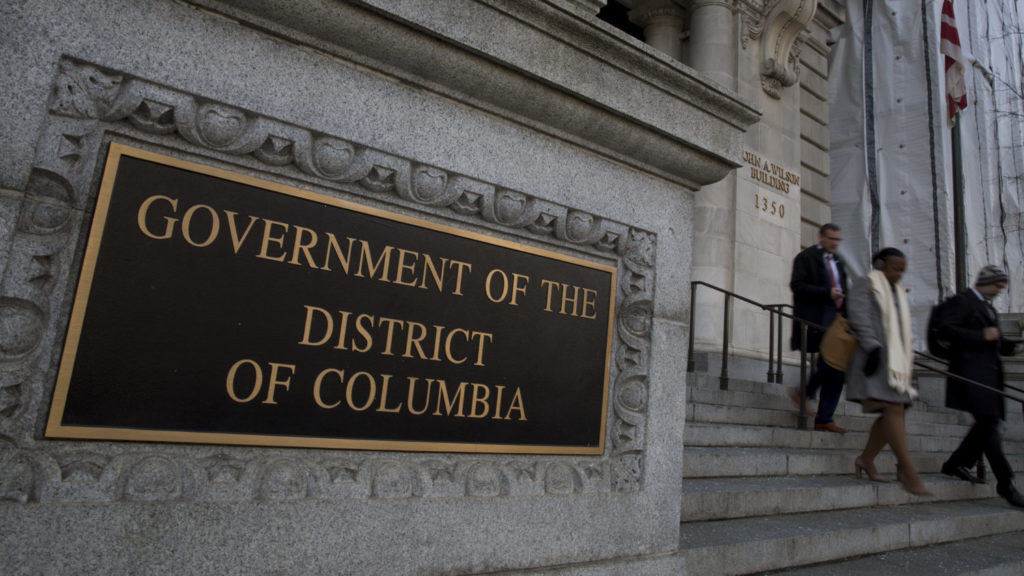
The D.C. Council on Tuesday approved an emergency public safety bill that proponents say will help stem the increase of violent crime and homicides so far this year. The council acted with a sense of urgency during the last legislative session before their usual two-month summer recess amidst heavy public lobbying by Mayor Muriel Bowser.
The vote was 12-1, with only Councilmember Janeese Lewis George (D-Ward 4) voting against it. Bowser quickly said it would make a difference. “The legislation that the council passed today will fill gaps in our criminal justice system and, in doing so, will increase accountability for violent and criminal behavior and make our city safer,” she said in a statement.
The narrowly tailored bill was introduced last week by Councilmember Brooke Pinto (D-Ward 2), pulling provisions from a broader proposal Bowser unveiled in mid-May to address what she called gaps in the law allowing certain violent crimes to occur more frequently. Pinto’s bill would create a new offense for firing a gun in public, make it easier for prosecutors to extradite people for misdemeanor offenses, allow police and prosecutors to use GPS data from ankle monitors to prove people’s guilt in court, and expand an existing subsidy for residents and businesses who buy security cameras.
More significantly, the bill would allow D.C. judges more flexibility in holding people with past violent offenses in jail pending any trial for new violent crimes, including juveniles. “This change responds to a serious problem of a revolving door,” said Pinto.
The council also unanimously approved a separate measure that clarifies when police can engage in a car chase, which Pinto said was needed to address confusion over existing restrictions that she said MPD had interpreted to mean that car chases are virtually never allowed.
The council’s votes comes amidst a 33% spike in violent crime compared to the same time last year, and a 17% increase in homicides — as well as a significant jump in the number of juveniles involved and impacted by gun violence. Recent high-profile incidents have included the killing of a former U.S. Army interpreter who fled his native Afghanistan and worked as a Lyft driver in the region, a mass shooting that killed two and injured nine in Ward 7 on July 4, and a daily drumbeat of carjackings.
Bowser has been pushing to hire more police and has urged the council to take legislative action, and even congressional Republicans have held multiple hearings on public safety in the city. At the same time, the city’s crime lab has remained without accreditation, and there is mounting criticism of dispatching errors by the Office of Unified Communications, which handles 911 calls.
The building political and public pressure was evident inside the Wilson Building, where almost all lawmakers said that something had to be done to address what many are now calling a crisis.
“We have a crisis of violent crime in the District. Unless things turnaround quickly, we could have a third straight year with more than 200 homicides in more than two decades,” said Pinto. “I hear from residents every single day that people are fearful and want urgent action.”
“There’s no question we had to do something. We saw a man come from another country who was an interpreter for special forces, jumped through incredible hoops to get to the United States, move somewhere, didn’t feel like it was safe enough for his family, came to our area and was killed in cold blood. Last week at church, the priest in his eighties who was supposed to fill in for my pastor couldn’t make it because he was beat over the head in a robbery in the city. These are the types of things people are unfortunately seeing every day, and it’s getting worse and not better. So there’s an expectation from the city that we act today, but we’re going to have to do more in the fall,” said Councilmember Robert White (D-At Large).
Still, some lawmakers expressed unease with the provision expanding pre-trial detention for adults, saying that the council should not rush into changing a legal standard that could result in more people being held in jail — especially as overall recidivism rates among those awaiting trial remains low. (It has ranged between 1% and 2% of those arrested, per court data.)
“There is no credible evidence that pre-trial detention would make D.C. safer. We’re doing the same thing we did in 1994,” said Lewis George, a former D.C. prosecutor, during the debate on Tuesday afternoon. She was referring to tough-on-crime bills passed in the 1990s. “We have books on this, we have scholarly articles on this. It’s the same reaction… we cannot make the same mistake. This is how mass incarceration happens. Bit by bit. We do not need to choose between bad strategies or nothing.”
Lewis George introduced an amendment to remove the provision expanding pre-trial detention for adults, but it was voted down by her colleagues 11-2. Still, her concerns were echoed in part by Councilmember Matthew Frumin (D-Ward 3), who said he wanted to revisit the provision in the fall, when the council will debate a permanent version of the legislation.
“If you create a rebuttable presumption in favor of pretrial detention, there are going to be some people who are going to be detained who maybe they shouldn’t have been, and that’s going to have an adverse impact on them,” he said.
The bill also drew opposition from criminal justice reform organizations like the ACLU of D.C. and the D.C. Justice Lab, which argued that the provisions rely too heavily on incarceration and fail to address the root causes of crime in the city.
“Every summer, crime goes up. Every summer, someone tries to introduce an emergency bill to do something about it. And every summer, these bills fail to make any difference. And it’s because they’re not tailored to what actually works to reduce crime. In D.C., we know that locking more people up and that having big, sweeping generalizations doesn’t work. We know that having really specific targeted interventions does, and that giving people support and resources does,” said Emily Cassometus, the director of government and external affairs for the D.C. Justice Lab.
Still, the apparent public pressure moved some progressive-minded lawmakers to support Pinto’s bill, drawing the ire of activists and supporters on social media. Councilmember Zachary Parker (D-Ward 5) was lambasted on Twitter on Monday after announcing he would vote for the bill, a decision he said he made after he was able to work with Pinto to narrow the provision on pre-trial detention to focus on the most violent offenses.
“We have to face the fact that what is playing out in our streets is unacceptable. And I want to underscore that Ward 5 neighbors elected me to be responsible and thoughtful and keeping them safe. And so it’s easy for someone that lives in Maryland or some other part of the city to pontificate around what I should do. But I’m more than confident that Ward 5 neighbors support what I’m doing today,” he said.
D.C. Attorney General Brian Schwalb voiced support for the final bill, but also highlighted the need for broader solutions in an email to DCist/WAMU.
“Our office works every day to address District residents’ urgent and growing concerns about juvenile crime and gun violence in the city. But prosecution is not enough. To truly make our city a safer place to live, work, and visit now and in the long run, we must collaborate across government to develop a comprehensive, city-wide approach that addresses the root causes of crime and prevents people from entering the criminal justice system in the first place. I look forward to working with the Council, the mayor, MPD, and members of the community on these critical efforts.”
Political tensions between Bowser and the council were also on display, notably when Council Chairman Phil Mendelson got his turn to speak. He criticized Bowser for what he said was her unfairly singling out the legislature as the reason crime has increased, and as the sole means to address that increase in crime.
“I’m angry because the council is being blamed, that the council does not care. There are also things the mayor can do outside of legislation… and she is not doing it. She is the chief saber-rattler that the council must act,” he said. “I am angry because our citizenry is being misled. Crime-fighting is a function of the executive branch. They make the arrests. They prosecute. They lock up. We don’t do that.”
Councilmember Brianne Nadeau (D-Ward 1) echoed Mendelson’s comments on Bowser. “We have not had a good strong partner.”
Mendelson said more should be done to close cases, and he also criticized the U.S. Attorney for D.C., which prosecutes violent crime in the city, for declining to prosecute many cases brought to it by MPD.
On social media, the D.C. Police Union, which has battled with the council for years over what it says it anti-police legislation, celebrated the bill’s passage. “While today was just a small step forward, it was incredible to watch a cottage industry of activist liars collectively lose in a landslide,” tweeted the union.
Pinto did accept two amendments to her bill: one from White that would require Bowser to annually report on where illegal guns seized by police originate from, and another from Councilmember Charles Allen (D-Ward 6) that requires MPD to publish regular date on case closures and to find ways to increase the use of the city’s red-flag law.
A permanent version of the legislation, possibly including other provisions that Bowser has proposed, will be debated in the fall. As the discussion came to a close, Pinto tried to put a positive spin on the council’s action.
“I want to end on a positive note. This is an example of [our government] coming together… to collaboratively solve our public safety problems,” she said. “We should lead by example that we are willing partners with the executive and this bill I hope is an example of that.”