Elliot C. Williams
 Kayla Hewitt
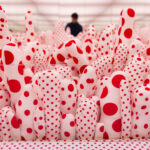
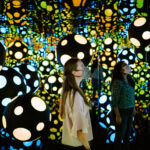
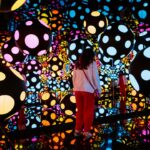
The wildly popular exhibit “One with Eternity: Yayoi Kusama in the Hirshhorn Collection” at the Smithsonian Hirshhorn Museum and Sculpture Garden will close on July 16 after more than a year — and no, it won’t be extended again.
How does one summarize the impact of this exhibit, which broke attendance records since it opened in April 2022 and led to countless polka-dot-backed Instagram selfies? To help answer this question, WAMU/DCist spoke with Hirshhorn Director Melissa Chiu and the exhibit’s curator, Betsy Johnson, about the legacy of the Kusama exhibit and what comes next for the Hirshhorn, one of the nation’s leading contemporary art museums.
“One With Eternity,” attracted over 480,000 visitors, triple 2017’s “Yayoi Kusama: Infinity Mirrors” exhibit, which ran for three months at the museum located on the National Mall and drew over 160,000 visitors. By comparison, “it’s allowed us to share Kusama with a much larger audience than we were able to with our 2017 show,” Johnson says.
Collectively, the exhibits contributed to a new appreciation for Kusama’s work and gave the 94-year-old Japanese American artist her due credit, says Chiu. The exhibits also drew visitors to the work of other artists in the Hirshhorn collection, such as the French conceptual artist Marcel Duchamp, she adds.
“In some ways, Kusama [opened] the way for some visitors to see other kinds of artwork or artists that they would not have otherwise thought they would be interested in,” says Chiu.
The Hirshhorn learned a lot about curating the visitor experience from its two Kusama exhibits, the first of which created a bit of a free ticketing frenzy.
“Six years ago, we felt like we were in the crowd-control business rather than the museum business because we had lines from 3 a.m. snaking all around the museum and down the street,” Chiu says.
The museum experimented with an in-person distribution policy at first for “One with Eternity” and then shifted to online-only passes that go live at noon the day before, with a few additional passes available on site each day.
“We tried to be as responsive as we could to visitors,” Chiu says. “There’s no perfect system right now, but I do think that having the combination of in-person and online [passes] allowed for a lot of people to get through.”
The Hirshhorn has five Kusama pieces in its permanent collection, meaning it could showcase them again in the future. However, they take up a lot of floor space in the museum, so it could be some time before visitors can see them in another exhibit. “We just have to have the right space and timing for them,” Johnson says.
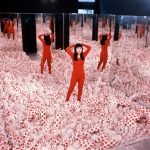
Kusama’s 2018 infinity mirror room, My Heart Is Dancing into the Universe, is a co-acquisition with the Buffalo AKG Art Museum and will travel back and forth between the two institutions. Phalli’s Field, a breakthrough piece Kusama first exhibited in New York in 1965, is the other infinity mirror room in the Hirshhorn’s permanent collection. Some of Kusama’s early works on paper, acquired by the Smithsonian in the 1990s, are more fragile and can only be on view for about six months at a time, per Johnson.
Before “One with Eternity” closes, there are a few ways to see the exhibit: Free next-day passes are released daily starting at noon on the museum’s website. Unclaimed timed-entry passes are available online and in person during the museum’s hours of operation (10 a.m. to 5:30 p.m. daily).

In the meantime, the Hirshhorn is preparing to celebrate its 50th anniversary next year, full details for which are yet to be announced. Chiu recommends that visitors view the upcoming exhibit of Simone Leigh, a sculptor whose work Sovereignty was selected to represent the U.S. at the Venice Biennale. The Hirshhorn’s comprehensive survey of Leigh’s artistry — which draws inspiration from traditions across the African diaspora and centers on ideas of Black femininity and colonization — will be on display at the museum starting in November.
On July 14, the Hirshhorn will open the largest-ever museum installation by Jessica Diamond, “Wheel Of Life,” which will fill the second-floor galleries with 15 of the American conceptual artist’s works.
The institution has also been in the middle of the largest renovation project in its history, a three-part modernization project whose first phase, a restoration of its iconic, ring-shaped façade, was completed last fall. The sculpture garden will now undergo a $60 million renovation, which will include reopening and adding a new light feature to the underground tunnel that connects the museum to its sculpture garden and National Mall. After the garden reopens, renovations to the museum’s interior will commence, likely in 2025.
Chiu is overseeing it all, even as she reportedly was recently in the running to take over as director of the Guggenheim Museum in New York. On that note, she tells DCist/WAMU definitively: “I’m fully committed to the Hirshhorn. We have so much to do.”