 Jenny Gathright
 Colleen Grablick
Understaffing at District of Columbia’s youth pretrial detention facility reached dangerous levels this spring, leading to kids being confined in their cells beyond legal limits and hindering the facility’s response to assaults on youth, according to advocates and the facility’s oversight agency.
The Youth Services Center (YSC), where kids in D.C. are detained as they await trial, is relying on extended periods of confinement to cope with the lack of staff, several youth defense attorneys and the city’s independent juvenile justice monitor say. The staffing shortage has been so severe that the agency has broken its own policies on monitoring kids at risk of suicide, according to the independent monitor. The monitor also says the shortage delayed the response to an assault that occurred in the facility.
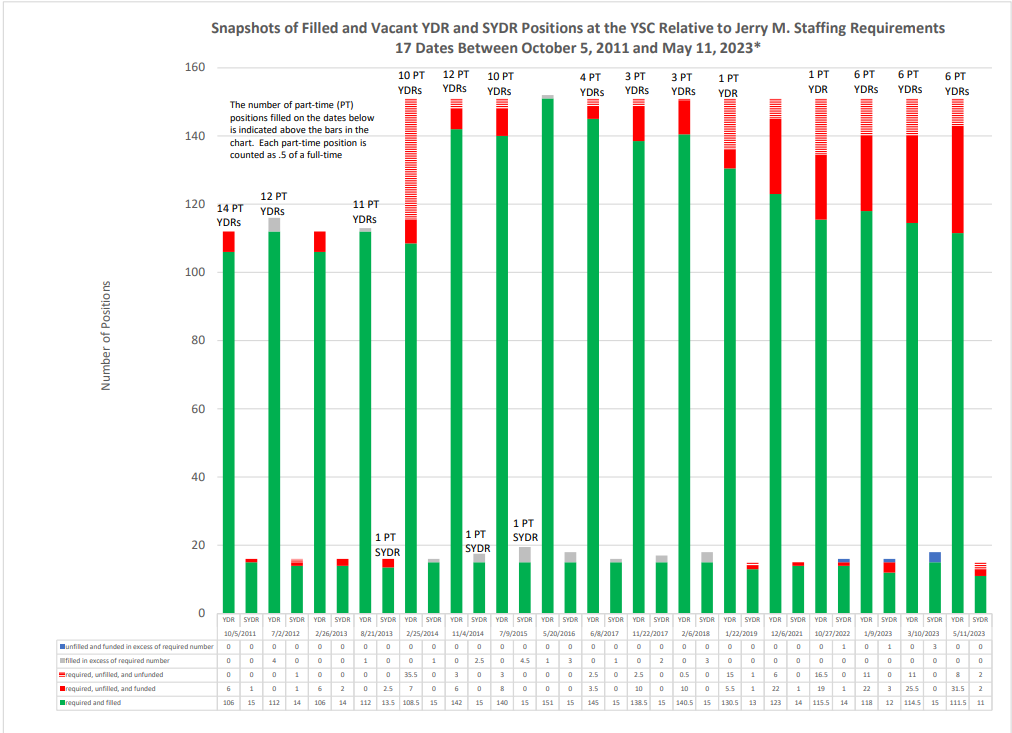
The Department of Youth Rehabilitation Services (DYRS) has been losing staff steadily for the last five years – as of this spring, there were almost 30 fewer youth development representatives, or YDRs (essentially corrections officers), on staff than there were in 2018, according to the independent monitor’s data. In many cases, that means the facility is staffing units with one officer where there used to be two. The agency has also reportedly resorted to using administrative or maintenance staff to fill in for trained YDRs.
Meanwhile, the population of youth at the facility has only increased in recent months, reaching a peak of 91 on May 31 before falling back below its capacity of 88, to 78 as of last week.
One consequence, advocates for youth say, is that kids have been confined to their cells for as many as 23 hours a day, sometimes for days at a time. This appears to violate District law on room confinement for detained young people, which says confinement can only be used as a temporary response to safety issues and should not last longer than six hours.
YSC has also seen an increase in youth-on-youth assaults, according to the facility’s independent monitor. Staff have struggled to respond to some of these assaults because there aren’t enough YDRs, the monitor says.
In an email to DCist, DYRS denied that kids have been held up to 23 hours in their cells, though a spokesperson conceded that extreme staffing shortages have led to some “modifications” in out-of-cell time. The agency declined to answer most questions regarding allegations about conditions at YSC, including questions about whether DYRS is breaking its policies on supervision for kids at risk of suicide and questions about youth-on-youth assaults.
The spokesperson instead offered an emailed written statement.
“At DYRS, the safety, security, rehabilitation, and well-being of the youth under our care – either at our secure facilities or within the community – is our top priority,” it said. “We remain steadfast in our commitment to provide our young people an environment in which they can successfully transition into adulthood.”
In public testimony, government officials have conceded that staffing is a major problem at DYRS, and offered some solutions: In testimony before the D.C. Council last month, Deputy Mayor for Public Safety Lindsey Appiah said the agency is rotating schedules frequently in an effort to retain its workforce, and that officials can keep the population at YSC manageable by moving kids to other facilities where possible.
“We certainly have a blueprint to ensure the safety of youth and staff regardless of the numbers,” Appiah told DCist/WAMU in an interview ahead of her testimony.
A DYRS spokesperson later confirmed that 16 YDRs were starting in July, and an additional 15 YDRs were expected to be onboarded in August. The agency also has a new acting director after months of interim leadership: Sam Abed, who formerly led Maryland’s juvenile justice system, assumed leadership of DYRS this month.
Still, the ongoing crisis at the facility has parents, advocates, and the agency’s independent monitor concerned for the safety of children in DYRS custody – 99% of whom are Black and Hispanic, according to a study from D.C.’s Criminal Justice Coordinating Council.
One parent with a child at YSC, who agreed to speak on the condition of anonymity to protect their child’s privacy, said they “cringe just to think my child is in that place.”
“I pray that safety is over my child and all of the children,” they said. “But it don’t seem to be that way, from my understanding.”
YSC is supposed to offer programming and schooling to the children in its care, most of whom are waiting for court hearings in juvenile court or Superior Court. Some young people there have already been convicted and are awaiting transfer to another secure facility.
According to DYRS’s website, YSC “focuses primarily on meeting the basic needs of the residents, including diagnostic assessments, medical and behavioral health services, and educational services,” but it also provides youth with “physical fitness, mentoring opportunities, and creative arts programs.”
And DYRS, the agency that runs the facility, has a troubled history: In 2020, a judge officially ended more than 30 years of court-mandated oversight prompted by a class-action lawsuit over its treatment of the youth at Oak Hill rehabilitation center. While under court oversight, the city implemented various reforms to its youth rehabilitation programs; namely, it opened YSC in 2004, closed Oak Hill in 2009, and replaced it with a smaller and more humane facility for committed youth called New Beginnings. YSC and New Beginnings are now monitored by D.C.’s Office of Independent Juvenile Justice Facilities Oversight, led by executive director Mark Jordan, who has full access to conduct random inspections and interviews of residents.
YSC has a capacity of 88, which it has exceeded several times since it opened in 2004 – at its peak population in 2009, YSC held 156 kids, according to data from Jordan. The population began to fall as the District underwent a spate of juvenile justice reforms, and the pandemic reduced the population even further. The facility has been well under capacity for several years, which made the steady loss of YDRs less problematic at first.
But that changed this year.
In January 2023, the daily population of YSC hovered around the mid-forties, according to Jordan’s data. By mid-April, more than 70 kids were being held there. And by the end of May, the facility went over its capacity for the first time in six years, peaking at 91 kids. (Since then, the population has fallen below 88 again, hovering in the high 70s.) The exact reason for the increase is unclear, but it’s likely a combination of juvenile arrest rates and the rate at which judges are ordering youth detained pretrial.
The result is that a skeleton staff are having to supervise far more kids. In 2018, YSC averaged about 140 YDRs on staff with a population that hovered between approximately 30 and 50, according to data provided by Jordan, the independent monitor. But as of May 11, DYRS had the equivalent of 111.5 full-time YDRs to supervise about 70 kids. And, Jordan says, these numbers don’t capture the true depth of the day-to-day staffing challenges at YSC, since staff who are on leave are included in the total even though they are not available to work.
The results have led to severe lockdowns and safety challenges.
The situation began to grow increasingly dire this April, after a serious fight among youth led to a facility-wide lockdown where kids were only allowed out of their cells one at a time for days, according to Jordan.
The lockdown began on April 10, when Jordan says a conflict between youth got so out of hand that DYRS had to call the Metropolitan Police Department — a very unusual step for a facility that is supposed to have staff equipped to manage any incidents.
“Once that incident was under control,” he says, “there was a period of days when youth were being let out one at a time.” The lockdown lasted at least three days, and perhaps longer, according to Jordan.
Often referred to as “one-in, one-out,” this type of lockdown could mean in some cases that kids are spending between 22 and 23 hours per day in their cells, only being let out in brief stints every 10 or so hours, depending on the number of kids housed on each unit, Jordan says.
Multiple attorneys with clients at the facility told DCist/WAMU that clients have intermittently been held in their cells for as long as 11 hours at a time.
“We have clients who are saying that instead of going to school for a number of hours a day, they’re getting work packets that they have to do behind their door and have to knock to try and get instruction through a cell door if they have questions,” said Eduardo Ferrer, policy director of Georgetown University’s Juvenile Justice Initiative. “They’re coming out maybe for an hour every ten or 11 hours or so, in shifts, and so in a 24 hour period, they may be coming out one, maybe two hours total.”
Heather Pinckney, the director of D.C.’s Public Defender Service, testified under oath before the D.C. Council on June 27 that four out of the five units at YSC were on “one-in, one-out” the previous week. Schooling for the kids, she said, happened through their cell windows.
“Teachers – the ones trying to save them — had to teach them by holding up their packets to the window of the cells where they sat,” Pinckney said. Jordan, too, said that kids at the facility have been locked in their cells during school hours, which means teachers must pass learning materials to them through their doors.
Those extreme “one-in, one-out” lockdowns have remained rare, Jordan says. However, he adds, increased restrictions on out-of-cell time have become commonplace at YSC. When Jordan tours the facility now, he expects that at least one housing unit will be only letting kids out of their cells in small groups, because of a combination of staffing shortages and concerns about conflicts between youth, he says. In practice, this can mean less than five hours of out-of-cell time per day for the young people.
“It’s not great to be running units like this,” Jordan says. “The kids get frustrated and programs suffer.”
The situation has left parents concerned about the state of the facility and the safety of their kids.
The parent interviewed by DCist/WAMU said they have been pressing the facility in recent months, asking “Why is my child always on lockdown? Why is my child not coming out? Why can’t I talk to my child? What’s happening?”
In response, they say, staff explain that they are stretched thin.
These kinds of hours-long lockdowns appear to violate D.C. law, which states that “secure juvenile facilities shall not use room confinement on a juvenile for the purposes of discipline, punishment, administrative convenience, retaliation, or staffing shortages.”
The law says room confinement can be used temporarily, in response to behavior that threatens “imminent harm to the juvenile or others,” or “imminent danger to the safe or secure operation of the facility.” But even then, the law says, a child cannot be confined in their room for longer than six hours. After six hours, the young person must return to the general population, get transported to a mental health facility or medical unit in the facility, or be provided with special individualized programming to address the issues that led to their confinement.
DYRS did not answer multiple questions and follow-ups from DCist/WAMU about whether it had broken this law.
Advocates and lawyers say DYRS has also been in violation of its own suicide prevention policy. Last month, Jordan says he saw several occasions where DYRS did not have enough staff to provide one-on-one monitoring for kids with the highest suicide risk, as the agency requires.
“They mitigate it in other ways, but they have to violate their own policy because they just don’t have enough staff,” Jordan says. “That’s another example of the way in which staffing levels really make a difference, in a tangible way, to create risk.”
DYRS also did not respond to questions about whether it has broken this policy and how staff are supervising children at risk of suicide.
The staffing shortage has become so severe that in some extreme cases, Jordan says, he’s seen the agency call in maintenance staff or administrative staff to help man the facility when there haven’t been enough YDRs. Jordan says this “shouldn’t happen.”
“YDRs are required to have specific trainings,” he says. “You can’t casually put people in [these] positions.”
DYRS also provided no comment on this allegation from Jordan.
Jordan also says the facility is regularly staffing units with one YDR where there used to be two. DYRS’s own website states that two YDRs are assigned to each unit at all times; in fact, a court used to require the agency to keep two YDRs on each unit, as well as a certain total number of YDRs overall. But since court oversight ended at the end of 2020 — and since the COVID-19 pandemic led to nationwide staffing challenges in corrections — the agency has steadily lost staff and currently has about 40 fewer YDRs than the court would have required.
The decline in staff has stymied the agency’s ability to keep kids safe at YSC, particularly as Jordan says staff have told him there has been an increase in conflicts and incidents between youth.
In one recent case on June 17, he says, understaffing delayed a response to an emergency when a young person at the facility was assaulted and seriously injured by a group in an outside recreation area. The one YDR on the unit was in an adjacent indoor area with another group of kids and didn’t even initially see the assault start, he says. It took nearly a minute for the YDR to get over to the fight outside — at which point more youth had piled on to assault the victim.
“The fact that there was only one YDR delayed the response substantially,” Jordan says.
The increased reliance on room confinement and ongoing safety concerns have advocates afraid that the city’s juvenile justice system is backsliding after years of reform and progress had improved conditions for kids at YSC.
Ferrer says he’s seen “a return to a very punitive and disorganized culture that I have not seen in D.C. at DYRS in over a decade.”
One of the latest expressions of this “punitive” culture, advocates say, manifested in Bowser’s recently unveiled crime bill, which proposed a change to the juvenile detention statute that would significantly expand pretrial detention for youth. The change would have favored more pretrial detention for a larger range of crimes, including crimes committed without a weapon. It also would have allowed judges to detain youth for their own protection.
Bowser officials say the changes were a way to save kids’ lives at a time when more and more of them are being killed by gunfire in the District, but the bill received significant opposition from youth defense attorneys and members of the D.C. Council, who cited research showing that juvenile detention increases kids’ likelihood of committing crimes in the future. The council ultimately passed a temporary crime bill that included other elements of Bowser’s bill but significantly pared back the changes to juvenile detention.
Mylan Barnes, who spent time at YSC as a teen and co-chairs D.C.’s Juvenile Justice Advisory Board, says she feels this focus on punishment is counterproductive — the most valuable period of healing for her, she says, came after her incarceration, not during it. After returning to the community, she worked with one of the agency’s Achievement Centers – community-based locations with arts programs, support groups for youth, and vocational training programs – through which she was able to get an internship.
“Why didn’t I have access to certain resources until I got out? Until I was ‘good enough’ to get it?” she asks.
The parent who spoke with DCist/WAMU also says they feel D.C. has not provided their child with enough services while detained, incarcerated, or in group homes — including quality education, vocational training, effective and comprehensive mental health services, or enriching outdoor activities.
“Instead of rehabilitating them, we’re messing more with their mental state,” the parent says. “I’ve seen that it’s kind of like a setup. They keep recycling them back through YSC, recycling them back, and then [the next step is] federal prison.”
City leaders have pushed back against this framing and repeatedly stated DYRS’ is committed to “loving” children in their custody.
“One of the things we said about DYRS over time is that we love our kids, and we have to ask ourselves, ‘What does love look like in public policy?’” Appiah, who worked at DYRS for years before becoming deputy mayor, said at the press conference announcing Bowser’s bill. “This is what love looks like in public policy: it does look like boundaries.”
But Ferrer couldn’t disagree more.
“There is no definition of love that encompasses the trauma, violence, and general lack that our kids are being subjected to at YSC right now,” he says. “If this is what love looks like to the [Bowser] administration, I think they need to do a serious self-examination of their definition of love.”