 Jenny Gathright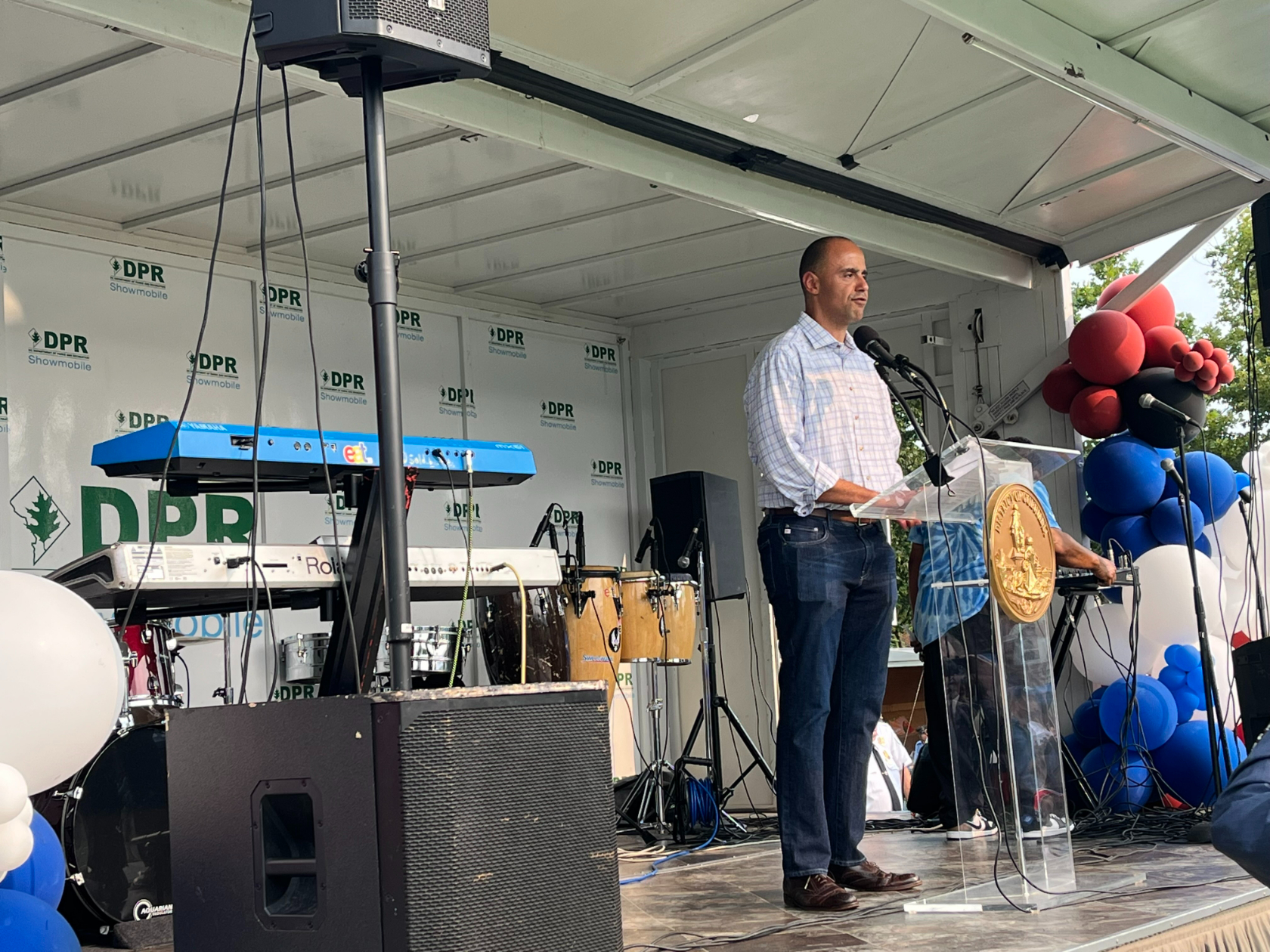
U.S. Attorney for D.C. Matthew Graves, the Biden appointee whose office prosecutes most adult crime in D.C., told residents Tuesday night that he knows how to reduce D.C.’s seemingly ceaseless surge in gun violence. The crisis has claimed 148 lives so far this year alone, according to D.C. police.
“Know that our office, the Metropolitan Police Department, and our federal law enforcement partners are completely aligned in what we need to do in response to this crisis – and that’s to go after the individuals that we know to be driving violence, and not simply wait for bad things to happen and try to close cases afterwards,” Graves told a crowd gathered at Rosedale Recreation Center for a community event hosted by D.C.’s police department.
Graves said his office is focused on targeting the relatively small groups of people driving most of D.C.’s gun violence; A 2022 study found that as few as 500 identifiable people, many of them involved in neighborhood crews or cliques, are responsible for 70% of the city’s shootings. Graves insisted in his remarks on Tuesday that proactively trying to catch and jail these people will bring down the level of violence in the city.
“The reason we know these strategies work is that they’ve worked in the past. Many of us were on the frontlines when we had another surge of shootings in the 2007 and 2008 time frame, and we’ve seen these strategies work,” he said.
After the increase in shootings that Graves referenced, D.C. eventually reached a record low of homicides in 2012, when 88 people were murdered. (For context, the city was averaging more than 400 homicides in some years in the 90s, and ended last year with 203 homicides.) In general, scholars say it’s difficult to know the exact causes of short-term changes in homicide rates — and there’s not much consensus among researchers about why the U.S. saw significant declines in violent crime in the 2000s.
In his remarks, Graves also acknowledged that there’s not necessarily one quick fix to longstanding problems and disparities that lead to concentrated violence. “We know that these strategies overnight cannot reverse trends that have built up for years,” he said.
Graves’ public remarks come after his office has faced criticism for months — much of it focused on the fact that his office did not prosecute most of the arrests police brought to them in 2022. His office declined to press charges for 67% of the arrests they received for review, a number first reported by the substack D.C. Crime Facts and later confirmed by multiple other local media outlets.
Graves has attributed the low prosecution rate to a number of factors, including victims who don’t want to move forward with charges, issues with arrests that show up on police body camera footage, and the fact that D.C. does not have an accredited crime lab to process DNA and ballistics evidence — which means that prosecutors must send samples to outside labs. The office’s high declination rate largely came from misdemeanors, gun possession, and drug possession cases. (On Tuesday, Graves said that there are “more no-papers than we’d like to see” for illegal gun possession in D.C., an issue that he says his office is working with D.C. police to address.) His prosecutors are, in contrast, bringing charges for nearly 90% of homicides, armed carjackings, assaults with intent to kill and first-degree sexual assaults, the Washington Post reported.
In response to news of the prosecution rate — which was significantly lower than that of other major U.S. cities —, along with a rise in violent crime in D.C. in recent years, House Republicans drafted articles of impeachment against Graves, arguing that he was “endangering, compromising, and undermining the justice system of the United States by facilitating the explosion of violent crime in the Nation’s capital.”
Criticism has come from progressive corners as well. For example, Ward 1 Councilmember Brianne Nadeau said recently on WAMU’s The Politics Hour that she wanted the city to focus not on long sentences or on increased pretrial detention, but instead on swift and certain prosecution for people who commit crimes — and she cited Graves’ office as the biggest obstacle to that.
Local officials have also noted that unlike the D.C. Attorney General, who prosecutes most juvenile crimes, the U.S. Attorney for D.C. is not elected by D.C. residents — and is therefore less structurally accountable to them.
“He’s not even trying two thirds of the cases that are coming before him. That to me is the big thing we should be focused on,” Nadeau said.
But Graves pushed back against these critiques, and their framing, in an interview after his remarks at Tuesday’s “National Night Out” event at Northeast D.C.’s Rosedale Recreation Center — an annual effort to improve police-community relations. Graves said residents should expect to see higher prosecution rates when the office releases more data this fall — and called the 67% statistic a “snapshot in time.”
“That was largely a picture of what the office looked like when I came in,” said Graves, who assumed the top prosecutor role in the fall of 2021. “There were issues that had built up over years that we are addressing — and we are addressing it in terms of increasing the number of cases that we’re bringing.”
And his broader point was that focusing solely on the prosecution rate ignores some of the important work his office is doing: proactively going after and prosecuting the relatively small group of people who are driving the bulk of the District’s gun violence. Graves’ office recently announced a big indictment of a dozen alleged members of the Kennedy Street Crew in Northwest D.C.; it claims that the men in the crew trafficked large quantities of drugs and were responsible for up to seven murders.
“If you go community by community, if you walk out in this community and you talk to the people in the community, they generally know the handful of people in the community that are driving violence,” Graves said. “So you have two options: You can just wait and hope to catch one of them after they’ve committed an act of violence. Or you can figure out if they’re involved in other criminal conduct, such as illegal firearms possession or illegal firearms distribution, illegal narcotics distribution — and put out an investigation together around that conduct to try to get them off the streets.”
He says D.C. residents should expect more of these big cases going forward, noting these types of large investigations have taken as long as 10 months to a year to complete. But Graves’ office is “trying to figure out how to do them shorter, and how to do more of them at the same time – because they’re obviously resource intensive.”
D.C. residents, in general, remain somewhat divided on the approach the city, its police department, and prosecutors should take to violence prevention. A hearing this summer over a crime bill proposed by D.C. Mayor Muriel Bowser attracted intense engagement from residents, who expressed both strong support and strong opposition to it. The bill would have greatly expanded pretrial detention for youth and created harsher gun penalties, among numerous other provisions.
In the absence of prosecution for many gun-related crimes, some groups have been advocating for increased investment in non-police forms of violence prevention that target those most likely to carry and use guns for intensive therapy, job training, and education.
“When we see that 67% of cases are not being prosecuted [by the U.S. Attorney for D.C.], well what are we going to do with the rest of them?” said Roger Marmet, the co-founder of the violence prevention-focused nonprofit Peace for DC, in an interview earlier this year. “When we know we can’t reach [people] and there are no witnesses and there’s no evidence, that’s where people-based transformation and outreach has a huge role … there’s an incredible role for building this complementary and alternative system.”
Other residents want to see more aggressive policing, and more detention and incarceration for people accused of crimes. And some residents want a balanced approach where police focus their efforts on the most serious gun crimes but don’t target residents for quality of life offenses.
Shana Willingham, a 40-year-old Trinidad resident who attended the community event on Tuesday, said she generally feels safe in her neighborhood but wants leaders to come together to focus on bringing down unacceptable levels of violence in the city.
“More than anything, I’d like them to focus on these crimes that we’re seeing on the news every day and whatnot and not on a lot of frivolous things – harassing people standing out in the street, et cetera,” Willingham said. “Put more focus into what’s actually happening out here that really is a problem.”