 Jordan Pascale
Every night while we’re asleep a crew is racing against the clock to repave Reagan National Airport’s main runway. It’s a nightly show as hundreds of workers and construction vehicles race to finish before the day’s first flight takes off.
Work started in April and will take two years, with a pause in the winter months. National Airport’s runway was last repaved over a decade ago and it’s near the end of its life because of wear and tear.
At many other airports, this repaving process isn’t too big of a deal. At Dulles, for instance, they could close one runway and have three others to use.
But National doesn’t have that luxury. It’s landlocked and has one main runway and one secondary runway that are suitable for large aircraft. They need them both open every day.
WAMU/DCist recently got a firsthand look at the overnight work, a marvel that includes tearing out a strip of the runway just moments after the last flight takes off and opening it back up before the first plane takes off in the morning. Here’s how it went.

9:02 p.m.: When we arrive, the TSA security checkpoints are closed so we don’t have to go through them, but the PA system is still announcing special security announcements to not leave bags unattended.
We meet James Keogh, operations director for Lagan Aviation, the Belfast, Ireland, company that specializes in the complicated work of repaving runways. Tonight’s goal, he says, is to do a strip of the runway that’s 1,000 feet long, 15 feet wide, and 8 inches deep, meaning milling out the existing pavement, and putting new asphalt back in.

I ask him how long they have to do that.
“Five and a half hours,” he says.
With such a fascinating job, working under the lights at night with the pressure of thousands of airline passengers relying on you to do your job correctly and on time, I wonder if Keogh is the center of attention at parties. He says no.
“It’s really boring,” he laughs. “It’s just asphalt.”
But what his crew does every night is far from boring. It’s a precise performance, a nightly orchestra if you will. All while trying to meet a rigorous nightly deadline.
Tick, tick, tick.
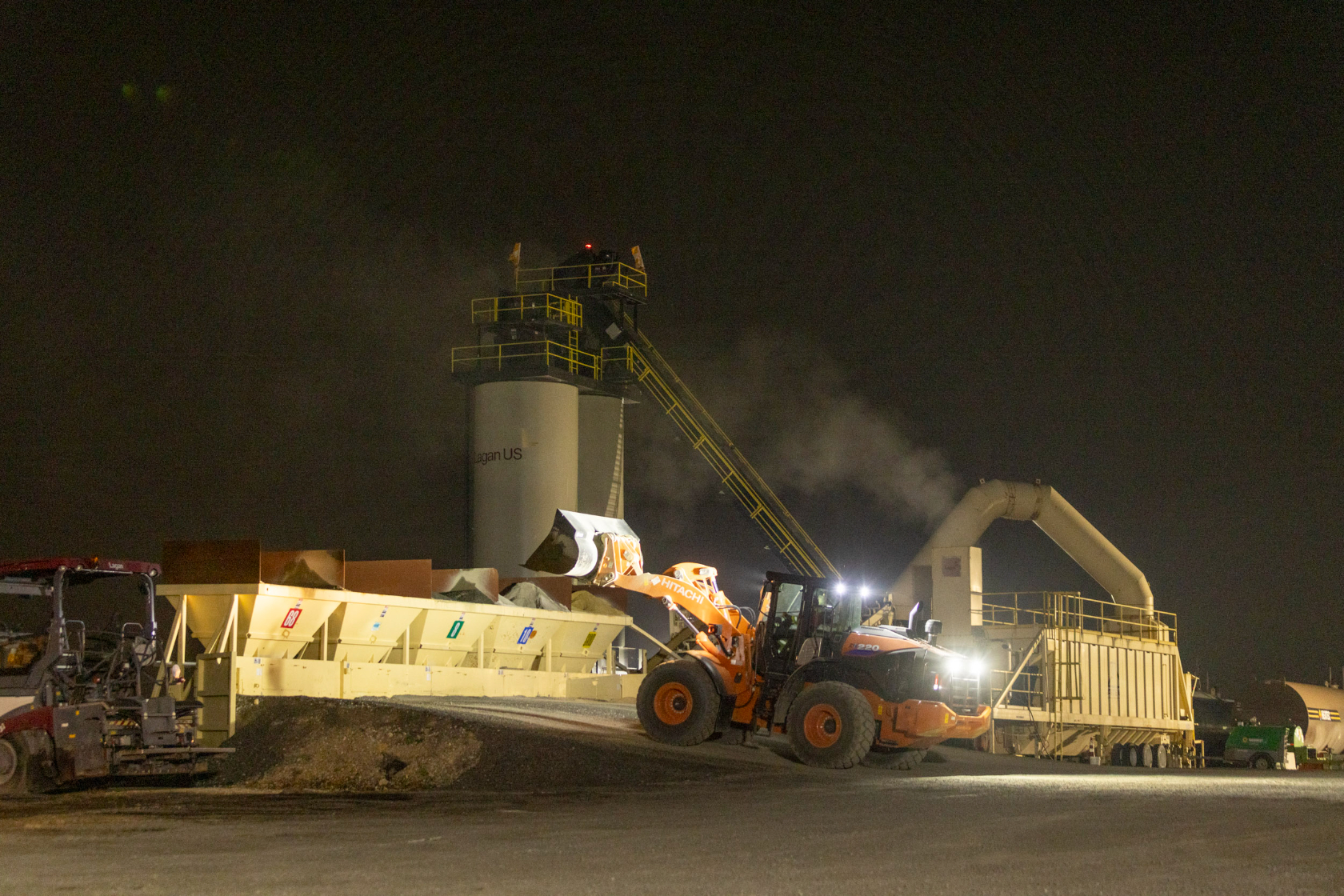
10:43 p.m.: Busy worker bees mix hot asphalt, move it into trucks, and line up trucks to hit the runway. There are more than 100 workers here every night.

How is there a full asphalt production process happening next to a major airport runway? When literally every second counts, they can’t have dump trucks stuck in traffic on U.S. Route 1, so they built an asphalt plant on-site to churn out hundreds of tons a day. (Some asphalt is still trucked in, but much of it comes from the sure thing on site.)
That planning, including for risk mitigation, took years to complete, says Shimelis Meskellie, the project manager for the Metropolitan Washington Airports Authority.
Those risks include flight delays that push back the nightly start time, or machinery breakdown. That’s why there’s such a huge number of people and trucks involved: They need backups.
“If there is any machinery problem, there is always a standby machine. Just take it out of service and then put the new ones in,” says Meskellie.
While crews are prepping for the night, the buzz of air traffic control is on the radio as flight operations start to wind down for the night.
“You better be quick, tell them the runway closes at the top of the hour,” an air traffic controller says over the radio. The main runway closes at 11 p.m. so crews can replace the center lights that guide pilots with modern, energy-efficient LED lights. The secondary runway closes at midnight and that’s when repaving work kicks off.
I ask Keogh if he ever gets nervous ahead of the night’s work.
“It’s a high-pressure job, everybody’s used to it,” he said. “My stress levels are fairly calm because the guys that we have out here know what they’re doing and we’ve got every confidence that they get it done.”
So with that level of experience, maybe he’s not even worrying about the clock?
“Oh no, you’re always watching the clock,” Keogh says. Tick, tick, tick.

11:15 p.m.: The main runway has been closed for a few minutes and crews are using saws four and five feet tall to cut holes into the runway to replace the lights.
There’s a lot going on, but there is a sense of precision and organization. The work environment here is tough. It’s loud, and the lighting is uneven: bright in some places lit by a spotlight, and near pitch black in other places.
“Look, this is a mission,” Meskellie says. “It’s not a regular project.”
As the clock ticks closer to midnight, the crews head to the place where they’ll start tonight, which is marked by a sign that reads “STOP AIRCRAFT MOVEMENT AREA.”

11:57 p.m.: It is just minutes before midnight and a series of American Airlines planes are taking off in quick succession before the deadline. The last plane takes off just seconds before the clock hits midnight and the calendar turns over to July 17.
“This is whisky 4-7, are we clear to get in?” a worker asks into a handheld radio.
“(Secondary runway) 15/33 is now closed,” an air traffic controller responds. “I repeat 15/33 is now closed. You can now proceed onto 15/33.”
Even before the air traffic controller finishes his sentence, dozens of trucks, semis, and other equipment are off to the races, speeding ahead to the work site. The much slower brontosaurus-looking milling machines follow slowly behind.
It feels like a scene out of a movie that should be scored by “Flight of the Valkyries.” It feels epic.
Tick, tick, tick.

12:15 a.m.: The specialized milling machines get to work cutting eight inches deep in one swoop. They’ll do a 15-foot wide stretch about three football fields long in an hour.
When they’re done, they leave rough pavement in their wake. Then, crews lay hot asphalt and roll it flat, which takes about two hours.
So how do planes land the next morning without getting sticky tar on them? It’s because crews use quick-set asphalt and only do small portions of the runway at a time.

1 a.m.: We’re not in for the long haul — we say our goodbyes to Keogh and his team. But the crews are just hitting their stride. They have many more feet of runway to go before they sweep up at the end of the night and get out.
The next morning we learn the crew beat the clock: A United flight to Newark took off at 6 a.m. on the dot that morning. It’s another night well-orchestrated, and they’ll do it all over again tomorrow. It’s the latest in a line of triumphs; workers haven’t missed a deadline yet.